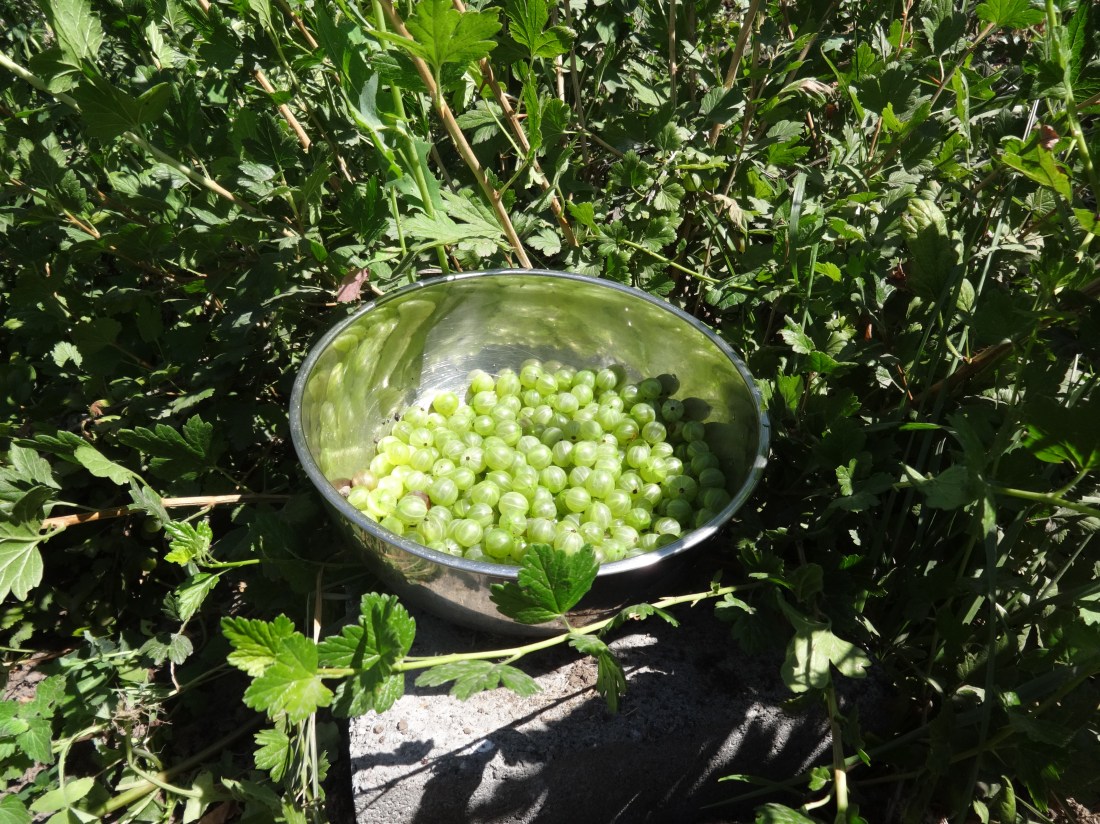
They say that firewood warms you three times. First when you cut the wood, second when you split the wood, and third when you burn the wood in the winter. I have determined that gooseberries require picking three times. First when you pick the berries, second when you pick off the stem and the “tail” of the berry, and third when you pick a good recipe. The first picking is the easy part.
While I was picking and cleaning a bowl full of gooseberries, my husband picked some pie cherries at the neighbors. He was back with a gallon in nothing flat. I asked how he got done so quickly. He said he “knows how to pick the low hanging fruit”.
The gooseberries were even lower hanging, the branches right next to the ground were completely full; I picked just two branches and had a full bowl in about 10 minutes. I simply ran my hand down the branch, dropping the berries in the bowl. Previously I believed I had missed the gooseberries and the birds got them all. I had been watching and tasting the berries every few days, then there were none. Until I was weeding and found a hoard of berries on the bottom of the bush. Apparently the birds don’t look under things.
I found many gooseberry recipes from the U.K. online. Gooseberries are very British. There were recipes for cobblers, crisps, tarts, and pies. Plus, gooseberry gin! One recipe described making gooseberry compote on a hob. What is a hob? A crockpot? A Dutch oven? Turns out it just means stove top. In contrast, I found zero gooseberry recipes in my own American cookbooks. I remember gooseberry bushes as a kid, and hearing about gooseberry jam, and gooseberry pie. But then, somehow, the berries fell out of favor.
Why don’t I have a stronger recipe history for gooseberries? It turns out that gooseberry plants carry White Pine Blister Rust. Western White Pine is a very beautiful and large pine tree in western mountains of the U.S. and Canada. They are gorgeous, with grayish green soft and fuzzy needles. If you look closely, each little needle bundle has 5 needles in it, giving it that fuzzier fluffier look. Both Eastern and Western White Pines were enormously valuable lumber trees, until the blister rust started wiping them out. The white pine blister rust came over with some white pine seedlings grown in European nurseries (at a time when U.S. nurseries couldn’t keep up with the demand). The rust fungus doesn’t spread from pine to pine, but requires an alternate host (Ribes species, including currants and gooseberries). To try to eliminate the disease, the U.S. started eradicating vast amounts of domestic and wild gooseberries and currants.
During the eradication time, the growing of Ribes species was illegal under federal law, and war was proclaimed on the native species. We even used the Civilian Conservation Corps to uproot gooseberries and currants throughout our forests. Eventually, rather than eradication, we started developing rust resistant White Pines.
I believe this is why I don’t have a cooking and recipe history with gooseberries. For decades they were not farmed commercially and weren’t sold in nurseries. Eventually immune and blister rust resistant Ribes species were also developed. Now gooseberries are easy to find in nurseries. I am assuming that my gooseberry is a blister rust resistant variety. Although I do not have white pines in my neighborhood, and there are also many wild currants around here.
My gooseberry bush is happy, the birds are happy, and I am happy to try to figure out how to use the plump and slightly sour berries. I’m thinking of a gooseberry/cherry/oatmeal crisp.
I found a recipe for a gooseberry and oat crumble (I think crumble is British for crisp). Surely, I can just toss in some pitted pie cherries, and it will be fine! But the recipe is British, and it requires golden caster sugar (?), demerara sugar (?), all the measurements are in grams, and the oven temperature is in Celsius. It also says to use a “crumble dish” instead of a certain size baking pan. Time to pull out the scale and do some more googling and some measurement conversions. Hope I picked a good recipe!
Sources:
Malloy, Otis. 2001. White Pine Blister Rust. Online. Plant Health Progress doi:10.1094/PHP2001-0924-01-HM. https://www.fs.fed.us/rm/highelevationwhitepines/Threats/pdf/whitepine_PHP2001_0924_01.pdf
Silver, Akiva. 2022. White Pine Blister Rust and Ribes. Viewed online July 30, 2022 http://www.twisted-tree.net/white-pine-blister-rust-and-ribes.
Link to recipe: https://ahohomemadefood.com/2018/06/23/127-gooseberry-and-oat-crumble/.


 Michelle Eames