The Magnificently Fecund Buttonweed

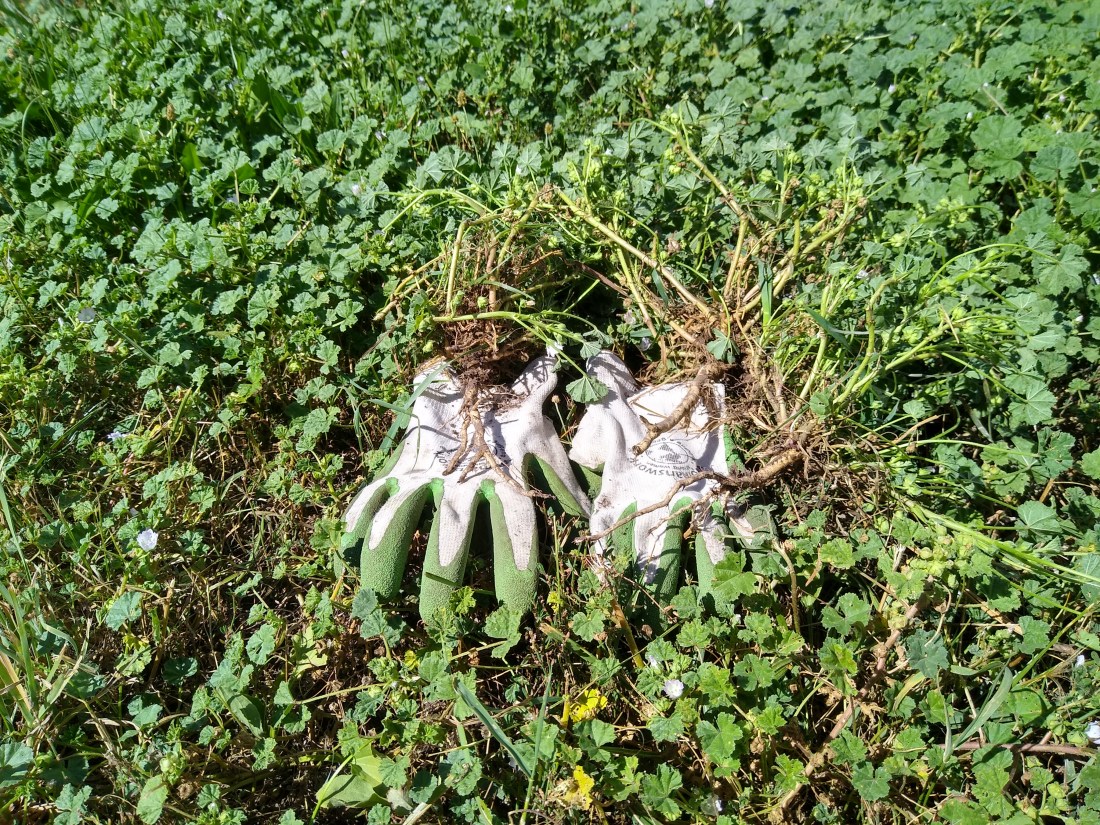
It got away from me this year: buttonweed, also known as common mallow also known as  Malva neglecta.  I’m pretty sure that Malva neglecta is latin for, if you neglect it, it will take over the world.  We have one more phrase for the plant at our house, but it involves swear words.  While I don’t mind swear words, I believe that the duty of teaching you or your family members important new swear words and phrases belongs to the parent or individual that is in charge of plumbing repairs in your house. I shall not overstep.

Back to the mighty freekin’ buttonweed.  When it first showed up at my house several years ago it was near the barn.  The seeds likely came in some hay.  It’s a pretty broadleaf plant with light pink/purple flowers.  What’s not to like?  So I let it go.  I didn’t know that it’s tap root grows thick and about 8 feet (okay, maybe only 8 inches) deep, making it as hard to pull up as a full-grown weeping willow.   I didn’t know that the cute button shaped seed pods produce a bazillion seeds in each pod.   (Okay, I counted them.  There are only about 15 seeds in each button shaped pod.  But they are very fertile, and I swear every single one germinates.) I also didn’t know that the horses won’t eat the plant, so it has a strong advantage in fields and paddocks.  Heck, even our goats didn’t eat them.  Oddly, however, if you look it up, humans can eat the seed pods.  Somehow, I’m not interested in trying them.

A friend with the same plant in her yard told me I had to keep up with it and pull it and pull it and pull it some more.  I focused on the horse pens in the last couple years, and there are fewer struggling plants in there now.  But I didn’t focus on the chicken pen, or the yard.  Apparently chickens do not eat buttonweed either.  I even tried Round-up on the plants once, and I hate herbicides.  It briefly wilted the leaves, then the plants bounced back as robust as ever.    

This year I had old growth and second growth patches of the nasty weed in my yard.  In the chicken pen where we dump the compost, it grew to knee-high, and the branches were strong as rope and created a tripping hazard.  With this year’s wet spring the patches have outcompeted the grass in many areas of the yard.  It was a monoculture of flowering buttonweed.  I was overwhelmed, with seed pods and flowers everywhere. Dried out pods, green pods, about to pop pods.  Finally, I could no longer avoid weeding it. 

I decided I needed to follow good weed management practices, by not just pulling and leaving the plant on the ground to hopefully die as I usually do.  I needed to pull up not only each plant, but also to destroy the seeds.  If it wasn’t so dry, I would burn them.  I have placed some of the plants in deep buckets of water.  This is a technique where you let noxious weeds rot while submersed in water.  You know the process is complete when your bucket of rotten weeds smells like a dead animal and the neighbors start to complain. Then, theoretically, you can use the putrid smelling weed water to fertilize lawns and gardens, and in the process make your whole yard smell like a dead animal.  Even with this fine and sustainable technique, we had way more weeds than available buckets.  Who knew there was so much biomass in old-growth buttonweed?

We then used plastic feedbags and dog food bags to stuff full of buttonweed.  I worked at weeding for two days with short-bursts of weeding time.  I ran out of available bags before running out of weeds and had to beg for more feedbags from my neighbor.  Currently I have six bags full, and I’m not sure what we will do with the bags of weeds, since they will overwhelm our garbage can.  Maybe I’ll let the weeds and seeds dry out, and burn them with the pinecones this fall, when it’s finally safe to burn.  Maybe I’ll try filling the bags with water to make some more stinky rotting fertilizer water.  Maybe bit by bit and bag by bag I’ll find room in the garbage can.

For now, I’ve caught up on the backlog of buttonweed pulling.  But I know they will re-appear in the spring and wouldn’t be surprised if they start sprouting again this winter.  They are that kind of grudge-holding plant.   I imagine the seeds are long-lived, and I’m sure that the bits of the taproot that didn’t pull out will come back to life, like little zombie plants.   I’m sure next year I won’t let them get so out of control.  Oh, cripes and criminy, I forgot about the weeds in the chicken pen.   They are so tall that the chickens get lost in the buttonweed jungle.  Plus, I’m out of feedbags again.   And my hands are aching from pulling up the plants.  Oh well.  The sun is shining, the weather has cooled, and the seed pods are bursting.  Time to pull some more.  
Whisky is for Drinking and Water is for Witching

Dowsing:  the search for underground water or minerals by observing the motion of a pointer, supposedly in response to unseen influences (Oxford English Dictionary). 

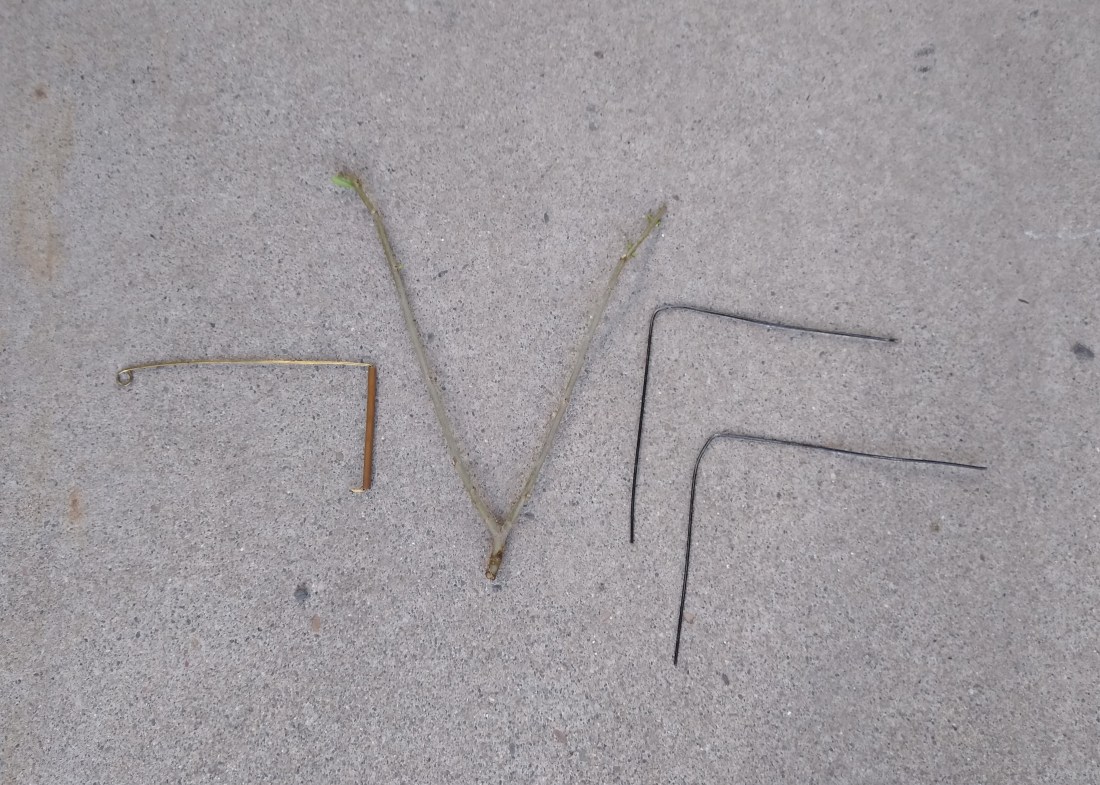
My mother’s uncle could do it.  My mother can do it.  I can do it sometimes.  Water dowsing, or water witching, runs in the family.   My mom uses a forked willow branch.  The tip drops when she is over water.  I use two L-shaped wires bent out of coat hangers.  The wires cross, or separate, when I walk over underground water pipes or electric pipes.  In my yard where I have experimented, the electric lines run near the water lines so I’m not always sure what my divining rods are showing me. 

I have heard of dowsers that can tell you where on the property to dig the well, and how deep the water will be.  They use a formula for how many times the rod dips at the end to calculate the depth.   Actually, I imagine one can estimate well depth pretty well by reviewing data on the wells in the neighborhood but dowsing the best location could be useful.  I wonder how many wells actually come up empty, with dowsing versus no dowsing?  Personally, even though the dowsing rods move for me, I have no idea how they work.  I have a pet theory though… electric wires, and running water are really a bunch of moving electrons with charges.  I believe the divining rods (wires in my case) are lining up with subtle electric or magnetic fields.  Like metal shavings above a magnet will align to the magnetic field.  However, when I read a book about dowsing (The Divining Rod by Barrett and Besterman), the authors disputed the magnetic theory, based on old experiments with dowsers on insulated versus uninsulated surfaces.  They also concluded that because divining rods can be wood, or metal, or other substances that are not influenced by magnets or charges, that the theory is not supported.    

Am I biased and making the rods move unconsciously? That’s what my son says.  But I had one set of divining rods that are in a metal sleeve.  It would be much harder for my unconscious muscle contractions to move them, and they still moved when I crossed a pipe.  Or at least they did move, until I lost one of those special rods.   I like that I can dowse, but I have only ever used it for fun and interest’s sake.  I have never had to dig a well, so I’m not sure how successful I would be on that task. 

We dowsers also can use pendulums to answer questions.  My mom has explored that, using a needle hanging on a thread as the pendulum.  You ask a question, and the needle moves left and right, or back and forth, or in a circle.  I would have to read a different book to remember which movement is supposed to be yes, no, or unknown.  When I try a pendulum, it does move decisively.  But is it real?  I don’t know.  My mom’s generation, and her mom’s generation would use the needle on a thread over a pregnant woman’s belly to determine whether she will have a boy or a girl.  Now we have ultrasound. You could probably develop a pretty good pendulum prediction experiment using ultrasound as the proof.  All you need is a whole bunch of friends that are pregnant and willing to share the data with you.  I have no pregnant friends at this time.   There goes that experiment.     

Are people still dowsing these days?  I asked the giant orb in the sky (Google).  There was one website for a guy explaining that Christ called him to dowse water.  That reminded me of a friend of mine who said she had dowsing ability but didn’t use it because she thought it was un-Christian.   Perhaps because of the “witching” name.   Another Google result showed a local well drilling company that says they will recommend water-witchers if you want, but generally if you simply dig deep enough you will find water around here.  They also stated that, more rarely, sometimes both witchers and well drillers get skunked.   As I dig a little deeper into the depths of the subject, I find many stories that say witching is not scientifically explained, it’s unproven, and no one tells the stories of when it fails.    

Back to the dowsing book.  I skimmed it; it was extremely wordy.  It discussed the history (going back to medieval times) and summarized some experiments that seemed to indicate water dowsing works.  The book was published in 1968 but was based mainly on earlier studies and information from the late 1800s and early 1900s.   After using the book illustrations to refresh myself on how to hold the rods, I went outside with a forked willow stick, and with my bent wire coat hangers.  I recognize that I have a bias when I dowse in my yard.  I know where most of the water pipes and electric lines are.  Nonetheless when I tried dowsing with both implements across known water and electric lines nothing happened.  I failed.

The book also described how some dowsers can find missing objects, or minerals such as silver and gold.  I had lost a small key to my camper a couple months prior.  I assumed the keys were lost out in the yard where my camper was parked.  As an experiment, I “introduced” my dowsing rods to my other camper key by touching the key with the rod.  Then I visualized the key while gridding the side yard.  Nothing.  No response; my second fail.  Is this because the key was not silver or gold?  Is this because the key was not lost in the area I gridded?  Or is this because dowsing for objects is a crock? 

After two failed dowsing trials on the same day, I thought I had lost my dowsing talent.  I was bummed.   Then I invited my mom, my son, and his girlfriend out into the yard to try dowsing.  My mom got some bobbles out of the forked willow stick, near some known water pipelines.  I tried it again and also got some responses with the willow rod tipping down.  Maybe my mom needed to charge it or something?

Then I started getting reactions with the wire rods, where I hadn’t earlier in the day.  Maybe I needed to be in the right frame of mind?  Meanwhile, my son showed us how he could move the willow stick purposefully, yet subtly, showing how it could be manipulated.  His girlfriend did not get reactions from the willow or the wire.   So is dowsing real?  I don’t move the rods purposely, but perhaps there is something that happens unconsciously.   None of these tests count as well-planned experiments.

The dowsing book finally concluded that the movement of the rod comes from an unconscious muscular action, but it didn’t scientifically explain what causes the unconscious movement.  My son says dowsing has clearly been debunked.  Perhaps.  I’ll have to dig deeper into the literature, and especially look for more recent literature.  In the meantime, I still haven’t found my lost camper key.  Maybe I should pull out my pendulum and ask it a bunch of yes/no questions to determine where the keys were lost.   I’m sure that will work, and I will successfully find the key.   Hey, if that does work, maybe I can use that process to find the missing dowsing rod with the metal sleave!  Or better yet, I can ask the giant orb in the sky to find me a new set of sleaved metal dowsing rods to purchase.  Maybe we don’t need dowsing now that we have the internet.  Heck, I’ll bet I can find a replacement camper key, too!  That type of search will work for sure.