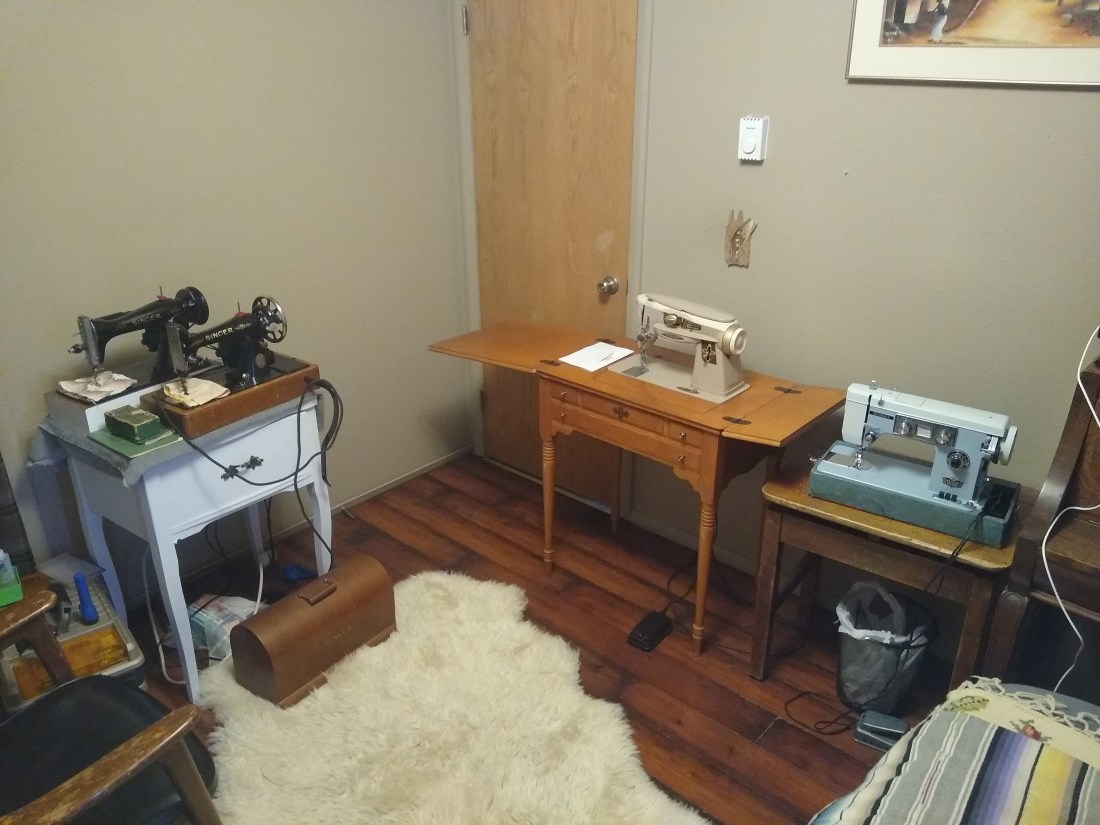
And I finally caught it. Covid. It wasn’t a bad bout, probably because I was vaccinated and boosted and boosted again. But I still isolated in my house, and away from my family. Gramma hunkered in her house next door, and my adult son stayed with a friend. Both my son and my mom had Covid before, and did not enjoy it, so they avoided me. Doug lived mostly downstairs. I, on the other hand, hung out upstairs, in the office and the sewing room. Mostly the sewing room because the twin bed in there is way more comfortable than the chaise lounge in the office. And by sewing room, I mean sewing machine room. Let me take a moment to count the sewing machines. Eight. Eight sewing machines if you include the White up in the closet that is really a parts machine due to a broken gear deep inside its guts. I am slowly, bit by bit, learning how to repair sewing machines, but I don’t do broken gears. That would be the equivalent of open-heart surgery. I don’t do major sewing machine surgery. Yet.
When I am sick, and for me the Covid was like a bad cold, I don’t do creative work. I don’t write poetry or essays because my brain is sluggish, as if it is filled with old varnished sewing machine oil. But, when I am stuck in a room by myself with Facebook and YouTube, and eight sewing machines, I can definitely learn how to repair. My brain can still handle the step-by-step process of do this, then do that. Seriously, I believe the only thing the internet and social media are really good for is showing us how to fix things. And fixing old mechanical things keeps them out of landfills. Plus, it’s fascinating to learn how the machines work.
This week I fixed the Rocketeer. I always wanted a Singer Rocketeer because they are so cool looking, as if the Jetson’s made a sewing machine. That machine was giving me problems over the last few months, and I was really stuck and not progressing when working on it a half hour at a time. But since I was basically locked in a room with it for several days, I had a whole lot more patience to watch you-tube videos to figure things out. She now sews. The bobbin winder winds. And with the help of a vintage sewing machine Facebook group, I was even able to fix the broken hinge on her nose-door. The machine’s name is Irma, because I found a cool handmade purse in the same thrift store as the sewing machine, and it had a label inside, “Made by Irma”. Do you suppose Irma actually used that Rocketeer to make the purse? Maybe. Anyhow, I need to do some touch up paint on Irma, and a little cabinet restoration. Then she is ready for a new home. I thought I would love her, and keep her forever, but I love my other machines more. Irma has to find a new home to make room for my next foster machine.
Off and on during my Covid isolation, I also worked on my Dressmaker 2000 vintage machine. She is strong. She sews like a hungry draft horse turned toward home after a long trail ride: steady, focused, and nothing slows her down. The Dressmaker does not have a name, but she is a keeper. She did have a little problem with the bobbin clutch. That’s the mechanism that stops the needle running when you wind the bobbin. I tried to fix it while sick and isolated, but I couldn’t get the handwheel off. I tried liquid wrench, heat from a blow drier, sewing machine oil, hammering… nothing budged it. Eventually, after my isolation days were over, I made it out to a hard-ware store and bought a cool gizmo called a gear puller. Once I figured out how to use it, the handwheel slid off smooth as a fried egg off Teflon. Now that she does everything, the blue beast of a machine needs a name for sure. Blue Bell? Blue Beast? Blue Whale? Dierdre the Dressmaker? Maybe just Tank, because she sews over anything. I shall have to think on it some more.
I have three keeper vintage machines, and my son has two. So, of the eight machines currently in the sewing room, I need to find homes for three. The other machine I worked on while holed up was a Singer 15-90. Gosh, it took some time and some serious internet surfing just to figure out what exact machine model it was. This machine is one of those old, classic, retro looking, black Singers. A 1946 version with an electric motor. We got the machine cheap, $13 at an estate sale. After buying a belt, a new electric cord and foot controller, and some other small parts, we have $61 into this machine. My goal on these machine restorations is to break even, or to make a small profit to plow back into the machine rescue fund. I’m not sure we will break even on this one. But she sews nicely, and all the parts work, even the bobbin winder clutch. This machine does not have a name, the next owner can have that privilege.
So the Rocketeer, the broken-gear White, and the 15-90 need to go. Another machine I am keeping is Frankie, a gorgeous green vintage White sewing machine. Frankie is short for Frankenstein because I brought her back from the dead. She, along with the Dressmaker, came from a friends’ house when they were doing a big clean out. Frankie was my introduction into the repair world. Through Frankie we found a cool local repair shop that helped us with the final parts and pieces to get her running. Machine repair takes a village.
As I learned about all of the vintage machine types, I decided I really wanted a hand-crank machine. This is a machine that is not electric, and rather than being in a big foot-powered treadle cabinet, it is a portable machine that runs by a hand-crank. You crank with your right hand and guide the cloth to the needle with your left hand. I don’t know why I’m so intrigued with those non-electric machines, but I am. I finally found one locally, she is a Singer 99, and her name is Agent 99. She works, no repairs were necessary. Next time the electricity is out, I will be able to sew. My son also has a treadle machine, a Minnesota, named Minny. And he has another Singer 99, but it is electric. That is my next project. You begin to see why the sewing machine room is a little over-full right now.
One would think I love sewing. I know how to sew, but it’s not my passion. I really like the machines, the engineering, and figuring out how they work. In our throw away society this is a way I can push back and keep some wonderful machines out of the land fill. If I can also repair some clothing, sew a boat cover out of tarp, or upcycle some wool sweaters, well, the more power to those machines. Except for when we don’t have power. Agent 99 has those days covered, too.
 Michelle Eames