I will be interviewed about my book, Riding Lessons, Things I learned While Horsing Around, on Friday, August 4, 2023, at 1 pm. I will be on the Page Turner Show at our local community radio station, KYRS. Wish me luck! I’m already nervous.
About the show: The Page Turner Show focuses on reading, writing and the love of the written word. Every week the host, Annie McKinlay, interviews regional authors about their works and their lives. Other guests may include talks with the local librarians, book store owners and teachers and college instructors in literary studies.
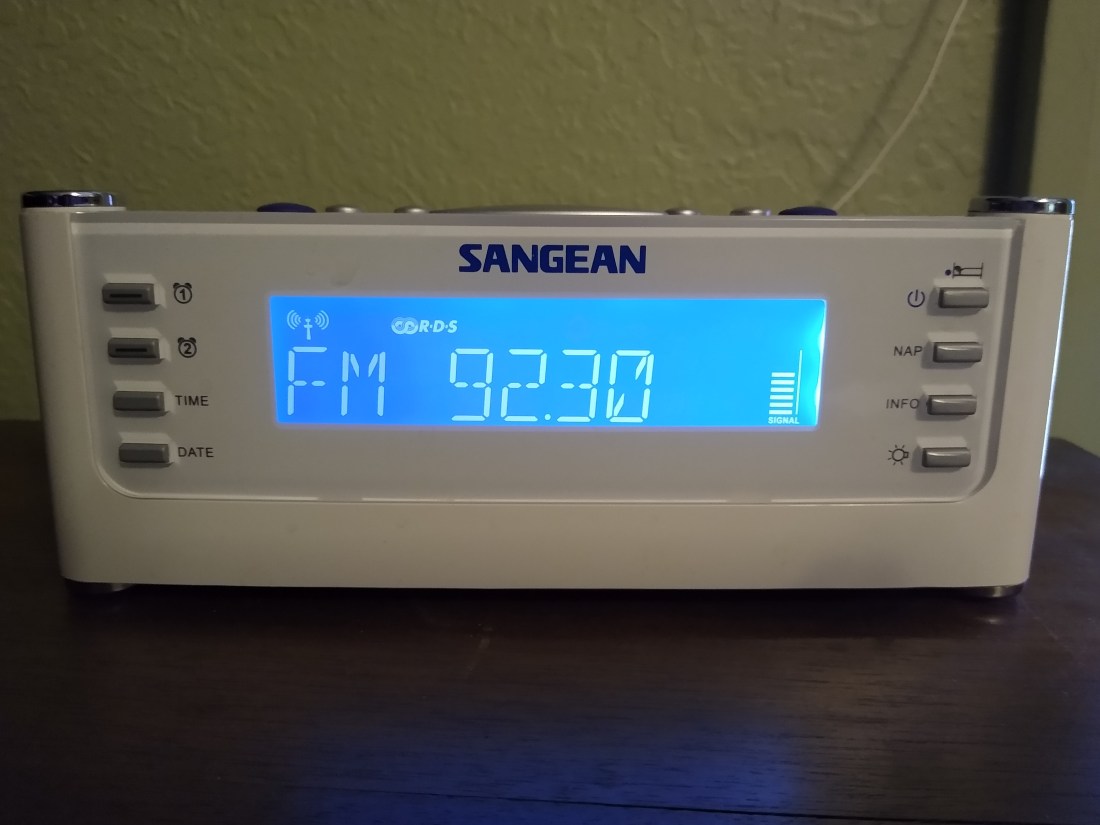
You can listen locally on FM 88.1 or 92.3, or stream it through the website. The show will be archived, so you can catch it at a later date, too.
Flies and horses go together like champagne and bubbles; you can’t have one without the other. Sometimes the flies are a minor nuisance, and sometimes they come in hordes, cause eye infections, or bite chunks out of the horse’s haunch. Fly spray can protect the horse, for a while, anyhow. Some horses will stand nicely for application from a spray-bottle; other horses are quite certain the sound and sight of the spray bottle is death itself coming to get them and will not stand quietly. And by not stand, I mean, rear, bolt, kick, spin and all other physically possible movements.
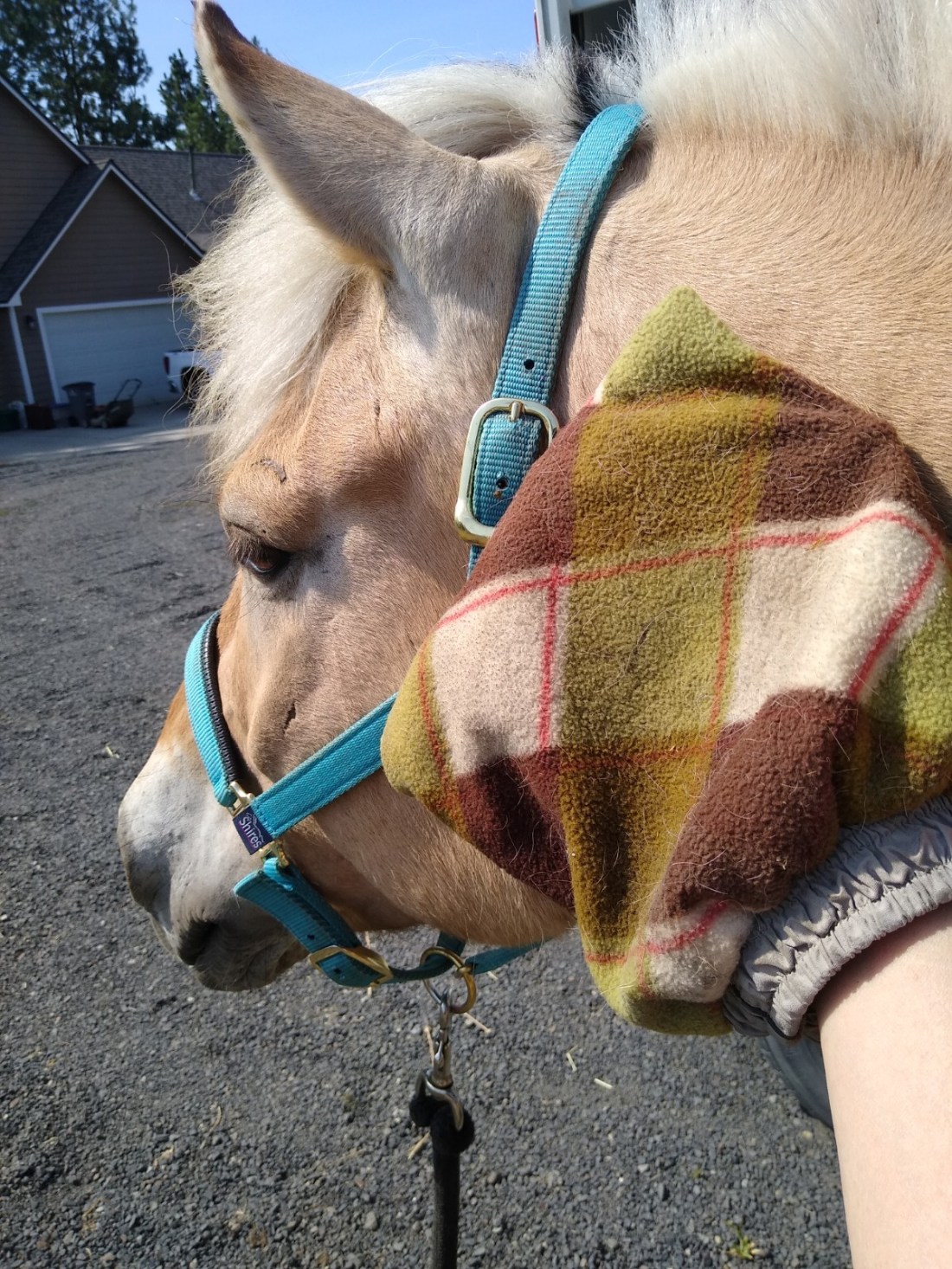
For those reactive horses, or for the areas around the face where you can’t spray easily, there are fuzzy fleece mitts lined with plastic, to apply the repellent by hand. These cost between 4 and 17 dollars. They eventually get grossly dirty from the oily spray and the dusty horse, or they wear out. Or, if you are like me, you lose them somewhere in a dark corner of the tack room or horse trailer.
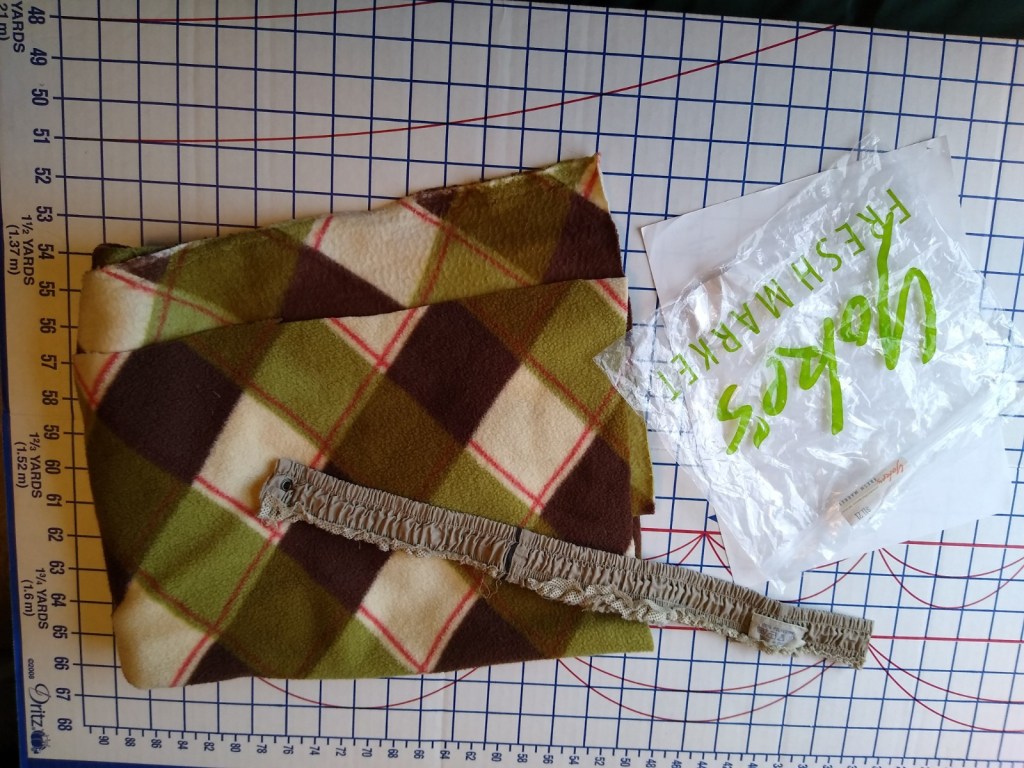
A friend and I were discussing how to make fly mitts for free. All you need is: 1) A sewing machine (preferably a vintage machine because they are the coolest); 2) a sturdy medium-sized plastic bag (preferably washed out and re-used) that is wide enough to spread your hand out in, and deep enough to reach over your wrist; 3) a scrap piece of gathered waistband from a worn out clothing item, or a piece of elastic; and, 4) a piece of scrap fleece, or an old towel, large enough to make a cover over the plastic bag. That’s it.
To make the applicator mitt, fold the material, and using the fold as one side, cut out the material about ¼ inch larger than the plastic bag on all sides (don’t cut through the fold). Determine which side is the bottom of your mitt. Sew the old stretch waistband to the bottom of the material, pulling and stretching the band out as you sew, so that it will be gathered and narrower than the top when finished. Then sew up the remaining side and top seams. I used a narrow zig zag stitch, to allow a tiny bit of stretch to the seam.
If you are using elastic instead of re-using a waistband, make the bottom side of your cover material about 1.5 inches longer. Sew top and side seams of cover first, then fold up a casing for your elastic, at least ¼ inch wider than the elastic. Sew along the edge of this folded hem, leaving about a 1-inch gap in the seam. Measure out the length of elastic to fit comfortably over your wrist. Use a large safety pin to thread the elastic through the casing. Sew elastic ends together. You can then sew together the one-inch gap in the seam, or if you are lazy like me, just leave it open. It won’t be obvious from the outside.
Once the fleece cover is done, simply push the sturdy plastic bag inside. If some of the plastic bag is hanging out, that’s even better because it protects your skin from the spray. You may want to add a safety pin or two to affix the bag to the fleece. Take it outside, apply the spray to the mitt, and rub the spray on the horse. Once the mitt has the oily spray on it, you can store it in a larger gallon size Ziploc bag—washed out and re-used, of course.
So, now it’s done. You can do it, too. If at the end you look at the mitt and think, “Is it not beautiful?” As in, it looks a little funky and your seams are crooked, don’t worry. My second mitt, in particular, has some imperfections. That’s because I thought I needed pull my other vintage machine out for some exercise, and for some reason, the zigs were not zagging consistently. But no one will notice once I turn it right-side out. And the horses are not perfectionists about zig zags, they just want the flies to go away.
The cover should be washable (though maybe outside in a bucket, since fly spray is usually strongly scented), and the internal plastic bag can be replaced if it wears out.
Reduce. Reuse. Re-apply the repellent as needed.
Of course, I needed to test my two prototypes. I gave one to my horsey friend Levi and asked him to review the product. He gave it a “two hooves-up” and stated, “Anything that keeps my human from spraying that icky fly spray directly into my face is a good thing.”
I queried my own horse, Vali, about his thoughts on the mitt. While he thought it was effective for application of fly spray, he recommended not using crinkly plastic for the inside lining. When he hears plastic crinkling, he thinks it is a granola bar wrapper being undone, and it should be shared with him. He was disappointed to discover that the fly mitt did not come with a treat. Therefore, he rated it only one head-toss.
Regarding my own thoughts on the mitt, I thought my bag should be longer, or it should be safety pinned to the edge of the mitt. The inner bag keeps squishing up inside. So far I’m living with that problem, because I have not managed to remember to bring two safety pins out to the horse trailer where the mitt is currently living. Knowing my memory skills, it may never happen.
Nonetheless, despite the criticisms, the fly mitts are working fine. On my last mountain ride, I had 20 mosquito bites on my lower leg, and no obvious bites on my horse. I should have applied the spray to myself. Or maybe worn armor. Hmmm. I wonder what I can upcycle into mosquito armor?
At our house we play seasonal games with ourselves. I’m not talking scrabble, or monopoly, or even poker. This is the game of “How long can we go?” In the fall, it’s “How long can we go without turning on the heat?” A few days ago, we lost the game of “How long can we go without putting the air conditioners in the windows?” This year it was July 7 for downstairs, and July 8 for upstairs. I think that was later than last year. It would be interesting to look at trends over time… but did I write those dates down? No.
Our house, a boring rectangular two-story 80’s house, does moderately well in the heat. Especially downstairs. The house is built on a cement slab that helps hold the coolness for a while. When it starts getting hot, we manage the heat by closing-up the house during the day, and opening windows and doors at night. We especially open every upstairs window since leaving downstairs windows open overnight doesn’t quite feel safe. Then, in the morning, we shut windows, shut curtains on the sunny side of the house, and hope the house stays cool. But there is a limit to this passive cooling system. (Is it really passive cooling if I am running up and down the stairs opening and closing windows and curtains and strategically deploying fans? That feels like active cooling to me.)
But after about three days of 90-degrees or above weather, we need the air conditioners. Since we don’t have a central heating or cooling system in this house, we use those heavy, awkward, ugly, window air-conditioners. One in the kitchen/dining room downstairs. One in the office upstairs. We used to suffer gamely with the heat upstairs, using only the window opening/closing method, until COVID forced some serious teleworking on my part. I definitely needed cooling in the upstairs office. So the old air conditioner moved upstairs, and we bought a new quiet one for downstairs. The quiet one is lovely. The noisy one is functional.
We also play the “How long can we go?” game with watering lawns and gardens. That explains why newly transplanted trees often don’t do very well in my yard. Only the fittest survive. Last year I finally installed a drip irrigation system that reaches some of the perennials and bushes and trees in and around the garden area. Did you know that raspberries and volunteer sunflowers try to take over the world when they get adequate water? I didn’t know this. Now I do.
We bought a couple of apple trees this spring and set up a sprinkler system near them. We really want them to grow, rather than die, given that they produce more fruit when they are alive. Now that area is getting lots of water. But the rest of the yard? We’re kind of hoping some of it goes dormant. This spring the weather was perfect for growing grass, resulting in the need for near-constant grass mowing. We do try to keep the yard immediately around the house green, but further out our goal is simply to keep the grass short. We even mow part of the pasture because the fjord horses don’t eat it fast enough. They tell me they are willing to try to eat everything down, but then they would turn into marshmallows with pony legs. I wish I could let them graze the pasture hard, since we are in a wildfire prone area. Now that the grass is drying in the heat, the horses can graze more, but still not as much as they wish.
With the significant warm-up this week, we begin the flip flop season. And I don’t mean the plastic shoes. I mean the flip-flopping of chore time and outside recreation time to the morning; and indoor computer, TV, writing, or craft time in the afternoon. I don’t like this schedule as much; I prefer to do writing and computer work first, and outside activities later in the day. I am trying to adjust. The horses are adjusting well to their longer grazing in the morning, then spending their afternoons in the shade of their stalls. They do spend a lot of time staring out at the pasture longingly, or staring at the kitchen windows, mentally urging us to come out and feed them again. I understand. In this heat I wish someone would bring me ice cream every hour of every day.
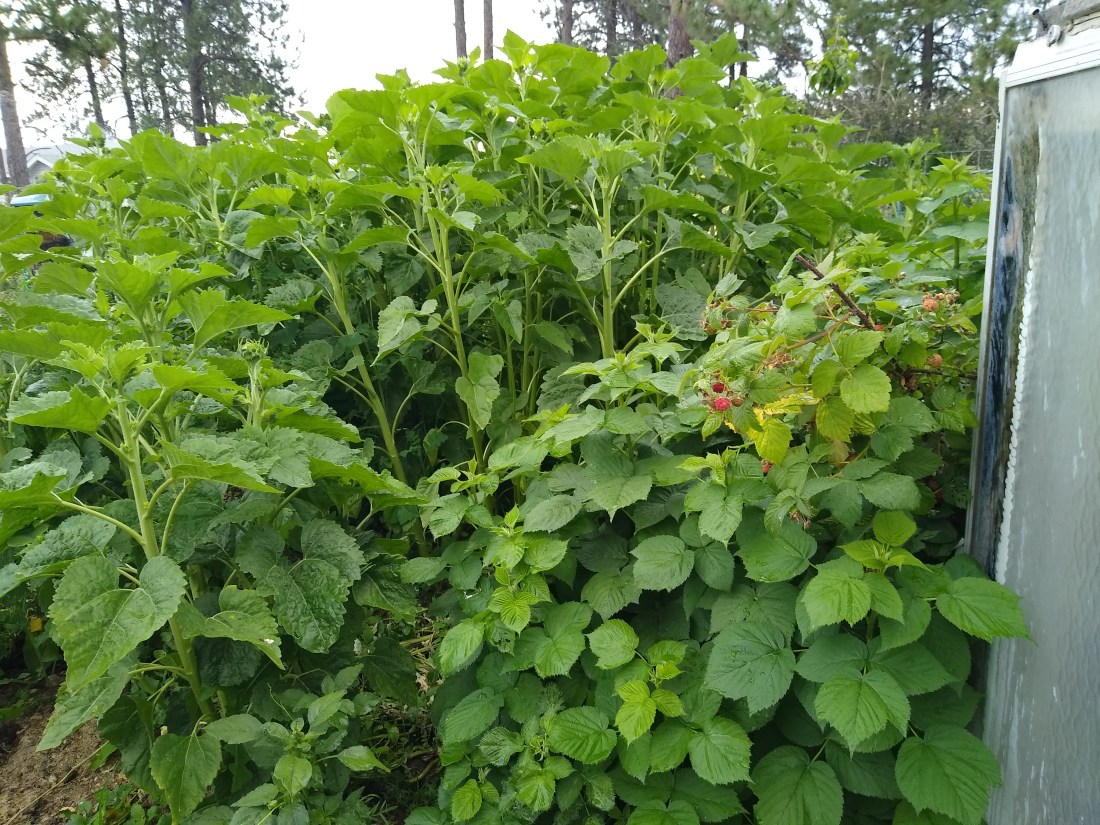
[I tried to get a good photo of the air conditioners, but they were just too darn ugly. Instead, I included a picture of the well-watered sunflowers and raspberries that are discussing how to take over Spokane, as a first step on their path to world domination.]
You can’t go wrong with peanut butter. Okay, maybe you can go wrong– peanut butter whisky and peanut butter beer sound disgusting. Other than that, though, all peanut butter foods are delicious: peanut butter granola bars, peanut butter cups, peanut butter brownies, peanut butter no-bake cookies… the deliciousness never ends.
But peanut butter in savory foods? Yes. Something changes when you cook it, it becomes more like a rich spicy gravy. The other night we had peanut butter noodles. You can use Asian rice noodles, or whole wheat noodles, or other non-gluten noodles. We added broccoli and snow peas to ours. Peanut butter sauce on noodles is good warm or cold. There are lots of recipes out there in internet land, just look for a simple one. Here’s a hint, though—add more peanut butter than the recipe asks for.
When I have been on various healthy diet kicks, for example when I was avoiding dairy to decrease sinus problems (it did help), the peanut butter noodles became a comfort food. Like macaroni and cheese without any cheese. It has a similar mouth feel. In an Asian restaurant, I will often order Chicken Satay, and not for the chicken. The chicken is just a carrier for the peanut sauce. I should probably just order the sauce on the side and request a spoon.
But my real comfort food, although one that I rarely make, is Domoda. This is from my Peace Corps time in the Gambia, West Africa. It is the best meal, a spicy peanut butter gravy over rice. With or without meat or chicken. It was definitely one of my favorite Gambian foods. The recipe is very similar to the Asian peanut sauces, but it is made in larger quantities. This is not an appetizer; it is definitely a main dish.
I have a scribbled-on worn out and well-loved paper recipe that I kept from our Peace Corps newsletter. I use it as a guideline, and I have a couple African cookbooks to compare recipes. The classic recipe is very spicy, I often add scotch bonnet peppers. Sometimes too many… my tolerance for hot peppers is not what it once was.
In the Gambia, we would eat this in a large flat bowl, eating with our hands, several people sitting around and sharing the same bowl. Sometimes we would use a spoon. We’ve served it this way with various family and friends over the years. Once when my aunts were visiting, we added the dimension of butchering an old chicken, and making chicken Domoda. It was so tough we couldn’t chew it. But the sauce was good. I don’t think even my immediate family would go for the communal bowl in this era of covid. Now we serve out individual dishes. With spoons.
I found a good-looking recipe online. I haven’t tried this one, but it looks like the real thing with all the right ingredients. Except they don’t mention a home-butchered chicken. https://www.daringgourmet.com/domoda-gambian-peanut-stew/
If you decide to try this recipe, use old-fashioned peanut butter, the kind without extra oils added, the kind where the natural oil separates off and you have to stir it in. Because that is how you know it’s done: the oils come to the top of the pan. The oil will be a pretty red color from the tomato paste. Also, add extra peanut butter.
I’m definitely craving Domoda now, but my chickens are looking at me nervously.


 Michelle Eames