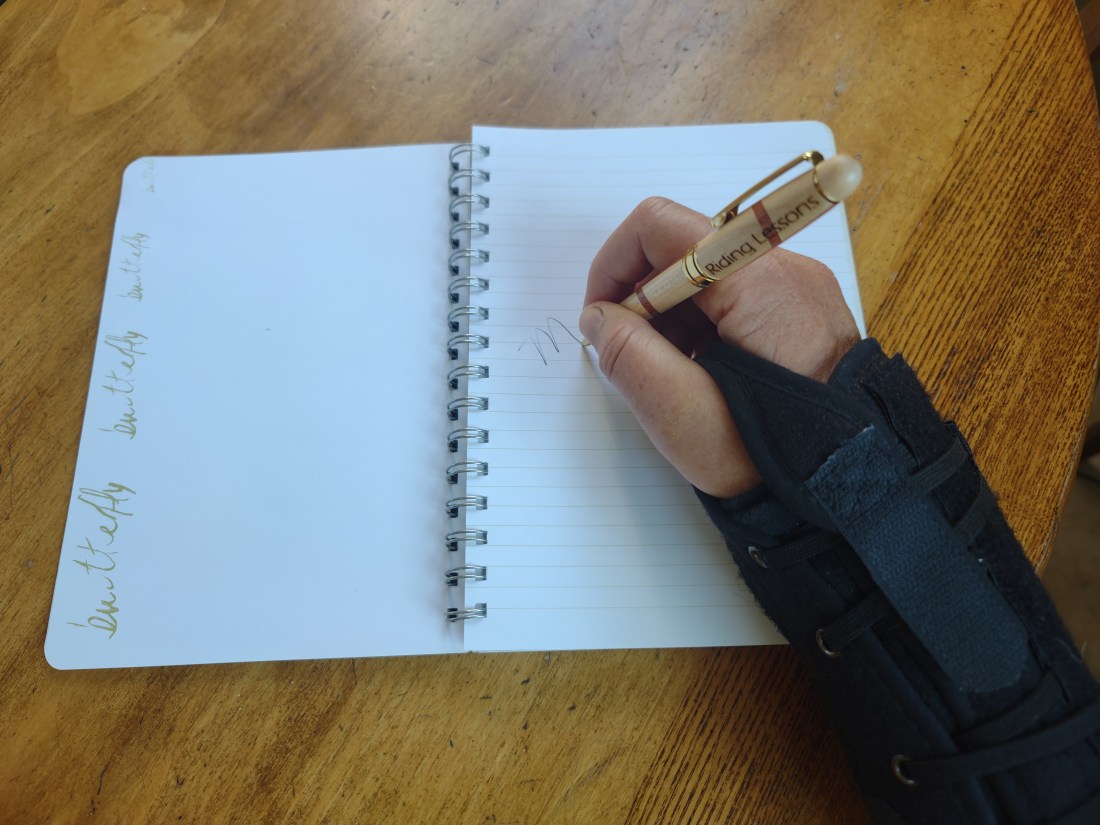
I broke my hand a few weeks ago. I didn’t realize how much I used my dominant hand. Learning how to sign, or even just initial, documents with my wrong hand was hard. The initials were large, square-edged, rough, robotic. The letters had none of that smooth roundness of automatic cursive we have all used since second grade.
At least some of us learned it and used it. I remember watching my younger son’s printing when he was beginning to learn to write. Large, square-edged, rough, robotic. But his teachers said just wait; wait until he learned cursive. Our grade school taught it when other schools were phasing it out. I watched, when he finally learned, how the writing got smooth, organized, pleasing to the eye. Something connects in the brain when you don’t lift the pen from the paper. Even his printing improved.
I remember when I was learning creative writing. A teacher said use paper, not a computer. Keep writing no matter what, even if you are just repeating, “I don’t know what to write.” Keep your pen moving on the paper. I did that for years, writing in notebooks, both good stuff and garbage. The trick is not to lift the pen out of the journal. Write your stream of consciousness. Later, you go back and pull out the good bits, and those become the start of pieces that you then improve on the computer. The process works, the pen connects to a deeper part of the brain. But eventually I changed to free writing on the keyboard instead. Have I lost something? Maybe. Although at the moment, keyboards are way easier than writing long hand.
Now with a broken hand I’m noticing the different connections to my brain. The left-hand connection is slow, like a shorted-out wire. I needed to find a way to write my to-do lists or take notes from a phone call. My left-hand penmanship was giant, messy, and nearly indecipherable. We had debates within the family on what my notes meant. I often wasn’t sure myself. Scribbling wasn’t working. Typing was better, with some finger movement allowed on my right hand. I finally started using the task list on my google calendar, instead of my usual long list of hand-written notes in a notebook. I had to keep my to-do list somewhere, or I was lost. The computer version works well, I may continue it after healing.
Initially, I wondered how I would make it through my reading and signing event in Blaine on October 21 with a broken hand. Luckily, on my recent visit to the hand specialist, I got a better brace that allows more finger movement. Typing is much easier now, and I can slowly, though a little awkwardly, sign a book with my right hand. Or should I call it my write hand? At least now, my penmanship is mostly readable.
 Michelle Eames