One thinks of sewing as a gentle craft. Lots of thought, precision, and fine hand-work goes into it. Cloth is lightweight, as is thread. Needles are small. The machine does all the work, so no real strength is needed.
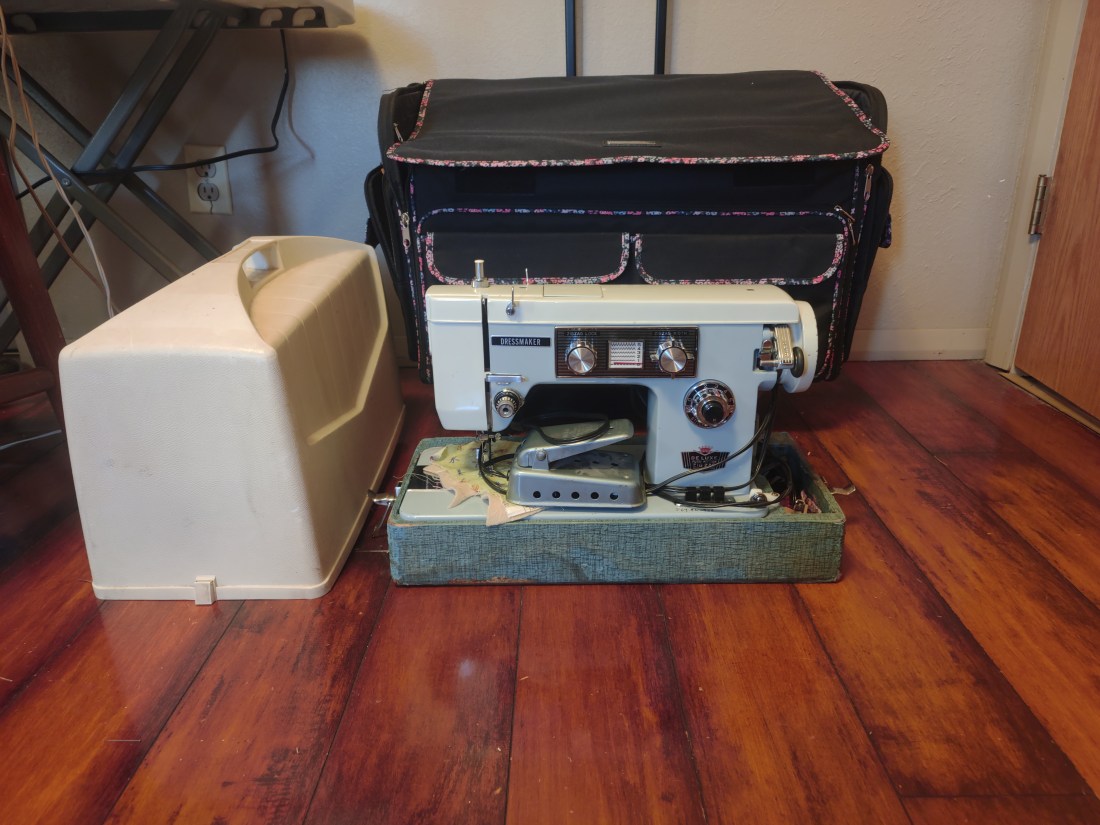
But when it comes to sewing machines at my house, we are talking substantial mass. You see, I like the old vintage machines. The all-metal, or mostly metal ones. None of that wimpy aluminum here (although I hear that a few lightweight vintage machines do exist). I mean machines made of steel. Or cast iron. Thick-walled tanks of machines. The kind of machine, that if you can’t get them working again, get new jobs as boat anchors.
Last year I went to several mending workshops put on by Spokane Zero Waste. I’m not a great sewer, but I’m a practical sewer. I can fix rips and holes. But at the workshops I borrowed a machine. I couldn’t figure out how to easily get my favorite blue behemoth machine from my car, across the parking lot, and into the mending rooms. I’m not as strong as I once was.
I noticed all the skilled and serious sewers brought their own machines: sleek, stylish, modern, and lightweight machines. From those skilled seamstress people I learned that there are ready-made sewing machine cases on wheels, with expanding handles, and numerous pockets for accessories and threads. Like rolling luggage, but squatty. I watched as the menders easily pulled their gear behind them in their brightly colored roller bags, and easily lifted their machines to the tables. I wanted one of those bags.
I looked locally and online for ready-made sewing machine roller-carriers, or even a piece of rolling luggage that might work. Then I measured my favorite blue beast of a vintage machine. In addition to being heavy, the machine in its wooden base is quite long. I would need an XXL size carrier. I finally ordered one of those wonderful bags and was happy the day it arrived. I was also a bit surprised at the sheer size of it… more the size of a camping icebox than the size of petite airline luggage. But I was ready. Have sewing machine (and bag), will travel.
A friend who quilts wanted to have a sewing gathering. A sort of play-date for crafty adults. I was in. I now had my travel bag. But first, I had to organize a project to work on–gather scissors, seam rippers, pins, cloth, everything I might need. I filled many of the pockets on my bag. Then I packed up my seventies-era machine to lift it into the roller bag. That went well, because it was a downward move from table to bag. I secured it with the inner Velcro straps, then, out of curiosity, tried to lift the bag. I can lift the beast machine by itself, but the roller bag was broader, awkward, and pushed my limits. It rolled very nicely, however. I rolled it out of my sewing room, into the hall, and stopped at the top of the stairs. Fourteen steps. Should I carry it down? Should I clunk it down a step at a time as if it were a washing machine on a hand-truck? I decided this was a job for super-husband. He carried the awkward bag down the stairs. I asked my husband how much he thought it weighed. He thought at most 30 pounds….? Really? I was sure it was 50. Once it was downstairs, I was able to maneuver it through the house, carefully down the three porch steps, and across the muddy lumpy yard to my car trunk.
My car has a big trunk. I grunted and lifted the roller bag up and in… feeling like I was pumping iron at the gymn…it sort-of fit, though I tipped it a bit to get the trunk closed. Perhaps I should have gone for the XL bag instead of the XXL.
But I got it done and drove off to join my friends for our sewing party. Maybe it wasn’t exactly a party, since it was too early in the day for alcohol… I got the case up her house steps by pulling it backward, using the hand-truck method, and wondering how long this bag was going to last with my rough treatment. I sewed, I watched, and I learned that quilters have cool tools and clever techniques. But they are also very meticulous and precise—not exactly my style. Nonetheless, I might be gathering some of those cool tools, not because I plan to become a quilter, but because I still have room in that XXL bag. I’m sure it won’t add any weight.
P.S. I finally weighed the great blue whale of a machine. By itself, without any extras like cloth and tools, it weighs 40 pounds. At least my husband wasn’t right in his guess, but then neither was I. We split the difference in our estimates. There must be a deeper meaning about life, marriage, and perceptions there somewhere… Anyhow, I think I will be able to work sewing-machine-weight-lifting into my winter fitness routine.
 Michelle Eames