We have most of the modern conveniences in our kitchen. A food processer, a blender, and a couple kinds of electric mixers (one of which is avocado green and is probably from the 70’s). We use them regularly, but we also have all the right stuff for camping, like a propane stove, battery and gas lanterns, and flashlights. Those items are not only handy for camping, but also for those times when we lose electricity due to wind storms or ice storms. We are pretty comfortable living without our modern conveniences, at least for short durations.
In my craft room, I even have a working treadle sewing machine, and a hand-crank singer. I love the old machines. I know I could use them if the electricity was out, but would I really? Usually if our electricity is off for any length of time it’s because of a big storm, and we are occupied with keeping the house warm, or getting water since the electric well pump doesn’t work without electricity. I’m not usually thinking about crafting. Nonetheless, I really appreciate the machines and tools that don’t require gas or electricity. Like manual eggbeaters.
One year my mother-in-law challenged the family to have a grow, gather, or hunt Thanksgiving. We were to bring food we had grown in our gardens, gathered in the wild, hunted, or fished for this dinner. Our plan was to bring home grown potatoes, and pumpkin pie made from our garden winter squash and eggs from our chickens. There was only a little bit of complaining about the small and erratic sizes of our potatoes as we were pealing them, but the dinner was fun, interesting, and delicious. There were some exceptions to the grow-your-own rules—like whipping cream. None of us owned dairy animals, but whipped cream is essential for pie, so we had store-bought cream and we made it in my mother-in-law’s state-of-the-art stand-mixer. Her mixer was way fancier than the wimpy electric mixers we had at our house.
Another year, we all agreed to have Thanksgiving at “The Cabin”. The Cabin has no electricity, and is way out on a narrow mountain road. There was a woodstove and a propane stove to cook on, and it even had a small propane oven. But there were no food processors, no microwaves, and no electric mixers.
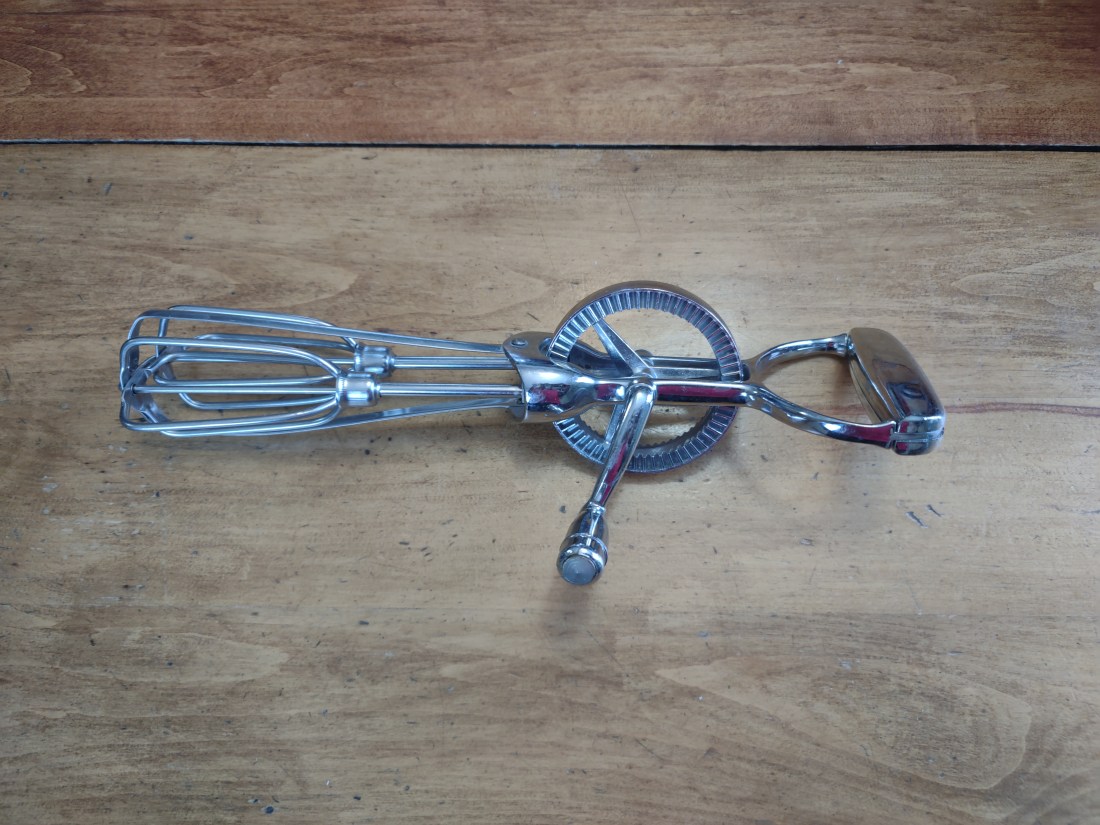
In many ways that meal was simpler than the grow/gather/hunt dinner. The turkey was pre-cooked and simply warmed up in the small gas oven. The mashed potatoes were instant, due to limited cooking space. But we had pumpkin pie and whipping cream. For the whipping cream we brought our manual eggbeater, the old-fashioned kind with the crank on the side. It takes forever to make whipped cream with a manual eggbeater. We kept passing the bowl around to each family member to share the beating duties. Finally, we had soft peaks in the cream, and proclaimed it done. The pie with whipped cream was delicious as always.
I left that eggbeater up at The Cabin, but eventually we bought another one to use at home. Because around here, you never know when the power will go out for an extended period of time. If it does, you might want to sew on a manual sewing machine, or use a manual eggbeater to make whipped cream to serve on top of instant chocolate pudding. One must be ready for anything. Also, now I want some pudding.
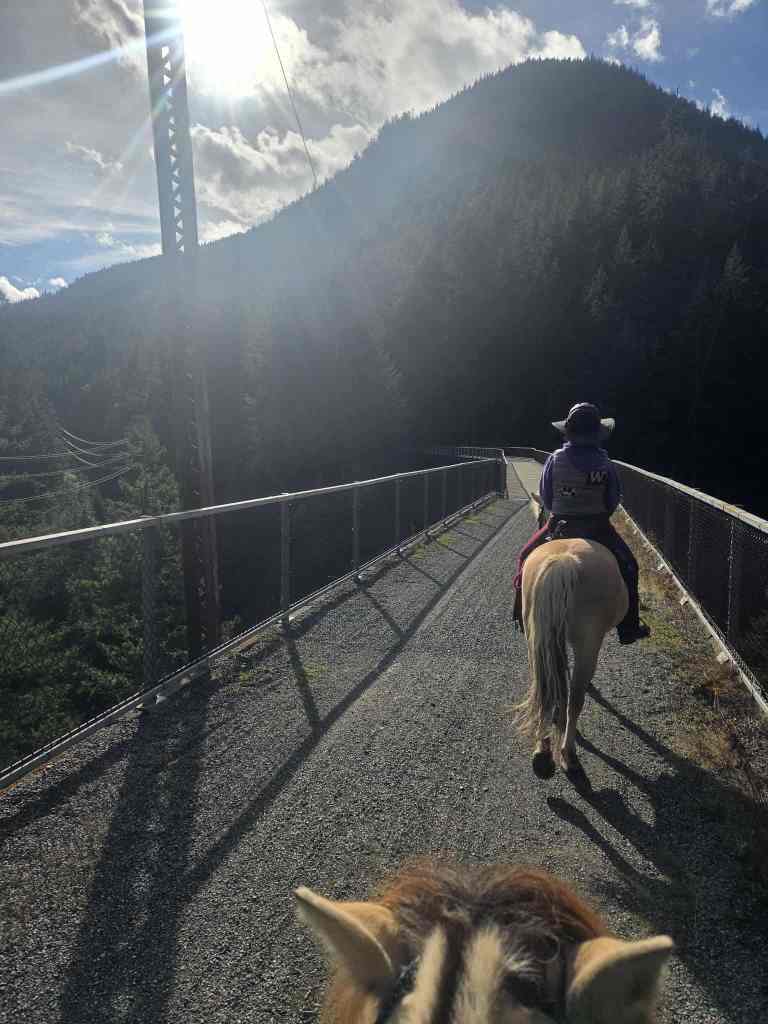
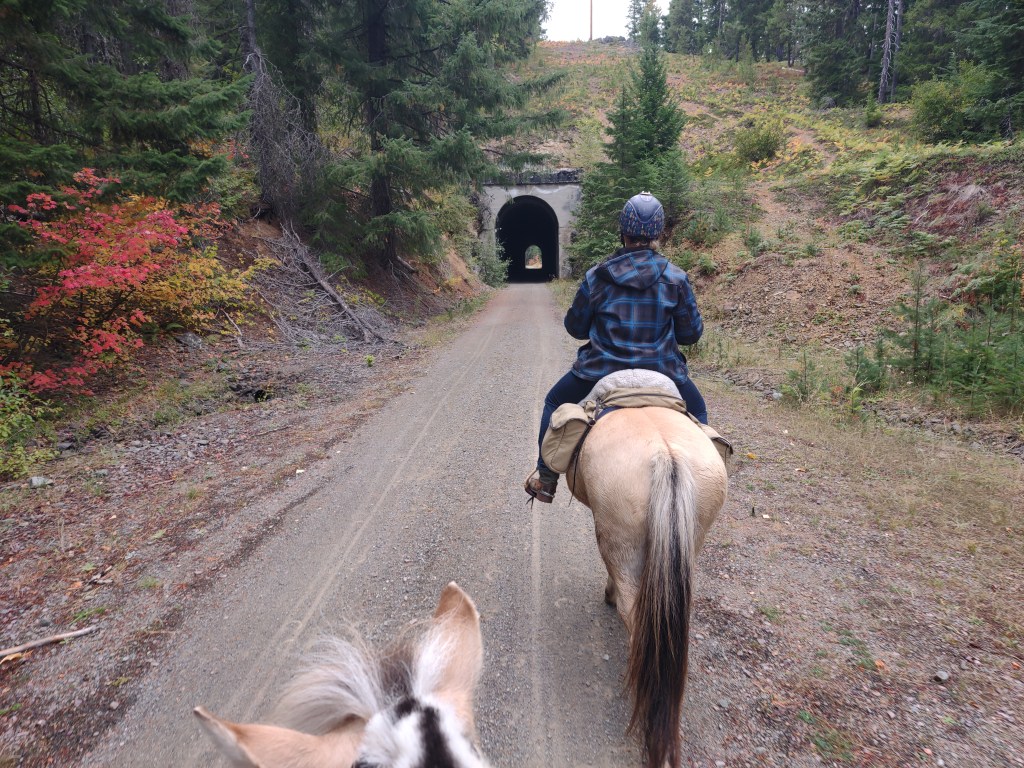
In the last blog, my horse Vali shared his thoughts on the Big Ride, the John Wayne Trail Ride on the old Milwaukee Road railroad bed from Thorpe to Snoqualmie Pass in Washington. Now it’s my turn.
We did a lot to get ready for the ride. Maybe there are people who can just throw their horses in the trailer and go, but I am not one of them. When it comes to planning, I am a list maker. My riding buddy Solveig says I am one of her OCD friends. I say, if she thinks I’m OCD, she should meet my other friends! But maybe she’s right. That is one of the reasons I try to avoid planning things: it requires a lot of mental energy, lists on backs of envelopes, and sharpened pencils. Nonetheless, once we were committed and signed up for the ride, there were things to be done.
Camper Prep.
We would definitely take my truck with my pop-up slide in camper, because it is warm. It has a propane heater. However, we needed to be able to dry camp for 5 nights. I was pretty sure my current lead-acid battery system would not suffice. So I needed a better battery system, or a back-up of some sort. I called in my buddy Sandy to help re-do my camper with solar charging. She knows her stuff, given her experience outfitting her own camper from scratch.
First, she told me to buy a battery monitor and install it on the existing battery. This of course required buying a new lead-acid battery, since the old one was deader than dead. This is a skill of mine, killing batteries. With help from my techy son, we got the new battery installed and figured out the battery monitor. So cool! That would have been very useful over the years to know how much power was being used, and how much power was left. Did you know that lead-acid batteries can only be drawn down halfway without damaging them? That apparently is how I kill them. Anyhow, during our shake-down horse-camping trial at the local State Park, I tracked the use of the battery. On that very warm summer night, I used a third of my available battery life. The current system would only get us 3 nights, if we were lucky.
Sandy then designed a solar system (the battery kind, not the planets), told me what to buy, and came to visit and work for several days to install it. It was time consuming, but easier than I thought, especially because my job was to be the go-fer and assistant. That is my favorite job.
Once it was done, I camped in the yard for a test run. Everything seemed to work, but I still crossed my fingers. On the actual trip, the battery monitor would display a drop of about 10 percent each night, and recharge during the day to 100 percent. We had heat and water and lights and phone charge-ability—but most importantly we could run the propane fridge with electric controls each night and were able to have ice for our cocktails. We definitely needed our cocktails.
Trailer Prep and Supplies.
We briefly debated bringing my two-horse trailer, versus Solveig’s three-horse trailer. The three-horse was the better choice, because we could use the extra horse stall for hay storage. Then the trailer needed maintenance, installation of high-ties, designing of plywood covers to keep the horse’s legs out of the tires and fenders while tied, and we had to figure out all the extras to carry with us. We packed too much hay in the end, but that is better than too little.
We had to carry enough water to go at least 24 hours. Between us we had enough big blue jugs (5) plus some extra small ones. We filled them and packed the trailer a few days before the trip. Note to self: look in and wash out the jugs before filling. One had a dead mouse in it. Ick.
Prior to the trip we tested Solveig’s trailer behind my truck. Everything worked and the truck handled the weight. Hooray!
Gear.
The rides would be long, up to 19 miles in a day. Not only would the horses get tired and sore, so would the humans. And we had to carry food, water, rain gear, halters, lead ropes, and minimal emergency gear with us. We experimented with seat savers and saddle bags as we trail rode over the summer. By the time of the ride, we had all the kinks worked out. During the pre-rides and the Big Ride, we only wrecked two of our bags. One was fixable, one was not.
Horse fitness.
Once Solveig and I committed to the ride in July, we knew that fitness would be key for both horses. And although Vali was a pretty predictable and mostly brave trail horse, Moyfried was young, and had not been out a lot. We took the pair out on close to 30 trail rides and rode almost 220 miles before the Big Ride. Not only did this get our horses fit, it improved our rider fitness, too. One day we rode 16 miles. We knew if we could do that, we could do 19.
We exposed our horses to bikes, people, rivers, bridges, rough trails, easy trails, paved trails. We got them used to horse shoes, and then shoes with pads in preparation for rocks and gravel. We rode in groups from two to six horses. We rode with new horses and with familiar horses. We rode across the only trestle-like bridge I could find in the area, and we went under a rural overpass. Neither horse liked trucks and cars passing above them, but we did it. We tried to expose them to everything we could, but we could not practice tunnels. (Later, on the actual ride, we heard that people would ride at night with flashlights to get their horses tunnel-ready.)
Our horses practiced tieing, and standing, and being on the overhead high-ties at the trailer.
We were ready, except…
By the time we left, with all our gear, food, flasks, and cocktails packed, we thought we were as ready as we could be. Yet, some things surprised us.
The first half mile of the first day was road-riding. Moyfried had never been ridden on a road with cars passing. Luckily, it was a rural area with few cars and little activity. Also, those rural drivers knew how to pass horses slowly or not pass at all. I wish all drivers were as careful.
The tunnels were interesting, but not as much for the dark as for the noise. Vali has always been sensitive to noise, and I led him through the first one. We both rode the second one, but the intense dark was very disorienting, at least for me as a rider. Even though it was a short tunnel, pointing a flashlight on the wall helped.
There was a short bridge over an irrigation return canal, like a large waterfall contained in an almost-vertical cement channel. That was loud. I led Vali over that.
Toward the end of the first day, we had to go under two Interstate-90 overpasses. First the east bound, then the west bound. Both horses were worried, listening to the roar and bump of traffic over the expansion joints, and immediately after there was a wooden bridge that Moyfried thought she might need to jump. After some tense moments, we were able to get Moy behind Vali as I led Vali across.
Oh yeah, we walked right by a large pig farm on day two. Our horses were fine, but they have both lived near pigs. I figured that might have been interesting for some of the other horses, since pigs smell like carnivorous horse-eating beasts.
The trestles and bridges over the next few days got easier and easier for our horses. It was great to have two bonded horses, they gave each other confidence and were each brave about different things. We often clumped up with similar-speed horses, and a few times two women with more emotional horses tucked in behind us to borrow some of our calm. Our horses didn’t care.
All in all, Vali and Moyfried rocked the ride, mainly because we prepared them, and ourselves, ahead of time. I always thought I wanted to do the longer 17-day ride organized by the same group. Now I’m thinking a four-day ride is plenty. But my camper battery would definitely handle the longer time!
I’ve been quiet on my blog lately, mainly because I’ve spent a lot of time getting ready for, and then finally riding, a four day, 65-mile trip on the Palouse to Cascades Trail. The ride was organized and facilitated by the John Wayne Pioneer Wagons and Riders Association. There were so many topics to write about during this time, such as: preparation and fitness for horses and riders, gear to pack, revamping my camper to work from solar power with a lithium battery so we could dry-camp for five nights, surprises along the route, and more. However, my horse Vali nuzzled his way into the front of the line. He wanted to share his thoughts on the ride. So I have passed the lap-top to Vali to write this blog.
Uncle Vali’s* Thoughts on the Big Ride
I like travelling and seeing new places. It makes me happy, almost as happy as having a full hay bag and a bucket of water in front of me. My needs are simple. I like new trails, too. It’s fun to see what’s around the next corner. My human thinks my extreme attentiveness means I might spook (and I might, because sometimes you just have to keep your humans and herd mates safe from danger) but mostly I really like to see new things.
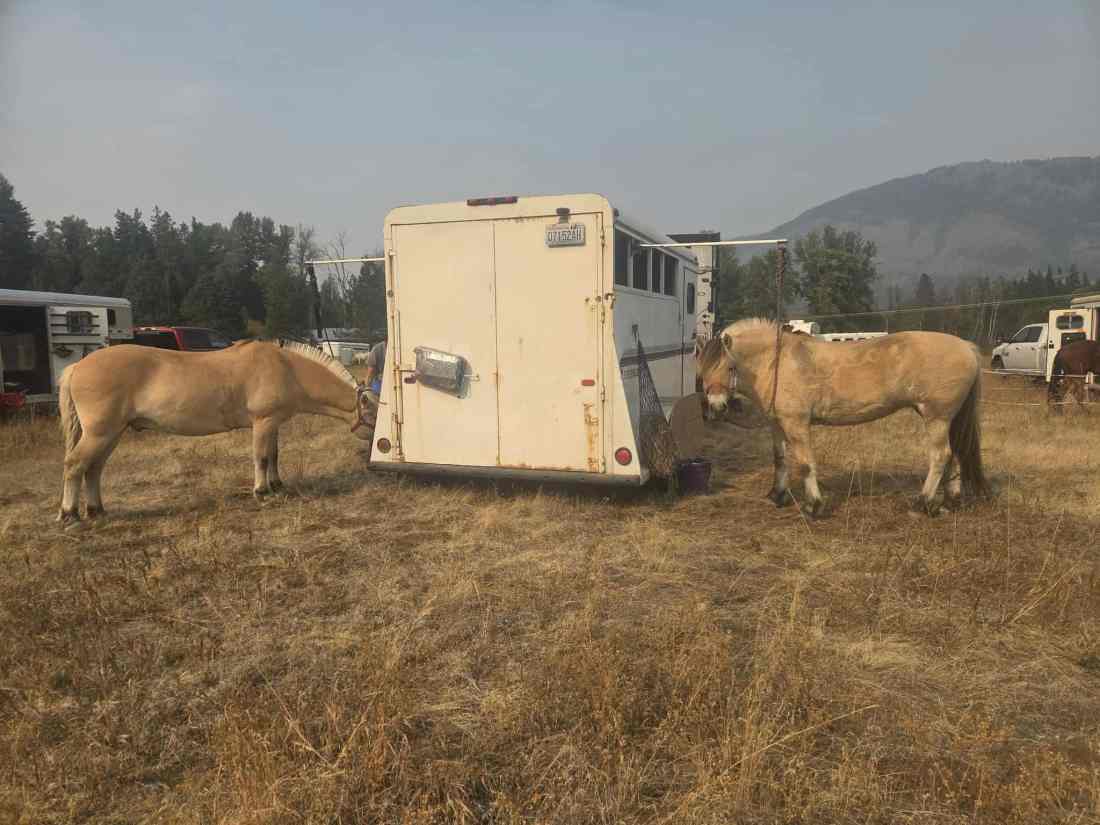
On this camping trip, we horses stayed on high-ties, these pole and bungie things attached to the side of the horse trailer. I have been on a high-tie before, but never for a whole night. It’s almost as good as a small electric fence, like my human usually puts me in during our camping trips. I can move around with the long bungie rope hanging from the pole above, and I even figured out how to lay down. But mostly, I could easily eat, so life was good.
My buddy Moyfried, though, thought the bungie rope was a delightful plaything. She pushed and turned and pulled and tested until it finally broke on our second night after some harmless deer walked by. She just came over to visit me on my side of the trailer to feel safe from what she thought were carnivorous beasts, but our humans were grouchy from being forced out of their snug camper. I’m not sure what is so special about that camper, they can’t see the stars, but they sure like to be inside all night. They must have really good hay in there. And I thought I smelled beer one night. I like beer, it’s made of grain. Moyfried escaped again on the third night. The humans were extra slow to catch her that night. I think they needed more hay to help them relax afterward.
This trip had some long rides. Luckily Moyfried and I are very fit. We rode lots of trails over the summer. Moyfried can be a little goofy, and gets worried about some things. She is a mare after all, and a young one at that. We geldings are much braver, although a few times on the ride even I got worried and my human got off to lead me. I like it when she leads me through scary spots. I can relax with the knowledge that she will be eaten by the trolls first. Seriously! One of the river bridges had a troll walking under it. The humans thought it might be an elk, but elk are not scary and they do not live under bridges. It was a troll. My human went first on that bridge and we all survived, luckily. I would be sad if my human was eaten, but I’m sure the other human would let me live at her farm.
There were so many bridges, and they can make some scary hollow sounds, and sometimes they have a metal strip in front that clangs like a bell when our shoes hit it. It is disturbing. I finally learned how to carefully step over that metal part. Also, sometimes the bridges have cracks in the surface! Those cracks and openings were scary at first, because trolls can get their fingers through the cracks and grab our hooves. We needed to lift our hooves very high over those cracks to avoid the trolls. But, late in the day, we would get tired and the trolls would take naps and all the bridges were fine for crossing.
There were these new things on the ride called tunnels. Tunnels are a dark hole in a mountain that we had to walk through. The darkness is a little concerning, but the true horror was the echoing sounds coming out from way up ahead– like a bunch of loud horses and trolls drumming and singing. Badly. At the first tunnel I made my human go in front on foot. At the second tunnel I felt better; I didn’t see, hear, or smell danger so I let my human stay on my back. On the last day, we started into a super-long tunnel. The humans were saying it was an hour long at Fjord Horse speed. An hour in Fjord time is the time it takes to eat a flake of hay in a haybag. Oddly, they didn’t make us go all the way through that breakfast-length tunnel. I could have done it! But I was secretly glad that we didn’t. I could tell my human didn’t like it. Sometimes you have to give your humans a win.
I don’t usually like the sound of big trucks, or rattling trailers, or far away loud noises. But we spent a long time walking along this thing called Interstate 90. I figured out that is where hay trucks and horse trailers go when they want to visit other far-away horses. Once I determined that noise wasn’t coming from troll parties under bridges, I was okay with it. It was kind of calming, like the sound of tractors mowing hay fields.
My human thought that I would be worried when horses came up behind us, or passed us, or got out of sight during the ride. But I wasn’t. I had my buddy Moyfried beside me, and she had me, and we were a herd of two. Our herd bond was strong. Also, some of those other horses were weird. A couple of the Arabs glared and called us “ponies” as they passed. We are Fjord HORSES! Some of those flighty horses jigged and jogged for miles. What a waste of energy. Don’t they know that these shoes were made for walking? Slow and steady wins the race. We did walk pretty fast, though; our humans were surprised we had it in us. Sometimes we walked slowly, too. On the third day of the big ride we Fjords were in front for two whole miles!! Of course we had started earlier than the others. Eventually the faster sillier horses caught up and passed us. We didn’t care, the views on that trail were stupendous!
There was a thing called a carriage pulled by two horses that our humans thought we would be scared of. We were not, because we got to meet those horses the first morning. They are steady and focused horses, and we respected them. They had a job to do, and that was to pull a noisy rattling wagon with flags on the back. We didn’t want to make their job harder by spooking when they came near.
Luckily the humans brought snacks in our saddle bags on the rides. It’s a lot of miles to go without a snack. You know the humans have food out when you hear that cellophane plasticky crinkling sound. Sometimes they tried to hide the food from us, but we have good ears. I always turn my head to get a tidbit. Or I try to get some cookies from Moyfried’s rider. I don’t know why they didn’t share the thing they called beef jerky. It smelled salty. I would have eaten it.
Our longest ride was 19 miles (that’s more than six Fjord-hours). I could have gone further. But the humans were tired, so we quit. Also, there was hay at the trailer.
At the end of our ride on day four, my owner took out this metal thing called a flask. The humans took a drink, and then my human poured some on her palm for me to taste it. I licked it up. And then I licked up a second taste. They call it brandy. I call it joyful juice, because the humans were joyful when they drank it. It’s good, but not as good as beer. Moyfried lifted her lip in disgust at the smell. She is too young to appreciate good joyful juice.But give me a couple more trips like this, and I’ll have her corrupted, I mean trained.
* Vali spent the 2025 riding season at my friend Solveig’s farm, where he earned his nickname, Uncle Vali, because he was an older finished horse that could be a good example to the younger horses and humans on the farm. Turns out that he is more like the goofy uncle that is always trying to get the other horses in trouble. He starts the biting fests through the fences with the foals. He taunts the stallion from two paddocks away and starts the galloping fence racing. As Solveig says, he is like that uncle that loves the nieces and nephews but gets them thrown in jail during their jaunts and escapades.
It may have been a mistake that day I stopped at the Zips Drive-In in Nine Mile Falls and ordered a chocolate milkshake. I knew the Zips was there, at the half-way point of my drive home from riding my horse. I’ve noticed that drive-in across the busy highway intersection and realized it would often be easier to take a right and then “zip” into the parking lot and loop around, rather than to wait for an opening for a left turn. But I was avoiding that extra-efficient jaunt, to avoid remembering how good a chocolate milkshake can be.
You see, I’m an expert on milkshakes. When I was working, I would drive to various meetings across the vast expanse of Eastern Washington. These were day trips, driving up to three hours, attending a meeting or a field trip, and then driving home. They were very long days, often requiring road food. And milkshakes were a perfect road food. They didn’t drop crumbs in the car, the cups were easy to hold while driving, and the straw allowed me to keep my eyes on the road while ingesting the necessary sugar and chocolate to keep me awake. And it’s a dairy product, so it’s good for me! It was also a bonus that drive-ins usually had bathrooms.
During those drives, I decided to rate the chocolate shakes at all of the drive-in restaurants along my routes. I only rated old-school type drive-ins, the ones that have the windows that you walk up to, and a long menu of comfort foods, like French fries, onion rings with tartar sauce, fish and chips, and deluxe cheeseburgers. I did not rate the national chains, in part because they are boring, but also because their milkshakes tend to be icky. The only exception to the chain rule was Zips because it was a local chain and their milkshakes were definitely not icky.
I kept a notebook for the milkshake ratings, with a scale of 1 to 5. I rated thickness: Does the straw stand up on it’s own? Are you likely to pop a blood vessel in your eye from sucking too hard? I gave extra points if a spoon would have been helpful. I rated technique: Did they use the old-school kind of milkshake makers, where they blend the syrup and ice cream in the serving cup? I rated sound effects: Does the straw make obnoxious sounds as you get to the bottom of the shake and try to suck up the final clumps? Do you have to say “excuse me” to any passengers in the car? And of course taste: Is the chocolate flavor strong, and not overly sweet? I gave negative points if they added malt flavor to the chocolate shake. What is malt, anyways? Flavored chalk?
I envisioned writing up my survey results in a milkshake review booklet and sending it to the Washington Dairy Council, knowing they would buy it and give me lots of money for my genius marketing idea. Except I never finished the manuscript to send it in. Then I lost my rating notebook. Nonetheless, I did manage to find the best chocolate shake joints in Eastern Washington. I also learned the gas stations that sold home-made cookies, and the coffee stands that sold espresso shakes (a close second to chocolate shakes with an extra caffeine boost). Eventually, as I got older, I had to start watching my calories and stopped drinking milkshakes. And over time some of the best milkshake locations, including my number one rated spot, closed down. It was right off Interstate 90, near Moses Lake. The second-best milkshake location in my survey still exists, though: Billy Burgers in Wilbur, Washington. I guess that moves them up to first place. Congratulations, Billy Burgers!
That day I stopped at the Zips in Nine-Mile Falls was a hot one, I was tired, a bit hungry, and needed a pick-me up. I turned right at the busy intersection, left into the parking lot, and pulled up to the drive-through lane. They offered choices of milk shake sizes and many flavors, though of course I went with chocolate. That first suck of the straw required a super-human effort. Thickness points 5. Could use a spoon. Taste 5. It was a very good milkshake. The problem is now I remember how good their shakes are, and that drive-in is in a very convenient location.
I had to go back one more time, because I neglected to get a picture the first time. The chocolate shake was still good on the second visit. Will I now need a milkshake every hot day on my drive home from riding? After all, the world is a chaotic and worrisome place, and I need to find moments of joy. A chocolate shake is joy in a cup. Unless it’s chocolate malt.
I love our chipmunks, and I saw some cavorting in a Serviceberry bush yesterday evening as I was bird watching. I was so happy the cats were indoors, or in their small catio, and the birds were all safe in my yard.
Apparently the chipmunks were not safe, however, as this morning my husband saw Purrcy run through the living room with a chipmunk in his mouth. He yelled, “Where was the cat? He has a chipmunk!” as Purrcy ran upstairs past me and into my son’s room. My son’s room is not a neat and tidy place. There are many spots to hide, I realized, as I grabbed the cat with the small live mammal in his mouth, and he dropped it. The chippy disappeared under the desk as I hurriedly put the cat out on the porch, and joined Doug in my son’s room. His hands were on his hips and he was frowning, with no chippy in sight. It had to be there somewhere.
We discussed a trap. But I don’t have a chipmunk-sized live trap. I grabbed a couple of mixing bowls from the kitchen thinking we might capture him under one… and then, um, maybe slip a piece of cardboard under it, like capturing a house spider under a glass to free it outside…? Yeah, surely that would work. But the chippy was nowhere in sight.
So Doug let the cat back in the room to capture the chipmunk. Purrcy had it caught before I had time to think through how we might get the chippy out of his mouth without it escaping again. Put the mixing bowl over the cat? Purrcy zipped out of the room, chimpmunk hanging from his mouth, past us, downstairs, and crashed through the swinging catio door. We ran after him, closed the inner catio door, and then ran out our back door and around to the other side of the house to the catio with hopes of getting the cat to release the chippy. Even before I had the outer catio door unlatched Purrcy had eaten the chippy’s head off. We left him to devour the rest of the body.
I love our chipmunks. But this was definitely a survival of the fittest scenario. That chipmunk obliviously entered a small fenced area that was full of cat-predator smell. Of course it got eaten (after being traumatized by the cat and two humans). As Doug says, even a blind squirrel will eventually find a nut. Even a caged cat will eventually find some prey.
At least it wasn’t a bird loose in the house. This time, anyhow.
P.S. At the time of this writing, it’s 24 hours later and I still haven’t found any cat puke. That either means it’s not going to happen, or that Purrcy has already made his deposit in some dark and hidden location that I will only find when I step in it, barefoot, in the middle of the night.
In May, my local friend Cindy and I joined our Colorado friend Katy, and her friend Natalie, on our third “Katy Misadventure”. Katy plans these trips regularly, to fun and remote locations. If they involve horses, I try to say yes. If they involve river rafting, I say no. Rapids scare me.
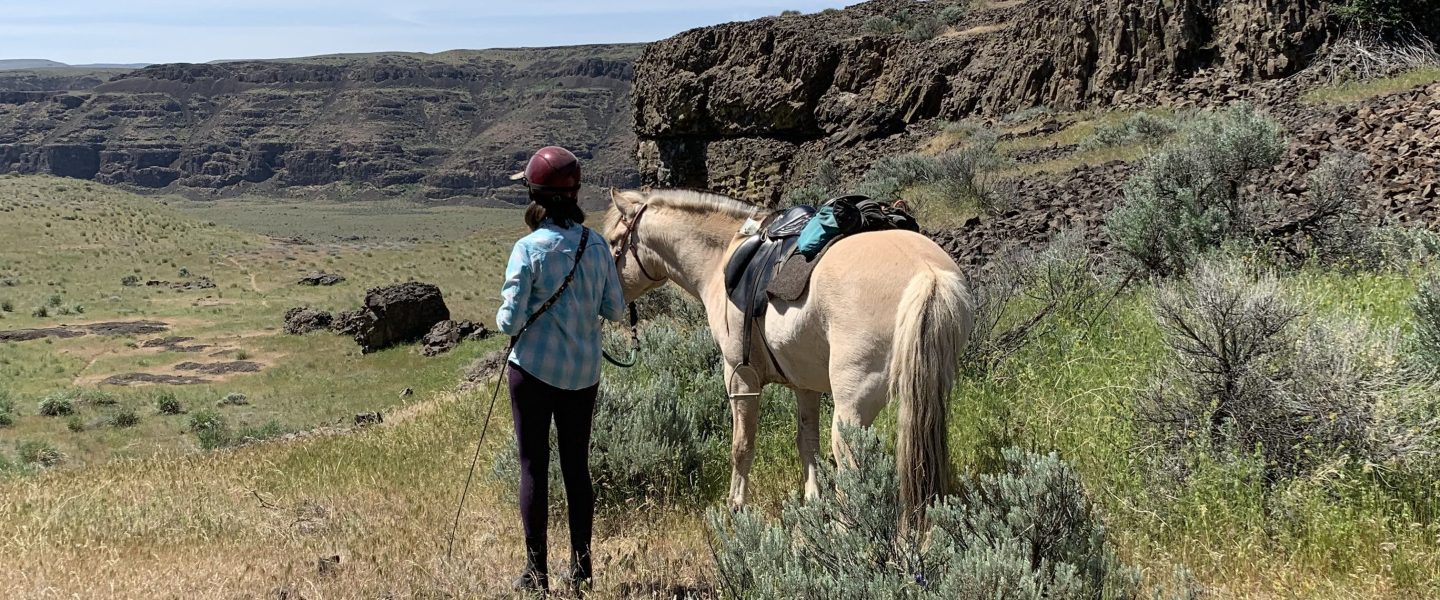
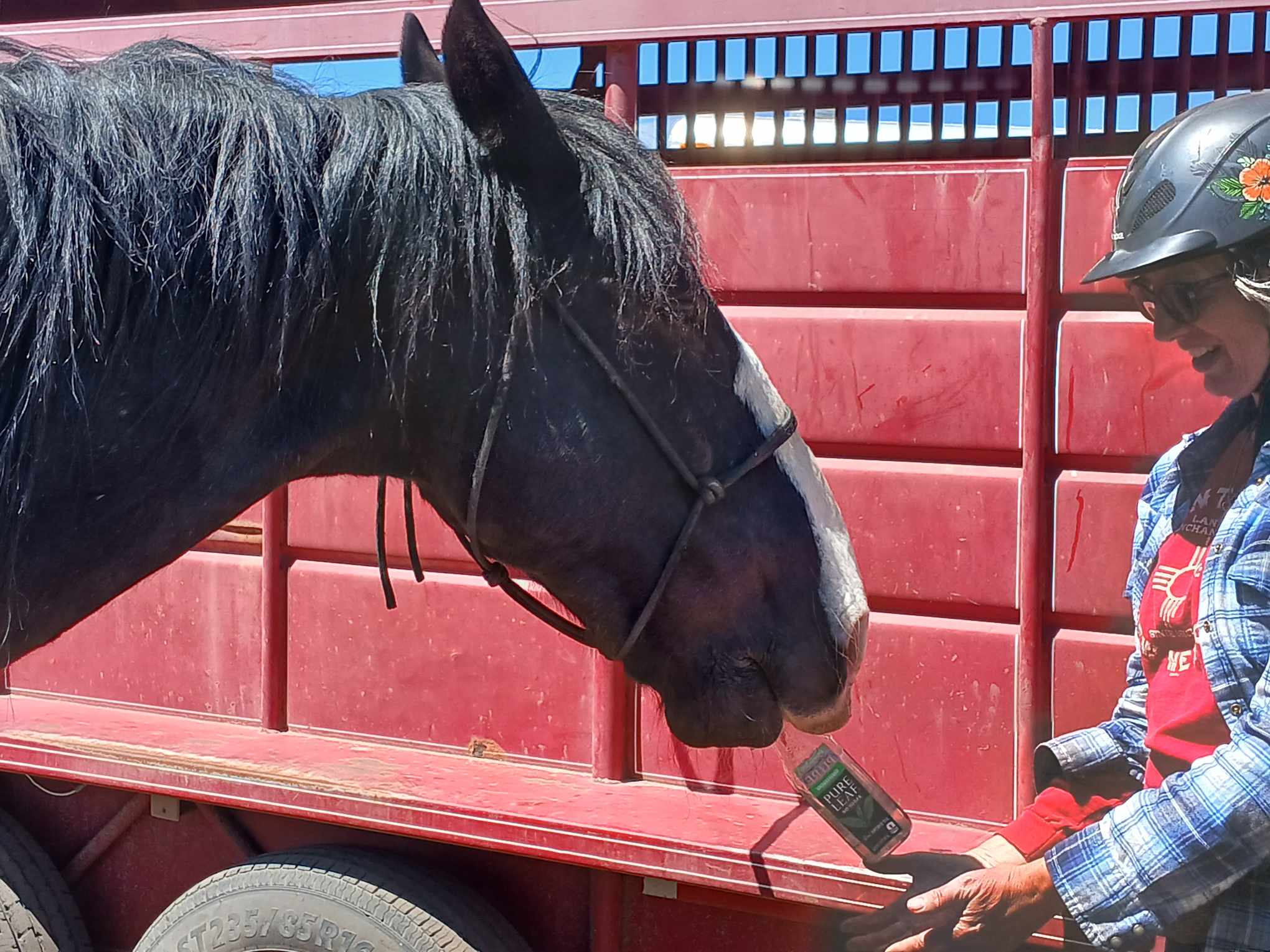
Katy hauled her two horses to the remote N-Bar Ranch in New Mexico, while Cindy and I rented outfitter horses, otherwise known as “dude horses”. My horse was Poncho, a giant black part-draft horse. He stood about 17 hands high. That’s huge, especially given that my horse at home is short, technically a large pony. Suddenly I was having to get on a horse whose withers (top of shoulder) was about eye level on me, instead of chest level. And I had to lift a heavy old-style Western saddle up even higher than that to saddle him. Though I had worked on fitness and strength over the winter, the saddle weight-lifting still tested my limits. At first it took two of us to get the saddle set in the right spot on his back, but by the fifth day of riding, I could do it without help.
Mounting that giant horse was a challenge, but there was always a mounting block, tree stump, or a rock around to give me some extra inches. Still, I had to lift my leg much higher than normal to reach the stirrup, and a loud grunt was required to make that final stretch to swing up, over and into the saddle. But the view from that height was amazing!
Dismounting, on the other hand, was even more challenging than mounting, in part because I kept inadvertently putting Poncho in a slight downhill spot, so that I was making him even taller. If I stepped down with my left foot still in the stirrup, Western style, my leg got a bit torqued and my foot would get stuck sideways in the stirrup, a very vulnerable position. As I pushed the stirrup off my foot with my hand, I could hear every trainer I ever knew yelling, “Danger, Danger, get your foot out!!” So instead, I started dismounting English style, where you step your right leg over the horse, pause while hanging sideways on the saddle, kick your left foot out of the stirrup, then slide or hop down gracefully. But on that mountain of a horse, there was no grace. It was like shinnying backwards off a cliff, when you don’t know how far away the ground is, and you hope you can find enough tree branches and roots to hang onto as you go down to prevent an out-of-control slide to the bottom. I slid down slowly while holding the saddle, until my stretched toes finally, after what seemed like minutes, touched the ground. Poncho always stood nicely as I figured out how to climb down without getting tangled up, and without falling on my butt. I suspect he was laughing at my strange gymnastics. I figure it all counted as another kind of strength training.
A friend at home has been teaching me how to do body work on horses, where you move your fingers lightly along the horse’s body, then hold, waiting for a relaxation response by the horse. Each day in the paddock I would practice a little on Poncho, along his neck one day, shoulder one day, spine or hips another day. He reacted subtly, wiggling his lips or dropping his head. On the last day I worked more around his barrel and girth area and especially focused on some white scars caused by misfitting saddles over the years. He suddenly pawed dramatically with his giant front hooves—I jumped way back, not expecting that, and watched as he stretched down low, grunting, and bowing with his head down between his legs like a circus horse. In my limited experience I had never seen such a dramatic reaction, such a big release. I smiled at him and walked away. My job there was done.
We had no wifi or cell signal at the ranch, so I was in withdrawal from my cell phone addiction. Without that constant stimulus, my brain went down different paths. On one trail ride on a very windy day Poncho and I were happily riding along at the end of the line of horses. The wind was screaming—all you could hear was wind rushing past your ears. I started singing. I am not a singer, by any stretch of the word, yet I was dredging lyrics out of my memory. First singing softly, then belting the songs out: Joy to the World, Delta Dawn, Country Roads, Bohemian Rhapsody… the riders ahead of me couldn’t hear, or could barely hear, due to the wind. I swear Poncho loved it. Or maybe he loved that I relaxed up there, singing in a windstorm, in rhythm with his stride. He walked calmly along, even though we were a fair bit away from the other horses. I think that because I had no phone to distract me, my brain started searching the depths of memories, and landed on songs that I used to know. Another hint to step away from our phones and computers for a time.
On the last day of riding, we had a short group ride and then the guide and I rode off on our own, straight up a hill and along a ridge. On the top we rode through pinyon pine and alligator juniper and as we circled further along the U-shaped ridge we saw live oak. We eventually came to a giant, gorgeous, beautiful old-growth alligator juniper. Right next to it was an ancient large gnarled live oak. We were in the grove of the grandmother trees. We named the area Alligator Ridge.
We dismounted and took a break at the grandmother grove. I had a drink of water from my water bottle, a reused plastic iced-tea bottle, and Poncho was very interested, bumping the bottle with his nose. I poured some water in my hand, but he indicated I wasn’t doing it right. I poured some into his lips. Still not right. Then he grabbed the neck of the bottle in his teeth, but at that point the bottle was empty.
When we got back to the ranch, I filled the water bottle again. I tried to pour it in his mouth; instead, he again took hold of the bottle with his teeth, tossing his head and chewing on the neck. He looked disappointed. I am certain he expected beer. Note to self: always pack extra beer for the horses.
Spokane Public Radio has a wonderful program for local poets to read their own and other’s poems each weekday morning. During the Get Lit Festival, they invited poets to read a single poem at the Central Library sound studio. Here is a link to the poem I read: “Mac pipes in the Storm”. Enjoy!
We’ve been without chickens for a couple years. Our last batch of older established chickens were slowly being picked off by something… an owl, a hawk, or maybe a prowling mammal. These were free range chickens, they had their own field, and we often forgot to close the hutch door at night. I don’t really begrudge the predators, they need to eat, too. When we got down to three chickens, I gave them to a friend.
We might have gone a long time without chickens, or forever, except for the price of eggs. And the potential for government or bird flu chaos. I know that home grown eggs are never cheaper than store bought eggs, even when eggs cost a lot. Partly because you must feed chickens for six to nine months before they start laying eggs. And you know that saying about cheap insignificant things being “chicken feed?” A bag of feed from the farm store actually costs a pretty penny. Plus there are other expensive inputs, like houses and chicken wire and feeders and grit and so on. Still, having some productive animals on the hobby farm seemed like a good idea this year.
Turns out, everyone else in Spokane county thought it was a good idea to get chickens this spring, too. Maybe there were fewer chicks available due to bird flu, or maybe everyone was naively hopeful that eggs would be cheaper if you grew them yourself. But when the chicks arrived at the feedstores, there were long lines, and they sold out quickly.
Plus, I’m a chicken snob. There are only a few breeds that I like. They must be calm, broody, and self-sufficient foragers. I don’t care what color eggs they lay, but I might want them to hatch some eggs in the future. A lot of chicken breeds are not broody (they don’t like to sit on nests or be good mothers). Of the chickens that I could find locally, the Speckled Sussex sounded like a good breed. A few weeks ago we got to the feedstore early on delivery day and finally managed to buy four very expensive Speckled Sussex chicks. Then one died. Life with chickens often involves death.
Finally, I found mixed run banties. Mixed run means the color, sex, or traits are a crap shoot. I love banties. They are tough little chickens, varied in color, and super-broody (we once had a little banty hen that hid and then hatched a nest of 15 eggs). They forage and eat bugs and are just busy little resourceful chickens. I bought three banties: a gold one (Goldie), a black one (Blackie), and a mottled one (Checkers). Just to keep up, we decided we should name the Speckled Sussexes, too. They became Speck 1, Speck 2, and Speck 3. We can’t tell them apart.
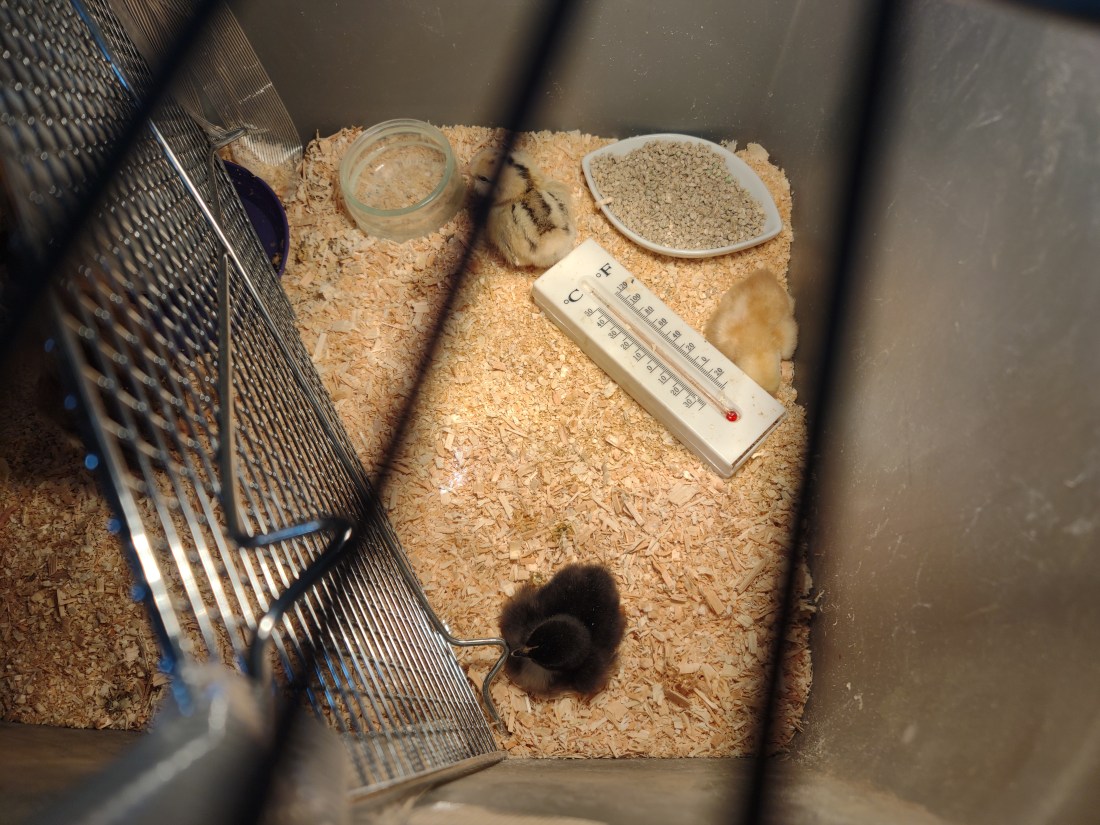
The older Specks were really kind of blah and boring. They simply ate and drank in the tub on our enclosed porch and napped under the heat lamp. They appeared kind of dumb. The banties, at a quarter of their size, were immediately scratching in the shavings and wandering around. They showed personality and cleverness. I divided the breeds at first, and Blackie was immediately pecking at the Specks through the wires. Blackie is probably a rooster.
After a few days I pulled out the divider in the rearing tub and wondered if the banties would be picked on by their larger cousins. Instead, the banties decided that their new roommates were perfect to run and hide underneath, between, or on top of. No space was too small for a banty to squeeze into. The chicks were going to be fine.
I’m looking forward to getting the chickies off the porch. They stink after a while. I have prepared the outdoor hutch, hung up a lamp, and added a run with a tarped roof. In this era of bird flu, it is recommended to keep wild birds and wild bird poop away from the domestic chickens. It will be a couple more weeks, though, before I can fully wean the little banties off the heat lamp. Then again, they are resourceful enough that they might just hunker underneath the Specks for warmth.
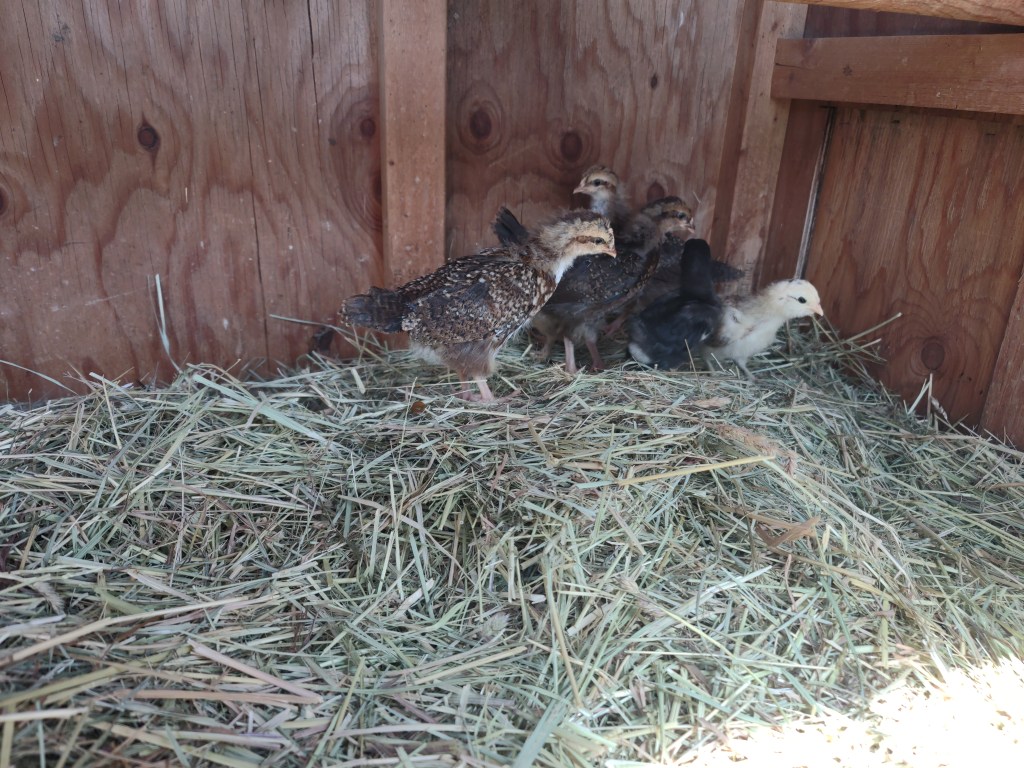
Speck 1, Speck 2, Speck 3, Blackie, Checkers, and Goldie (you can see her feet in the back) all enjoy their first moments in the chicken house. Or maybe they’re a little freaked out. But I’m enjoying their first moments in the chicken house…
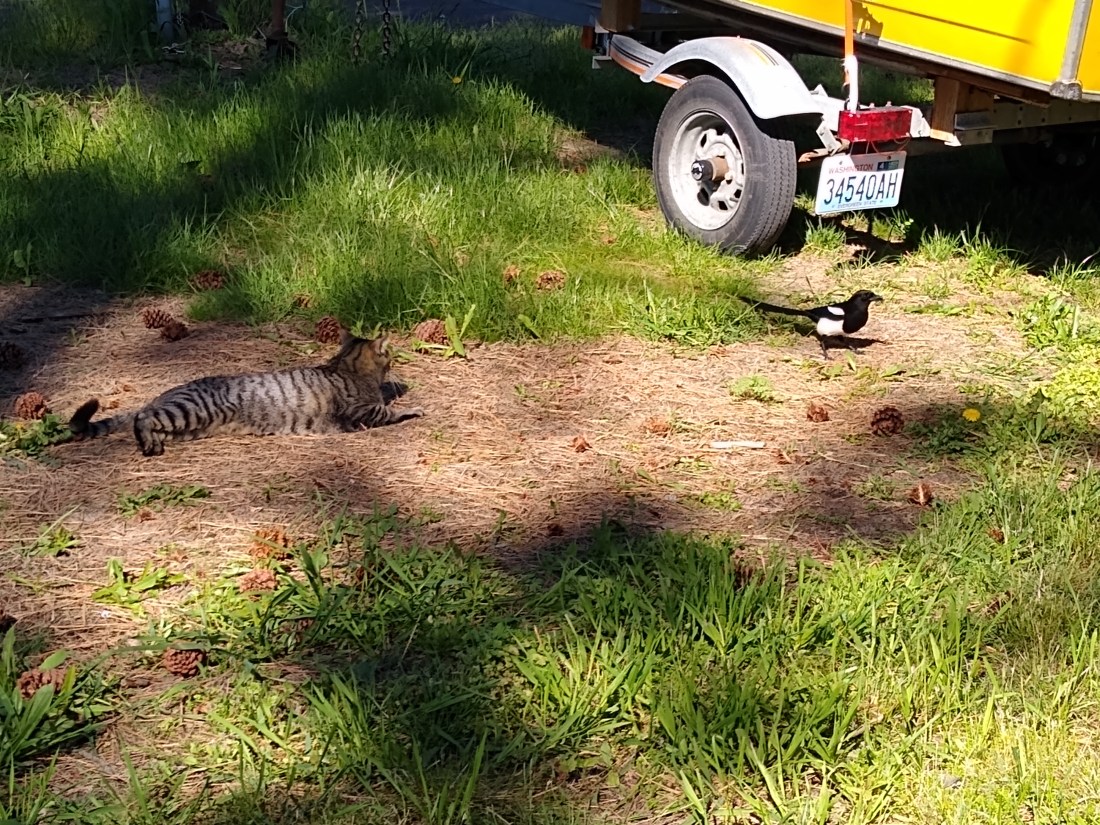
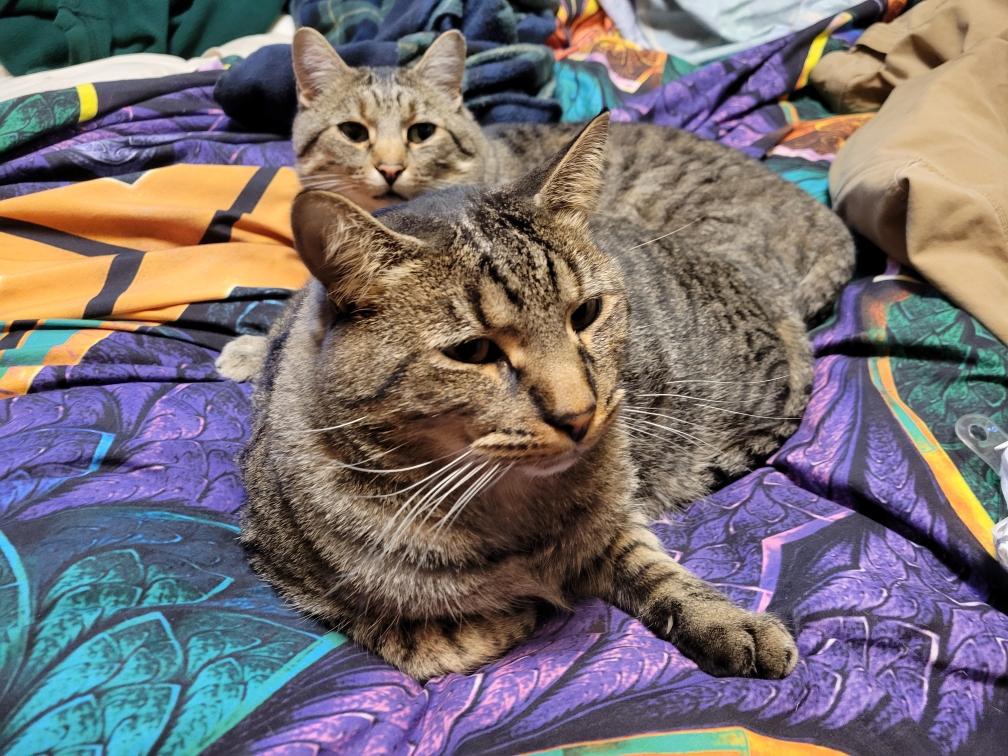
I’ve always been a dog person first, a horse person second, and only in recent years have I really begun to appreciate cats. We have had many barn cats over the years, all lovely and friendly animals. The goal of barn cats is to keep the mouse population down, but we still have many mice. Right now, we have two extra special cats: Purrcy and Squeaky. Both simply arrived in our barn. First Squeaky moved in, then a couple years later Purrcy showed up. They could be cousins based on appearance; they are very similar striped gray male tabbies. But in personality, they couldn’t be more different. Squeaky is shy, reserved, anxious about anything new or strange. Purrcy is bold, curious, fearless.
Although they started as barn cats, they both gradually morphed into indoor/outdoor cats and I have long considered making them into indoor-only cats. Indoor cats live longer, and they don’t eat wild birds. In the United States, outdoor cats kill about 2.4 billion birds every year (American Bird Conservancy). I really like birds, and Purrcy, in particular, is a skilled bird hunter. In addition, this year, we have worries of bird flu, carried by, you guessed it, birds. As best as anyone can tell with this new virus, if cats get bird flu, they die. Fast. And I like my kitties!
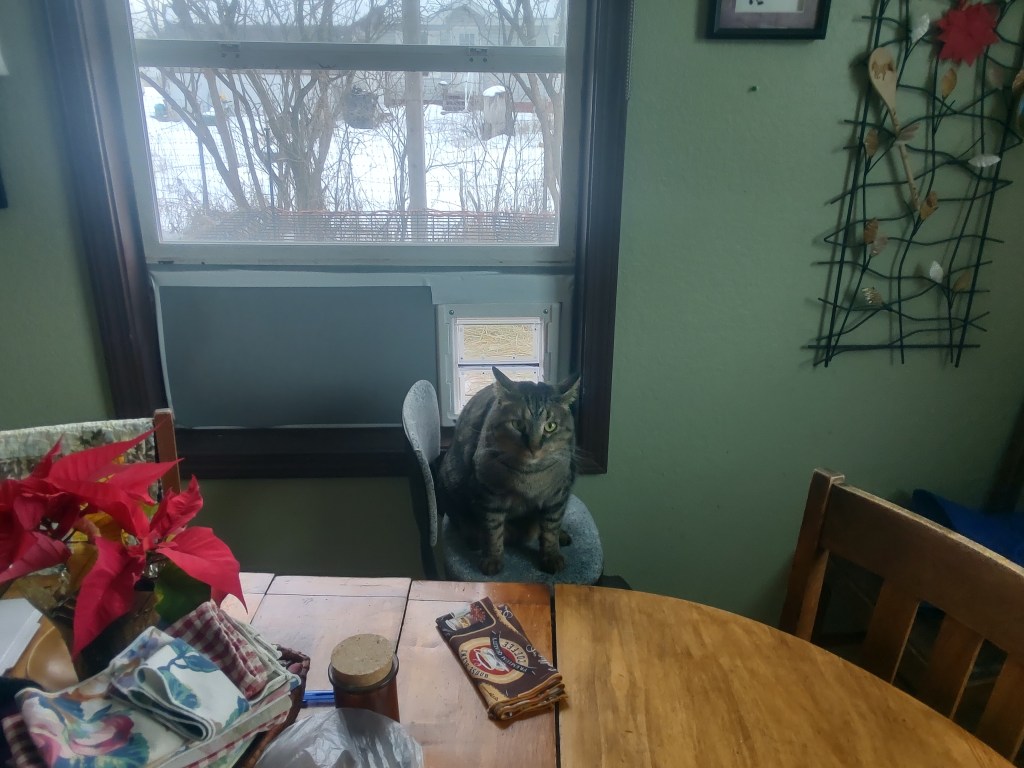
I’ve been planning the indoor transition all winter, and bird migration season is upon us. I knew it would be a rough transition for my cats, so I thought I would soften the transition by building a cat-patio (catio). This includes putting a cat door into a window, and then basically building a large cage outside. I ordered an insulated cat door and my mom and I started the project. My husband got to help with the sawing because I have a fear of cutting my fingers off with power tools, but other than that it is better for our marriage if we avoid construction projects together.
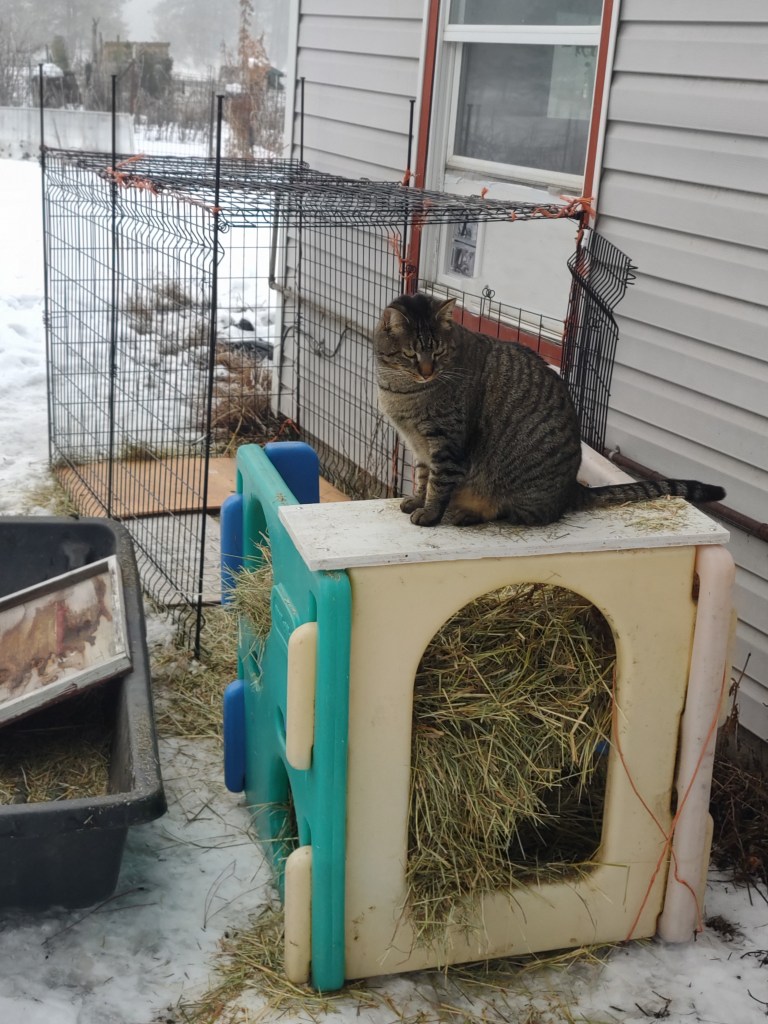
We cut the window plywood, painted it, attached the cat door, and added a layer of half-inch foam on the inside for insulation. Then we moved to the outside project. We built the cage out of yard fence panels and temporarily tied everything together with orange baling twine. In theory, if this catio experiment worked, we would eventually replace the garish twine with more subtle zip ties. In practice, we’ll see if I ever get around to it.
I repurposed a plastic yard kid toy under the window to make a bench for the kitties to step out onto from the cat door. Once everything was in place we were ready for the grand experiment to begin. My husband took off for a planned fishing weekend, and I was alone with the animals. Would the cats actually use the catio?
The first evening, after dinner, I introduced Purrcy, the bold cat, to the catio. I held the cat door open, put some yummy, canned cat food outside on the bench—he looked, hesitated, then walked out on his own. Soon he was coming in and out without help.
Later in the evening, it was Squeaky’s turn. I took him to the stool by the cat door, opened the door, put more yummy food outside—and Squeaky braced with his paws and claws spread wide, quickly becoming an immovable object. No way was he going outside, and I needed three hands just to hold him there. An hour later I tried it again, and I managed to push him out into the darkness. He ignored the food and started yowling, at one point climbing a fence panel like a monkey, looking for a way out. He dropped down and stayed in the corner close to the house, clearly upset.
Several times during the evening I opened the cat door and tried to coax Squeaky back in; no response. Purrcy also went in and out several times, seemingly checking on his buddy. Squeaky just hunkered outside, insulted, refusing to move. I wasn’t worried, there was warm hay in the catio and I knew he could survive the night, being a barn cat and all. Finally, before bed, I grabbed a flashlight and went out to visually check on Squeaky. I stepped out the back door onto our screen porch, and there was Squeaky, happy in his usual basket. How did he escape? He surely couldn’t fit between the fence panels. And cats don’t dig.
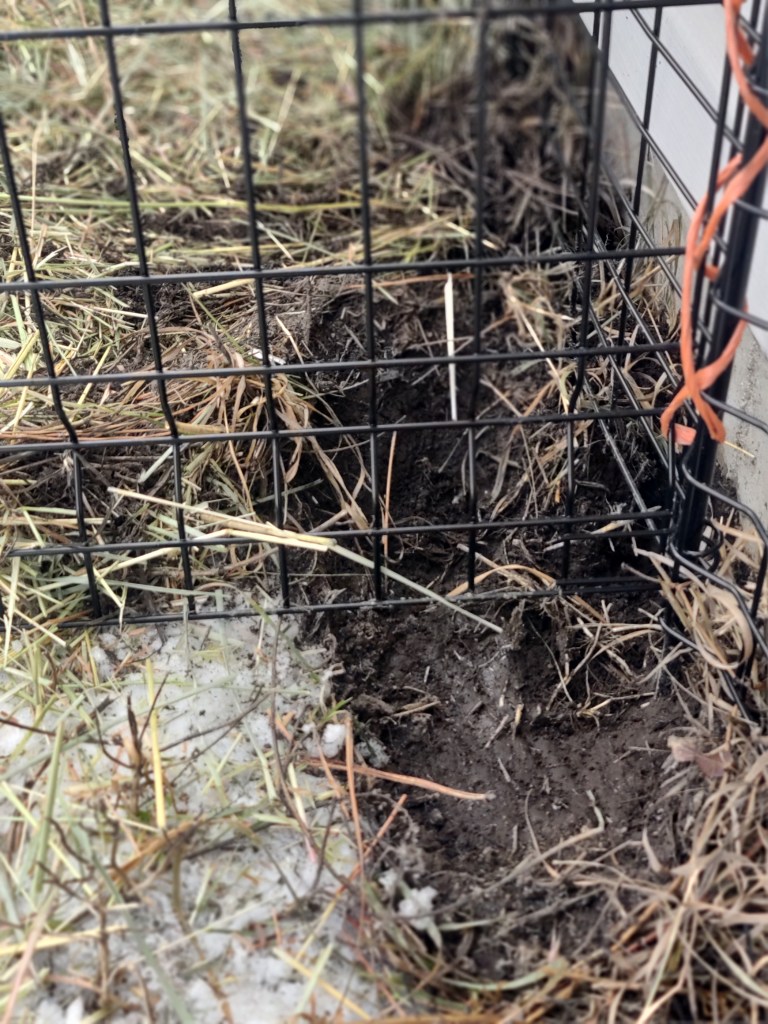
Turns out, Squeaky was a digger. He found the only thawed dirt close to the house and dug under the fence panels like a gopher. He was not staying in that repulsive cage. I was amazed and considered renaming him Sneaky.
That night, I put the plastic cover over the cat door to prevent cat escapes out through the newly dug tunnel and left the cats in the house all night. I expected a long and loud night. Typically, one or two cats will spend at least half the night on the bed, and then jump on me, or meow to be fed or to be let outside. At 2:30 Squeaky meowed to go out. Instead of letting him outside, I just pushed him out of my bedroom, shut the door, and figured he would quit meowing in a short time, then find a quiet spot to sleep. You may be wondering at this point how Squeaky got his name. He has a very strange, squeaky, non-melodic meow. And if you ignore his request for food, or to be let outside, he gets louder. The squeaky meow becomes a yowl, as if he is being tortured. The first yowl session lasted an hour before he finally quit. There were two more yowl sessions during the night, shorter, but plenty long enough to wake me up. One cat, probably Purrcy, decided it was time to get me up and stood at the bedroom door scratching and reaching his paws under, and somehow clunking the door, as if he were knocking. Between the yowls and the knocking, my dog and I barely slept.
Finally, morning came. I got up, started coffee, and let the cats go outside. I needed a mental break. I looked around the kitchen. The foam insulation on the window plywood was shredded, and bits of foam littered the floor. One cat wanted out that way last night, probably Purrcy, and was frustrated that I had locked the cat-door. Purrcy liked his catio.
My mom arrived and we went to work to fix the failings of the catio. First, we replaced the shredded foam. Then we put double-sided sticky tape all over a piece of poster board, and used that to cover the foam insulation. We thought this would prevent cat scratching, and it would also catch bugs, and possibly any humans that leaned against it.
Then we moved outside, discussed options, and decided to put a floor in the catio. We used scrap wood to make our floor, and used a large rock to close up the tunnel. During all of this activity, Purrcy kept going in and out of the cat door, checking on our work. He claimed that catio as his own. Once the fixes passed Purrcy’s inspection, we were ready for the next transition day.
Once again, I brought the cats in the house and was determined not to let them out. That night I left the cat door open and available for use and went to bed expecting to be awakened. Squeaky slept most of the night on my bed, with only a few meowing interludes that were short and moderate in tone. Purrcy wandered around the house, and in and out of the catio. The night went surprisingly well. My dog and I slept!
The next morning the cat door looked fine, and nothing was shredded. This was going great! By the next evening, Squeaky had figured out how to use the catio door on his own. Piece of cake! The experiment was working.
My husband returned home from his fishing trip, and I explained that the cats should now be permanent house cats. At the first sign of meowing to go outside, my soft-hearted husband wanted to let them out on the screen porch. The porch is enclosed, but it has a dog door. He blocked the dog door with the large dog food container and let Squeaky out. Squeaky figured out that the lightly loaded container could be moved aside. He was out and back in the barn quicker than we could say Sneaky Squeaky. I knew he would come back; his food was in the house. Eventually he did return, and we placed a heavier obstacle in front of the dog door. Squeaky spent time in his favorite basket on the porch, and he seemed happier.
Since then, our nights have been quieter, and we are more confident that our kitties will complete the transition to full-time indoor cats. They spend more time on our laps, and we find that they need some play time with us to expend some energy. We have toys spread throughout the house. Purrcy still wakes me up by jumping on me at some point before dawn, but when I push him out of the bedroom and shut the door, he finds something else to do. As I write this, I can hear the redwing black birds trilling outside and I see the California quail happily wandering in our yard, safe from our bird-eating cats. And hopefully our cats will be safe from bird flu.