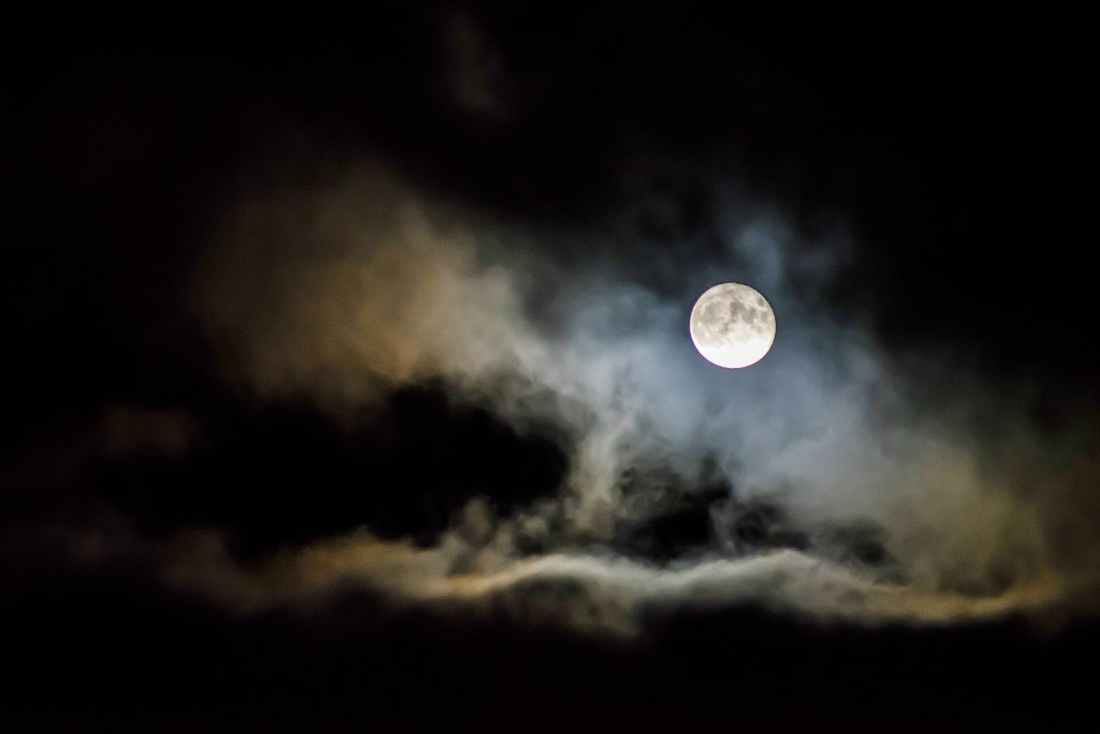
We will have a blue moon, the second moon in a calendar month, on August 30, 2023. This reminds me of a conversation with my son Mac, when he was very small. I love when kids are adamant about what they know. At least until they are teenagers, then its not quite as cute.
Blue Moon
“Mom, where’s the moon?”
“I don’t know.”
“Maybe there’s a blue moon.”
“Maybe, but it isn’t really blue.”
“Daddy said there was a blue moon.”
“I’m sure he did, but it just means there are two moons in one month.”
“When’s the moon blue?”
“I don’t know. We’ll have to look at a calendar. It isn’t really blue.”
“Then why is it called a blue moon?”
“I don’t know.”
“Maybe there’s a blue moon tonight.”
“‘Blue moon’ is a phrase; it means something that doesn’t happen often. We go to the mall once in a blue moon.”
“What color is the moon?”
“White, or yellow, or orange.”
“Daddy said there’s a blue moon. I’m going to ask him.”
“Okay. But it isn’t blue.”
“You’re wrong!”
“Maybe. That happens...once in a blue moon!”
[photo credit pexels.com]
The day before my mom and I left to visit my oldest son Mac in San Diego, I gave horse loading lessons to my husband Doug and my younger son. Luckily, my horses load easily. The trailer and truck were ready to evacuate if needed, my husband was trained up, and I could leave the house and animals in good hands. It was dryer than dry out there; Spokane was hot and crispy. All it needed was a spark, and high winds were predicted.
The Thursday morning that we left for San Diego, Doug checked the weather, and saw there was a hurricane warning for southern California and Baja. High winds were predicted. We flew out anyway.
Upon arrival in San Diego, Mac said, “What hurricane?” He checked the weather and shrugged it off.
By Friday, the hurricane warnings were more worrisome, it was expected to hit Sunday. Meanwhile, wind-blown fires erupted around Spokane, friends and acquaintances were evacuating. Our house and neighborhood were fine, and still are fine, but we watched the evacuation areas grow throughout the day. I juggled my attention back and forth between San Diego storm warnings, and Spokane area fire updates. Still, we visited beaches and coastal towns, ate well, and saw beautiful scenery in cool lovely weather. We enjoyed the calm before the storm.
I know fires. I know evacuations. But I haven’t been through hurricane-worry before. I’m good at worrying. Soon Hurricane Hilary was downgraded to a tropical storm. We visited another coastal town, an oyster farm, and a botanical garden. We watched ocean waves and tasted local beers. We vacationed and enjoyed the sights when we weren’t watching the weather news. They predicted flash floods, dangerous winds, and overwhelming downpours once the storm arrives.
Two large fires consumed thousands of acres in Spokane County. One was eight miles south of our house, and another 20 miles northeast. Then we heard about the numbers of houses lost in the fires back home. Hundreds. I felt the pull of Spokane, and a deep sadness for the folks evacuated, and all the homes lost. I have evacuated for nearby fires before, but our property has never burned. Yet. The wind either blows the fire toward you, or away. Like a flip of a coin. We listened to reports of smoke so thick it closed Interstate 90. Air quality levels were off the charts.
In San Diego, the air was clear. The tropical storm hit Sunday. Mac and his girlfriend Shayla still weren’t worried, they’d experienced inches of rain in the area before. The storm gradually got stronger during the day, but we still went out, explored, walked, shopped, ate lunch, and planned dinner at their apartment. Going outside was like walking into a lukewarm shower. When Mac and I walked the dog mid-afternoon, we started out in a steady shower, that quickly became a deluge. My light raincoat, the cute city coat with the pink lining, did not repel the rain. That raincoat shall forever more be known as the rain sponge. Our clothes soaked completely through. Little rivers of rain ran off our heads, down our hair, onto our eyelashes, into our eyes, and down to add to the ankle-deep water running along the road curbs, rushing for the storm drains. The wind was still mild.
As we ate dinner that night, the rain intensified, and finally the predicted wind added a sideways slant to the drops. It started to really look like a tropical storm, tree branches swinging in the night. The winds got higher, but never felt dangerous. It turns out our San Diego family was right. By Monday morning, all was fine. The highways were open. The airport was open. We could check in to our evening flight. Other areas of the state had flooding and washouts, but we only had a few branches down, with lots of leaves and bark littering the roads. We watched the weather and saw the predicted path of Tropical Storm Hilary: North and up to the edge of eastern Washington. Up to Spokane. Go Hilary!
The morning after our return flight, the remains of the tropical storm hit Spokane. It rained hard for hours, knocking down the smoke, quenching the hot spots, and giving the firefighters a break. One day of reprieve, before the weather dried out again. This time, this week, this year, we survived a tropical storm and raging wildfires. I feel like it was only luck, it could have been us hit hard by a hurricane, or our house burnt in a fire, instead of others. It all depends on the luck of the draw, and the whim of the wind.
After the chipmunks moved in, the sunflowers bloomed. I’ve planted sunflowers before and gotten a few short wimpy individuals. Now and then I would get a tall plant that would blow over in our summer winds. Being unsuccessful in growing them, we bought bags of sunflower seeds and thistle seeds to feed the birds. We had the pleasure of admiring the yellow flashes of the goldfinches and other seed lovers. We even had downy woodpeckers taking sunflower seeds out of the feeder, placing them in a crack in a fencepost, then pounding them open to get to the rich seed. Avian tool users.
Then chipmunks moved into holes under our backyard pine tree roots. We watched their staccato movements as they explored, carefully approaching the seeds. At first, they picked up the seeds the birds would drop. Later we would lay out extra loose seeds on a stump for them to find. They filled their cheek pouches to bulging, and then hid the seeds for later. It turned out that they stashed and buried many of the seeds in the vegetable garden.
I’ve never been one to keep a neat and clean garden, and I let the volunteer chipmunk-planted sunflowers grow where they chose. We had a park of sunflowers here and there, and they grew tall. Some had large foot-wide single sunflowers. Other plants had multiple smaller hand-sized flowers. We watched as the yellow flowers followed the sun each day, turning from east to west. We watched bees and butterflies pollinate the flowers. As the seeds started to mature, we watched chipmunks climb up the tall stems to nibble on their personally planted sunflowers, as if they were farmers testing their crop. Goldfinches and other birds joined the all-you-can eat buffet.
We didn’t harvest the crop; we left them for the birds to forage on through the fall and winter. The sunflowers come back thick, year after year. This summer we have a jungle of sunflowers in a large patch. Bright yellow petals color my pleasantly messy garden. The sun worshipping flowers first give shade to the birds on our long hot days, later they feed the insects, birds, and chipmunks. The feeding animals drop seeds on the ground, planting next year’s crop. If I’m not careful they will soon outcompete the vegetables. I may let them.
A while ago I resurrected a collection of my poems from the deep recesses of my electronic files. It was a chapbook-sized collection (a small booklet) of poems about wildfires and wildland firefighters. I liked the poems. I had sent them out to several journals and contests over the years, including five poetry contests between 2011 and 2014. One poem from the collection was published, but no contests were won. I paused for a few years, but I really wanted to share those poems. In mid-2022, after yet another unsuccessful contest entry, I gave up and decided to just print the booklet on my home printer, bind them by sewing through the midline with one of my vintage sewing machines, and give them as gifts to family and friends. In preparation, I shared the final draft chapbook with my writers’ group one more time before proceeding with my plan.
My writers’ group people vehemently vetoed my plan. They thought the poems deserved to be formally published, not printed at home. They insisted. I frowned. They insisted some more. I sighed at the idea of a lot more work to find a publisher, but finally agreed with my friends. What’s another year or so in the slow process of getting my poems out there…
I researched more contests and started sending the poems out again. Contests aren’t free; many charge a reading fee. That’s okay, because I have an official writing business now, and can claim the entry fees as losses. I was not optimistic as I sent each contest entry out. A writing teacher long ago said you hardly ever win contests, especially when they offer prize money. Nonetheless, I was determined to give it another try. I would do it for my writers’ group, to honor my support system. Then, when it didn’t work, I would home-print my collection after all and give them away as Christmas presents to family, friends, and my writers’ group.
Guess what happened? Eleven entries and submissions later, I have a publisher. It wasn’t a contest, just a submission to a press that prints poetry books. Ravenna Press in Edmonds, Washington, will be publishing my chapbook, Fire Triangle, in a volume with two other authors’ chapbooks. It will be part of their “Triple Series” and should be published in the Fall of 2023. Learn more about Ravenna Press and the Triple Series here: http://ravennapress.com/books/series/triple-series/.
I’ll share more details later, as I learn more, and as the publishing date gets closer.
In the meantime, thanks to the members of my writers’ group that pushed and prodded and insisted I get off my rear-end and send those poems out again. I am thrilled that my collection of fire poems was selected for publishing, and I’m doubly thrilled that it will be published by a Washington press. The fire poems are set in the Northwest, and it is fitting that the publisher is also in the Northwest.
Of course, I didn’t win any money. I’m pretty sure I won’t get rich writing poetry, essays, and blogs, but I am truly enjoying this writing and publishing adventure. First a humorous memoir published, now a poetry chapbook on the way… and then what next???
I will be interviewed about my book, Riding Lessons, Things I learned While Horsing Around, on Friday, August 4, 2023, at 1 pm. I will be on the Page Turner Show at our local community radio station, KYRS. Wish me luck! I’m already nervous.
About the show: The Page Turner Show focuses on reading, writing and the love of the written word. Every week the host, Annie McKinlay, interviews regional authors about their works and their lives. Other guests may include talks with the local librarians, book store owners and teachers and college instructors in literary studies.
You can listen locally on FM 88.1 or 92.3, or stream it through the website. The show will be archived, so you can catch it at a later date, too.
Flies and horses go together like champagne and bubbles; you can’t have one without the other. Sometimes the flies are a minor nuisance, and sometimes they come in hordes, cause eye infections, or bite chunks out of the horse’s haunch. Fly spray can protect the horse, for a while, anyhow. Some horses will stand nicely for application from a spray-bottle; other horses are quite certain the sound and sight of the spray bottle is death itself coming to get them and will not stand quietly. And by not stand, I mean, rear, bolt, kick, spin and all other physically possible movements.
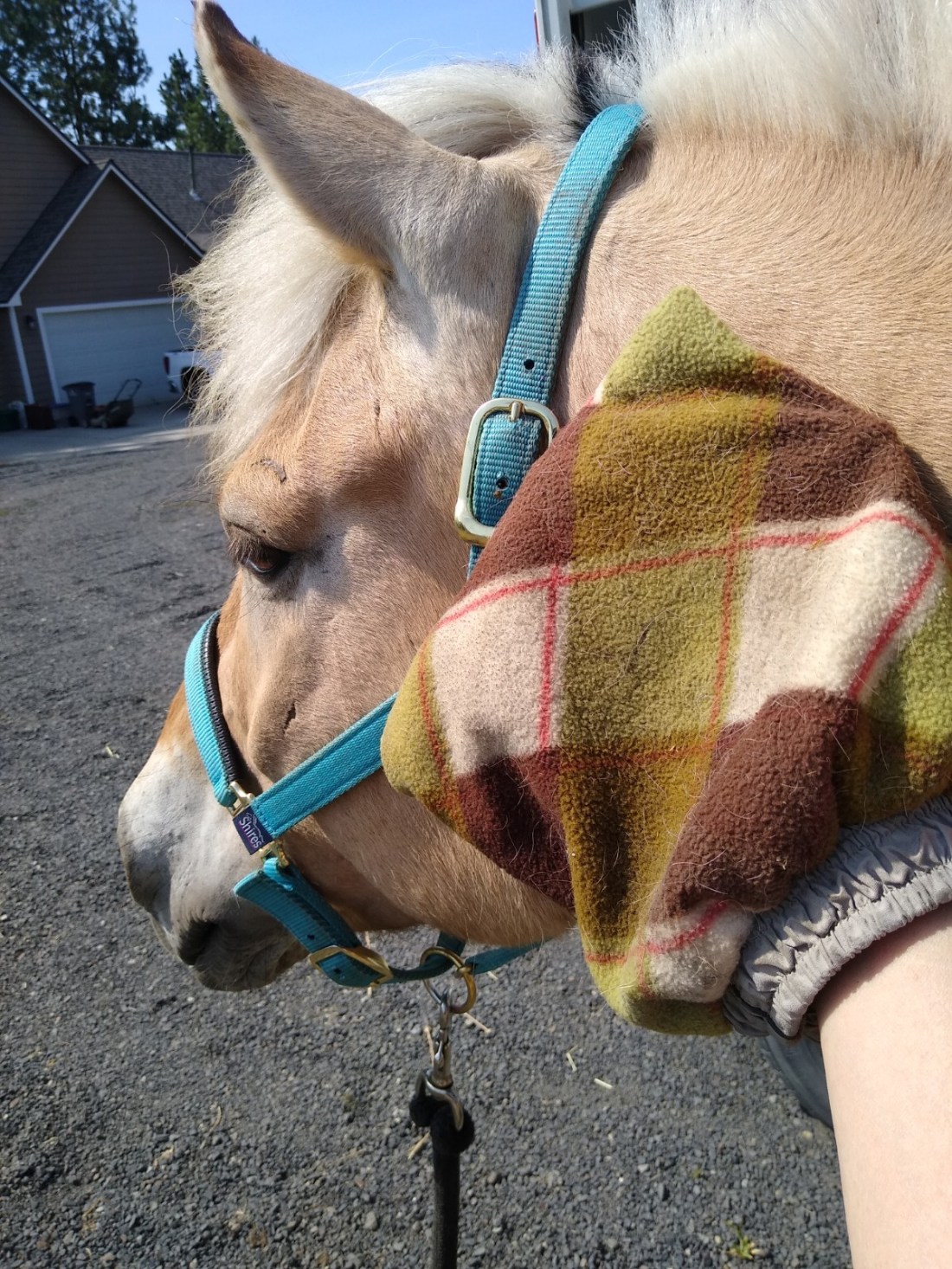
For those reactive horses, or for the areas around the face where you can’t spray easily, there are fuzzy fleece mitts lined with plastic, to apply the repellent by hand. These cost between 4 and 17 dollars. They eventually get grossly dirty from the oily spray and the dusty horse, or they wear out. Or, if you are like me, you lose them somewhere in a dark corner of the tack room or horse trailer.
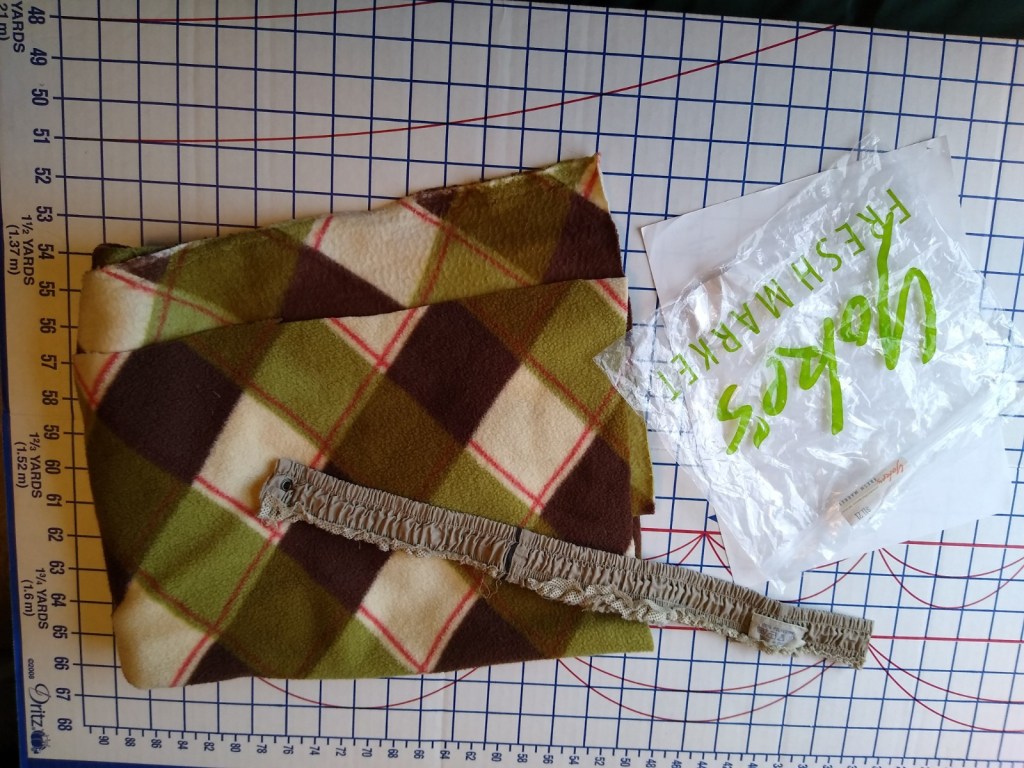
A friend and I were discussing how to make fly mitts for free. All you need is: 1) A sewing machine (preferably a vintage machine because they are the coolest); 2) a sturdy medium-sized plastic bag (preferably washed out and re-used) that is wide enough to spread your hand out in, and deep enough to reach over your wrist; 3) a scrap piece of gathered waistband from a worn out clothing item, or a piece of elastic; and, 4) a piece of scrap fleece, or an old towel, large enough to make a cover over the plastic bag. That’s it.
To make the applicator mitt, fold the material, and using the fold as one side, cut out the material about ¼ inch larger than the plastic bag on all sides (don’t cut through the fold). Determine which side is the bottom of your mitt. Sew the old stretch waistband to the bottom of the material, pulling and stretching the band out as you sew, so that it will be gathered and narrower than the top when finished. Then sew up the remaining side and top seams. I used a narrow zig zag stitch, to allow a tiny bit of stretch to the seam.
If you are using elastic instead of re-using a waistband, make the bottom side of your cover material about 1.5 inches longer. Sew top and side seams of cover first, then fold up a casing for your elastic, at least ¼ inch wider than the elastic. Sew along the edge of this folded hem, leaving about a 1-inch gap in the seam. Measure out the length of elastic to fit comfortably over your wrist. Use a large safety pin to thread the elastic through the casing. Sew elastic ends together. You can then sew together the one-inch gap in the seam, or if you are lazy like me, just leave it open. It won’t be obvious from the outside.
Once the fleece cover is done, simply push the sturdy plastic bag inside. If some of the plastic bag is hanging out, that’s even better because it protects your skin from the spray. You may want to add a safety pin or two to affix the bag to the fleece. Take it outside, apply the spray to the mitt, and rub the spray on the horse. Once the mitt has the oily spray on it, you can store it in a larger gallon size Ziploc bag—washed out and re-used, of course.
So, now it’s done. You can do it, too. If at the end you look at the mitt and think, “Is it not beautiful?” As in, it looks a little funky and your seams are crooked, don’t worry. My second mitt, in particular, has some imperfections. That’s because I thought I needed pull my other vintage machine out for some exercise, and for some reason, the zigs were not zagging consistently. But no one will notice once I turn it right-side out. And the horses are not perfectionists about zig zags, they just want the flies to go away.
The cover should be washable (though maybe outside in a bucket, since fly spray is usually strongly scented), and the internal plastic bag can be replaced if it wears out.
Reduce. Reuse. Re-apply the repellent as needed.
Of course, I needed to test my two prototypes. I gave one to my horsey friend Levi and asked him to review the product. He gave it a “two hooves-up” and stated, “Anything that keeps my human from spraying that icky fly spray directly into my face is a good thing.”
I queried my own horse, Vali, about his thoughts on the mitt. While he thought it was effective for application of fly spray, he recommended not using crinkly plastic for the inside lining. When he hears plastic crinkling, he thinks it is a granola bar wrapper being undone, and it should be shared with him. He was disappointed to discover that the fly mitt did not come with a treat. Therefore, he rated it only one head-toss.
Regarding my own thoughts on the mitt, I thought my bag should be longer, or it should be safety pinned to the edge of the mitt. The inner bag keeps squishing up inside. So far I’m living with that problem, because I have not managed to remember to bring two safety pins out to the horse trailer where the mitt is currently living. Knowing my memory skills, it may never happen.
Nonetheless, despite the criticisms, the fly mitts are working fine. On my last mountain ride, I had 20 mosquito bites on my lower leg, and no obvious bites on my horse. I should have applied the spray to myself. Or maybe worn armor. Hmmm. I wonder what I can upcycle into mosquito armor?
At our house we play seasonal games with ourselves. I’m not talking scrabble, or monopoly, or even poker. This is the game of “How long can we go?” In the fall, it’s “How long can we go without turning on the heat?” A few days ago, we lost the game of “How long can we go without putting the air conditioners in the windows?” This year it was July 7 for downstairs, and July 8 for upstairs. I think that was later than last year. It would be interesting to look at trends over time… but did I write those dates down? No.
Our house, a boring rectangular two-story 80’s house, does moderately well in the heat. Especially downstairs. The house is built on a cement slab that helps hold the coolness for a while. When it starts getting hot, we manage the heat by closing-up the house during the day, and opening windows and doors at night. We especially open every upstairs window since leaving downstairs windows open overnight doesn’t quite feel safe. Then, in the morning, we shut windows, shut curtains on the sunny side of the house, and hope the house stays cool. But there is a limit to this passive cooling system. (Is it really passive cooling if I am running up and down the stairs opening and closing windows and curtains and strategically deploying fans? That feels like active cooling to me.)
But after about three days of 90-degrees or above weather, we need the air conditioners. Since we don’t have a central heating or cooling system in this house, we use those heavy, awkward, ugly, window air-conditioners. One in the kitchen/dining room downstairs. One in the office upstairs. We used to suffer gamely with the heat upstairs, using only the window opening/closing method, until COVID forced some serious teleworking on my part. I definitely needed cooling in the upstairs office. So the old air conditioner moved upstairs, and we bought a new quiet one for downstairs. The quiet one is lovely. The noisy one is functional.
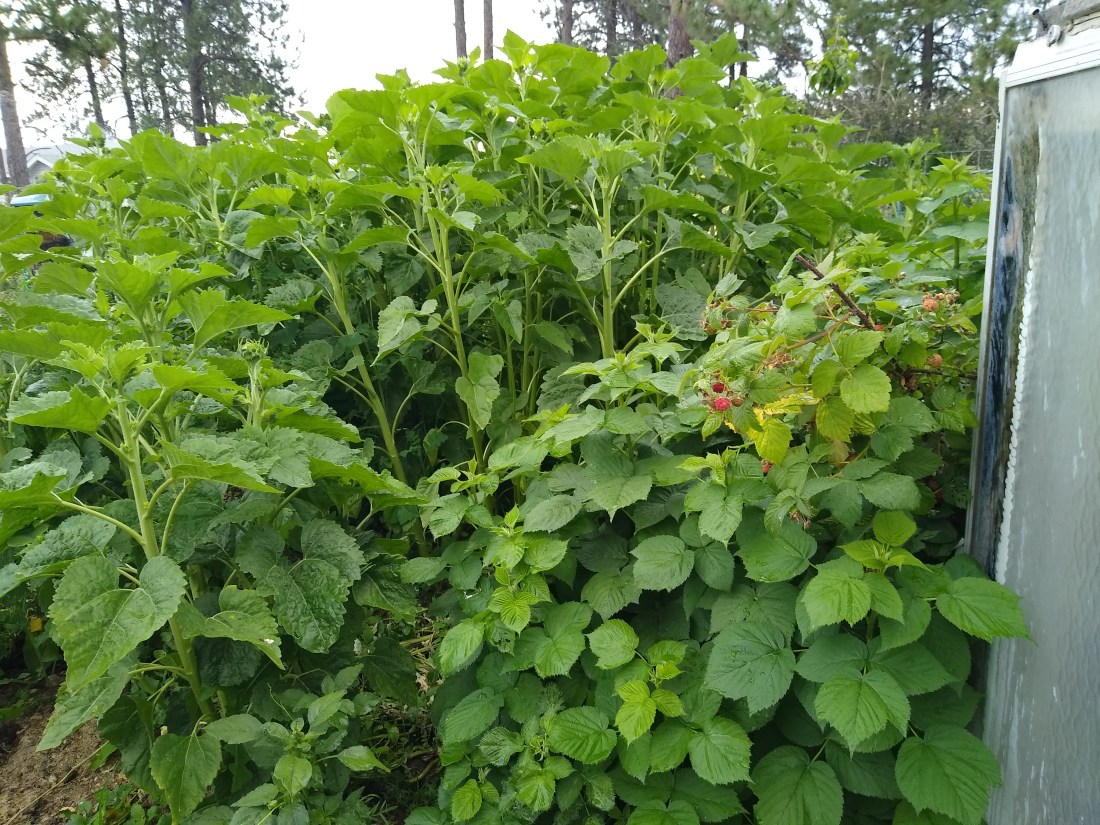
We also play the “How long can we go?” game with watering lawns and gardens. That explains why newly transplanted trees often don’t do very well in my yard. Only the fittest survive. Last year I finally installed a drip irrigation system that reaches some of the perennials and bushes and trees in and around the garden area. Did you know that raspberries and volunteer sunflowers try to take over the world when they get adequate water? I didn’t know this. Now I do.
We bought a couple of apple trees this spring and set up a sprinkler system near them. We really want them to grow, rather than die, given that they produce more fruit when they are alive. Now that area is getting lots of water. But the rest of the yard? We’re kind of hoping some of it goes dormant. This spring the weather was perfect for growing grass, resulting in the need for near-constant grass mowing. We do try to keep the yard immediately around the house green, but further out our goal is simply to keep the grass short. We even mow part of the pasture because the fjord horses don’t eat it fast enough. They tell me they are willing to try to eat everything down, but then they would turn into marshmallows with pony legs. I wish I could let them graze the pasture hard, since we are in a wildfire prone area. Now that the grass is drying in the heat, the horses can graze more, but still not as much as they wish.
With the significant warm-up this week, we begin the flip flop season. And I don’t mean the plastic shoes. I mean the flip-flopping of chore time and outside recreation time to the morning; and indoor computer, TV, writing, or craft time in the afternoon. I don’t like this schedule as much; I prefer to do writing and computer work first, and outside activities later in the day. I am trying to adjust. The horses are adjusting well to their longer grazing in the morning, then spending their afternoons in the shade of their stalls. They do spend a lot of time staring out at the pasture longingly, or staring at the kitchen windows, mentally urging us to come out and feed them again. I understand. In this heat I wish someone would bring me ice cream every hour of every day.
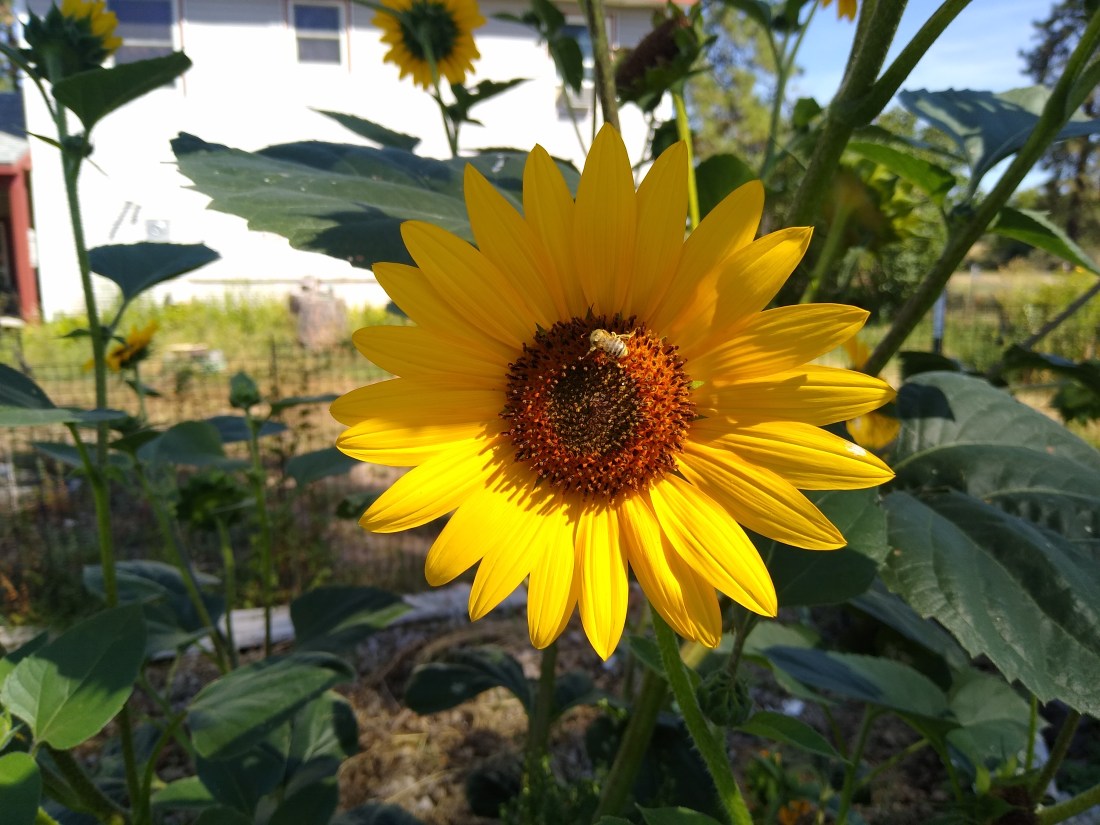
[I tried to get a good photo of the air conditioners, but they were just too darn ugly. Instead, I included a picture of the well-watered sunflowers and raspberries that are discussing how to take over Spokane, as a first step on their path to world domination.]
You can’t go wrong with peanut butter. Okay, maybe you can go wrong– peanut butter whisky and peanut butter beer sound disgusting. Other than that, though, all peanut butter foods are delicious: peanut butter granola bars, peanut butter cups, peanut butter brownies, peanut butter no-bake cookies… the deliciousness never ends.
But peanut butter in savory foods? Yes. Something changes when you cook it, it becomes more like a rich spicy gravy. The other night we had peanut butter noodles. You can use Asian rice noodles, or whole wheat noodles, or other non-gluten noodles. We added broccoli and snow peas to ours. Peanut butter sauce on noodles is good warm or cold. There are lots of recipes out there in internet land, just look for a simple one. Here’s a hint, though—add more peanut butter than the recipe asks for.
When I have been on various healthy diet kicks, for example when I was avoiding dairy to decrease sinus problems (it did help), the peanut butter noodles became a comfort food. Like macaroni and cheese without any cheese. It has a similar mouth feel. In an Asian restaurant, I will often order Chicken Satay, and not for the chicken. The chicken is just a carrier for the peanut sauce. I should probably just order the sauce on the side and request a spoon.
But my real comfort food, although one that I rarely make, is Domoda. This is from my Peace Corps time in the Gambia, West Africa. It is the best meal, a spicy peanut butter gravy over rice. With or without meat or chicken. It was definitely one of my favorite Gambian foods. The recipe is very similar to the Asian peanut sauces, but it is made in larger quantities. This is not an appetizer; it is definitely a main dish.
I have a scribbled-on worn out and well-loved paper recipe that I kept from our Peace Corps newsletter. I use it as a guideline, and I have a couple African cookbooks to compare recipes. The classic recipe is very spicy, I often add scotch bonnet peppers. Sometimes too many… my tolerance for hot peppers is not what it once was.
In the Gambia, we would eat this in a large flat bowl, eating with our hands, several people sitting around and sharing the same bowl. Sometimes we would use a spoon. We’ve served it this way with various family and friends over the years. Once when my aunts were visiting, we added the dimension of butchering an old chicken, and making chicken Domoda. It was so tough we couldn’t chew it. But the sauce was good. I don’t think even my immediate family would go for the communal bowl in this era of covid. Now we serve out individual dishes. With spoons.
I found a good-looking recipe online. I haven’t tried this one, but it looks like the real thing with all the right ingredients. Except they don’t mention a home-butchered chicken. https://www.daringgourmet.com/domoda-gambian-peanut-stew/
If you decide to try this recipe, use old-fashioned peanut butter, the kind without extra oils added, the kind where the natural oil separates off and you have to stir it in. Because that is how you know it’s done: the oils come to the top of the pan. The oil will be a pretty red color from the tomato paste. Also, add extra peanut butter.
I’m definitely craving Domoda now, but my chickens are looking at me nervously.
I haven’t been writing much. The spring weather has been calling me outside with gardening, weeding, watering, and of course trail riding. My writing has suffered. But I watched for a window on my calendar and saw a mostly-free Wednesday and Thursday. My husband planned to be out of town golfing, and the weather was going to be too hot for riding. I would make my own writer’s retreat.
Writers’ retreats are usually group affairs in exotic, or at least fun, locales. Writers come together, write in their hotel rooms or quiet common places, and maybe share readings of their work. There might be facilitated writing exercises. My writers’ group has tried this by meeting up at a member’s cabin on the river, but we ended up just chatting, eating good food, and drinking wine. We decided that for actual writing, we were better off alone.
I hadn’t really done this before, setting aside a large block of time to prioritize my creative process. I tend to write in the mornings, but it’s haphazard, and often comes second to other things on my “to-do” list. I usually write regularly, but my task list has been long lately, with travel planning, or house maintenance planning, or working on the business and marketing side of writing. I really needed a block of several hours to focus on the creative part of writing. I knew what I would work on, a couple of early draft blog posts (like this one!), and a collection of poems and essays about living in Washington that I’ve started to pull together. I had projects ready, but I thought my personal writer’s retreat needed something more.
Like good food. So I made some rhubarb oat bars the night before. My retreat also needed some good drinks- we have a very large selection of teas, so that was covered. We also have alcohol, but that was not desirable in the morning during my planned work hours. Maybe if it was an evening retreat, and my writers’ group was around… oh wait, we already determined that doesn’t work.
Then there were the other ever-present distractions that I had to remove. I logged out of Facebook. I logged out of my emails. I moved my phone to another room, so I wasn’t tempted to check for messages too often. Off it went to the bathroom, where I could hear the message notifications (in case one of the roofing contractors called back) but I had to physically get up out of my chair to check them. That slowed down my urge to constantly look and see what I was missing out there in internet-land.
The morning of the retreat, I read a bit of a novel over breakfast to get in writing mode. I kept another book beside me, Cascadia, a collection of poems and essays about the Northwest. I planned to turn to that if my brain got stuck. Then it was just me, the keyboard, and my printed drafts of poems and essays. I love words, sentences, and playing around with lines and paragraphs. Once I get into a manuscript, I can focus for quite a while. Off I went into my retreat away from the world, into the words, for several hours. When I found myself thinking of other tasks that were calling my name, as I always do, I wrote them down on my ever-growing to-do list, then went right back to the writing.
I would have preferred it if my office was cleaner before I started, as a way to clear my mind, but that didn’t happen. It was tempting to use that cleaning task as a last minute procrastination, but I just left the piles of books and paper where they were, a comfortable clutter to shove aside when I need to move to the chaise instead of the desk. Really, I am most comfortable with some clutter surrounding me. I have the messy kind of brain, not the OCD brain. The disarray in the room matches the words and thoughts bouncing around in my mind. My version of creativity is not neat.
That was it, a few hours alone, letting the words flow. I knew if I got stuck, there were writing techniques that would work for me: 1) free writing, about anything and everything, for a discrete length of time; 2) find a line in a book (like Cascadia) and write on from there; 3) read a little bit, then write some more; 4) make a cup of tea, grab a snack, look out at the trees, then come back to my desk; 5) change location, move to the chaise, or move outside.
And it worked. I wrote for several hours over two mornings. I didn’t get stuck. I edited and revised poems, essays, and wrote a blog. I delayed the busy tasks that tend to fill my brain, tempting me away from writing. I found my Zen writer’s mind. Plus, I ate rhubarb bars.
I get so much junk mail. I guess it’s because I’m intermittently generous and give to good causes or political causes. So how do they reward my generosity? They tell all of their friends, allies, and similar groups. Soon, I am getting more mail, not just from the groups I have given money to in the past, but a plethora of groups I have never heard of.
Now that I’m retired, I don’t like it when my day is scheduled with lots of appointments. I want to be free to pick my activities, to putter around the house starting, or not finishing, several projects at once. I want to base my day on the weather, doing outside projects when it’s cool, or warm, depending on the season. I want to do inside stuff when it’s too hot or too cold outside. I don’t want to watch the clock any more than is necessary.
I’m like that with my donations, too. Now more than ever, I want to give what I want, to who I want, when I want, without being pestered for more, more, more donations. Especially if the group is an unknown entity. Get me off the mailing lists!
I have found that it’s actually a lot of work to get off mailing lists. Here is how I have been trying to do it so far.
I gather up the junk mail.
I sort and set aside mail from my favorite groups, those that I know I will give to again when I’m ready. I may toss their junk mail for now, recognizing it will come again, like night follows day.
For the other junk mail groups, if there is a donation card, with a “no-postage necessary envelope”, I will write a note on the card next to my address: “Please remove me from your mailing list. Thanks!” Then I mail the card off, without a stamp, and without a donation. Sure, this group will be paying my postage, but better them than me. If they are sending me unsolicited mail, they can pay unsolicited postage.
Some groups expect me to provide the stamp for the donation envelope. Have you looked at the cost of a stamp lately? (Okay, I haven’t either, so I looked it up: 63 cents!) Multiply that times the volume of junk mail I would like to be rid of… it adds up! I won’t waste a stamp on unwanted junk mail. I will, however, make a stack of this kind of junk mail in my office. Now and again, I’ll go through that stack, find their website, and search the website for “remove from mailing list”. Or, if that doesn’t work, I will use the “contact us” option and request removal from the mailing list, providing my name and address exactly as it appears on the junk mail. I often get a response back saying they will remove me from the list. Hooray!
So far, there was only one group that neither method worked for. It was a draft horse rescue. They didn’t seem to have a website, at least not that I could find. I just tossed their junk mail. If I receive it again, I will dig deeper. It makes you wonder if they are a legit entity anyhow, since they have no email address and no website.
I’ve been doing this for a couple months, and I’m still getting a lot of junk mail. The groups that do respond often note that it takes weeks or months for my removal request to work its way through their systems. Crossing my fingers that it works, even if it’s slow.
I’m also working on eliminating unnecessary emails from my life. Last winter, I had an inbox full of thousands of emails. I was losing important things, like emails from my local book printer. Again, it was often groups that I’d given money to, or bought something from, or simply had signed up for their emails over time. But they ask again and again and again. Some send email information daily, weekly, monthly… I needed a break. Therefore, I have been hitting the “unsubscribe” button on a lot of emails. The button is often next to their incoming email address, or sometimes at the end of the email in very small print. My inbox still fills up, because there are many issues I continue to track, or may decide to put money toward in the future, but it’s so much more manageable now. The unsubscribe button is my new best friend!
Sometimes I worry I am guilty of this information overload myself: sharing blogs, or sharing posts, or sharing emails about my writing and my life. I guess I don’t have an unsubscribe button. But you all can do it through Facebook, just unfollow me. And if I send you emails about my blog (all six of you!) you can request removal from my personal list. Of course, if you follow my blog directly through WordPress.com, I believe you have all the control. So, now that I think about it, you can “unsubscribe me” after all. Hopefully your email inboxes aren’t as overfilled and overwhelming as mine was, and your junk mail is more controlled than mine is. Anyhow, I hope you still enjoy my blogs. If not, you know what to do!
ADDENDUM: Coincidentally, as I was writing this blog, I started reading a book by Eve O. Schaub, The Year of No Garbage. This was one of my Mothers’ Day presents and is a really interesting book. One of the early chapters included a section about junk mail. Per the book, here are some additional ways to rid your mailbox of those pesky envelopes and catalogs:
To opt out of unsolicited credit card applications, go here: optoutprescreen.com.
To opt out of direct mail marketing such as catalogs, magazines, and donation requests, go to two free links: DMAchoice.org, or Catalogchoice.org. A third option is to sign up for a phone app (PaperKarma.com) that is initially free, then costs.
I’ll be checking out all of these options as I continue the battle to streamline the junk I have to deal with. My time is valuable, and I want to spend it on important and enjoyable things, like writing and eating chocolate, not cleaning out and going through never ending junk in my mailbox and inbox. Plus, it’s such a waste of paper! And electrons! Once this problem is solved, I’ll start to address the clutter around my house. Ha ha, just kidding! Warm weather has arrived, and there are gardens to weed and trails to ride.