Blog

Whisky is for Drinking and Water is for Witching

Dowsing:  the search for underground water or minerals by observing the motion of a pointer, supposedly in response to unseen influences (Oxford English Dictionary). 

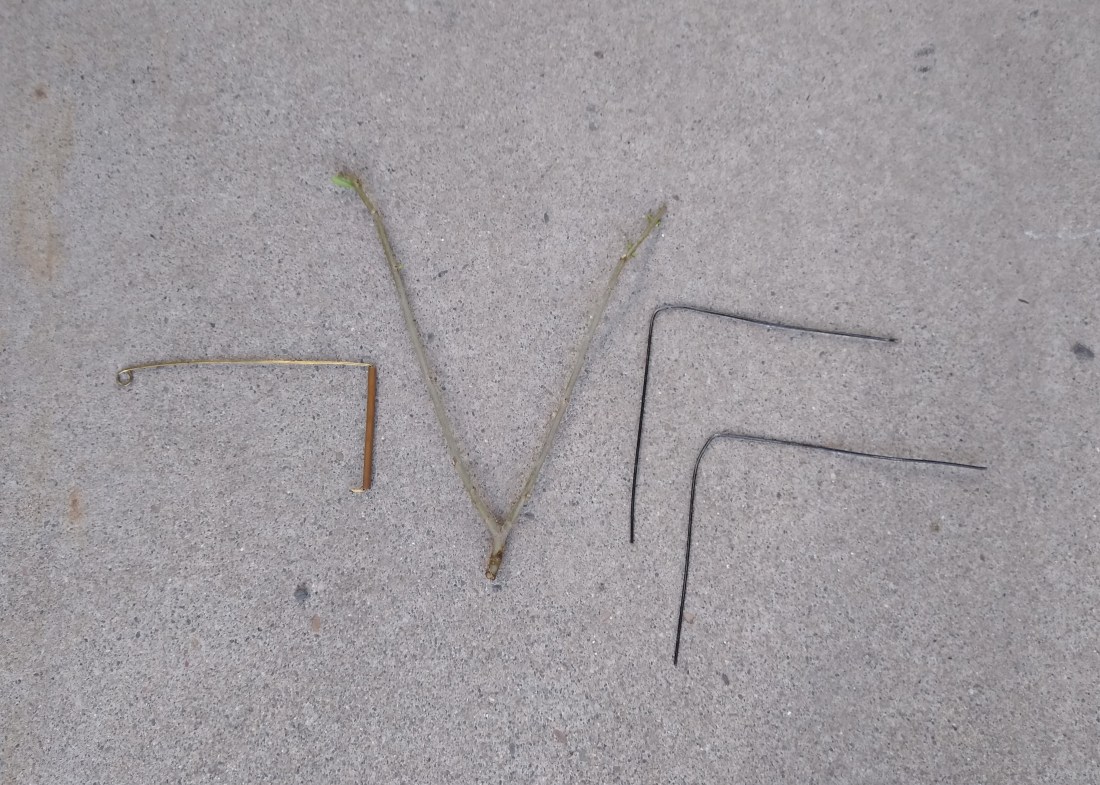
My mother’s uncle could do it.  My mother can do it.  I can do it sometimes.  Water dowsing, or water witching, runs in the family.   My mom uses a forked willow branch.  The tip drops when she is over water.  I use two L-shaped wires bent out of coat hangers.  The wires cross, or separate, when I walk over underground water pipes or electric pipes.  In my yard where I have experimented, the electric lines run near the water lines so I’m not always sure what my divining rods are showing me. 

I have heard of dowsers that can tell you where on the property to dig the well, and how deep the water will be.  They use a formula for how many times the rod dips at the end to calculate the depth.   Actually, I imagine one can estimate well depth pretty well by reviewing data on the wells in the neighborhood but dowsing the best location could be useful.  I wonder how many wells actually come up empty, with dowsing versus no dowsing?  Personally, even though the dowsing rods move for me, I have no idea how they work.  I have a pet theory though… electric wires, and running water are really a bunch of moving electrons with charges.  I believe the divining rods (wires in my case) are lining up with subtle electric or magnetic fields.  Like metal shavings above a magnet will align to the magnetic field.  However, when I read a book about dowsing (The Divining Rod by Barrett and Besterman), the authors disputed the magnetic theory, based on old experiments with dowsers on insulated versus uninsulated surfaces.  They also concluded that because divining rods can be wood, or metal, or other substances that are not influenced by magnets or charges, that the theory is not supported.    

Am I biased and making the rods move unconsciously? That’s what my son says.  But I had one set of divining rods that are in a metal sleeve.  It would be much harder for my unconscious muscle contractions to move them, and they still moved when I crossed a pipe.  Or at least they did move, until I lost one of those special rods.   I like that I can dowse, but I have only ever used it for fun and interest’s sake.  I have never had to dig a well, so I’m not sure how successful I would be on that task. 

We dowsers also can use pendulums to answer questions.  My mom has explored that, using a needle hanging on a thread as the pendulum.  You ask a question, and the needle moves left and right, or back and forth, or in a circle.  I would have to read a different book to remember which movement is supposed to be yes, no, or unknown.  When I try a pendulum, it does move decisively.  But is it real?  I don’t know.  My mom’s generation, and her mom’s generation would use the needle on a thread over a pregnant woman’s belly to determine whether she will have a boy or a girl.  Now we have ultrasound. You could probably develop a pretty good pendulum prediction experiment using ultrasound as the proof.  All you need is a whole bunch of friends that are pregnant and willing to share the data with you.  I have no pregnant friends at this time.   There goes that experiment.     

Are people still dowsing these days?  I asked the giant orb in the sky (Google).  There was one website for a guy explaining that Christ called him to dowse water.  That reminded me of a friend of mine who said she had dowsing ability but didn’t use it because she thought it was un-Christian.   Perhaps because of the “witching” name.   Another Google result showed a local well drilling company that says they will recommend water-witchers if you want, but generally if you simply dig deep enough you will find water around here.  They also stated that, more rarely, sometimes both witchers and well drillers get skunked.   As I dig a little deeper into the depths of the subject, I find many stories that say witching is not scientifically explained, it’s unproven, and no one tells the stories of when it fails.    

Back to the dowsing book.  I skimmed it; it was extremely wordy.  It discussed the history (going back to medieval times) and summarized some experiments that seemed to indicate water dowsing works.  The book was published in 1968 but was based mainly on earlier studies and information from the late 1800s and early 1900s.   After using the book illustrations to refresh myself on how to hold the rods, I went outside with a forked willow stick, and with my bent wire coat hangers.  I recognize that I have a bias when I dowse in my yard.  I know where most of the water pipes and electric lines are.  Nonetheless when I tried dowsing with both implements across known water and electric lines nothing happened.  I failed.

The book also described how some dowsers can find missing objects, or minerals such as silver and gold.  I had lost a small key to my camper a couple months prior.  I assumed the keys were lost out in the yard where my camper was parked.  As an experiment, I “introduced” my dowsing rods to my other camper key by touching the key with the rod.  Then I visualized the key while gridding the side yard.  Nothing.  No response; my second fail.  Is this because the key was not silver or gold?  Is this because the key was not lost in the area I gridded?  Or is this because dowsing for objects is a crock? 

After two failed dowsing trials on the same day, I thought I had lost my dowsing talent.  I was bummed.   Then I invited my mom, my son, and his girlfriend out into the yard to try dowsing.  My mom got some bobbles out of the forked willow stick, near some known water pipelines.  I tried it again and also got some responses with the willow rod tipping down.  Maybe my mom needed to charge it or something?

Then I started getting reactions with the wire rods, where I hadn’t earlier in the day.  Maybe I needed to be in the right frame of mind?  Meanwhile, my son showed us how he could move the willow stick purposefully, yet subtly, showing how it could be manipulated.  His girlfriend did not get reactions from the willow or the wire.   So is dowsing real?  I don’t move the rods purposely, but perhaps there is something that happens unconsciously.   None of these tests count as well-planned experiments.

The dowsing book finally concluded that the movement of the rod comes from an unconscious muscular action, but it didn’t scientifically explain what causes the unconscious movement.  My son says dowsing has clearly been debunked.  Perhaps.  I’ll have to dig deeper into the literature, and especially look for more recent literature.  In the meantime, I still haven’t found my lost camper key.  Maybe I should pull out my pendulum and ask it a bunch of yes/no questions to determine where the keys were lost.   I’m sure that will work, and I will successfully find the key.   Hey, if that does work, maybe I can use that process to find the missing dowsing rod with the metal sleave!  Or better yet, I can ask the giant orb in the sky to find me a new set of sleaved metal dowsing rods to purchase.  Maybe we don’t need dowsing now that we have the internet.  Heck, I’ll bet I can find a replacement camper key, too!  That type of search will work for sure.   

Barnacles on My Neck

Barnacles on My Neck is a “mimic poem” I wrote after reading “The Blue Terrance” by Terrance Hayes, a poem about place and where he came from. It took me a while to find the original poem, since I misplaced, loaned, or gave away the book where I first saw it. Then I had challenges finding the poem online.  It turns out there is more than one poem that Terrance Hayes titled “The Blue Terrance”.  That’s unusual. I will definitely be reading more of his poems. I hope you enjoy my poem about where I come from, below.

See my favorite version of The Blue Terrance here:  http://failbetter.com/17/HayesBlue.php.  See more about Terrance Hayes and his poems here: https://www.poetryfoundation.org/poets/terrance-hayes.

Barnacles on My Neck

I come from a long line of old cars driven on wash-board roads.  
The first daughter after the first son, afraid of edges, foreign wars, spiders, 
mean-eyed strangers, new cars, and knocks on the door after dark.  
I believe all the stories of who I was: long pretend hair from tights pulled onto my head, 
friend of all dogs, fearless of nettles, hands high but still stung.  
They say I ran to the wrong mom once.  
Before there were nettles, there were blackberries and there was a beach
plus tideflats with a soft hole of quicksand that we tried to fill with rocks one toss at a time.  
I come from boys, brother, cousins, playing army in the woods, 
a large cedar branch bouncing down for a horse.  
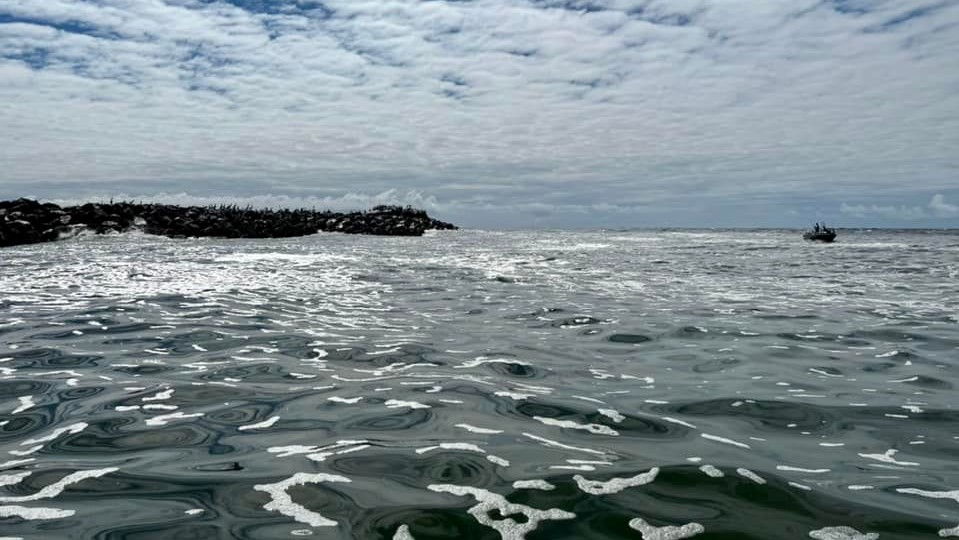
I come from fog horns, salt water, and small-craft warnings.  
I come from rip rap and rip tides, climbing over boulders, 
a railroad track, and then down to the bay with my aunt and cousin.  
We swam in sun-warmed water while the train rattled by,  
Cindy waved her bikini top at the engineer.  
Tell me what you remember of Grandma Seff, her flattened shoes and old dresses 
or Grandma Bess, her bleeding heart that thrived when she threw kitty litter on the plant
that later died after the cat died.  
I come from the rains, wet pastures with rushes that the cows don’t eat.  
I come from creeks pushed into ditches where salmon still spawn.  
I will not evaporate to ocean.  I will not fly with the seagulls.  
I wake up sometimes on this hot inland plateau with barnacles on my neck.  
Where did they bury my placenta, in those days when men were not allowed in the birthing room?  I come blessed, a river of blood to mother, to grandmother, to great grandmother: 
a kindness of strength when needed.  
Yesterday I was nothing but a soggy field,
when I threatened to go out to sea, my father offered his boat.  


[Photo credit Chris Frederick]

Gooseberries are Picky

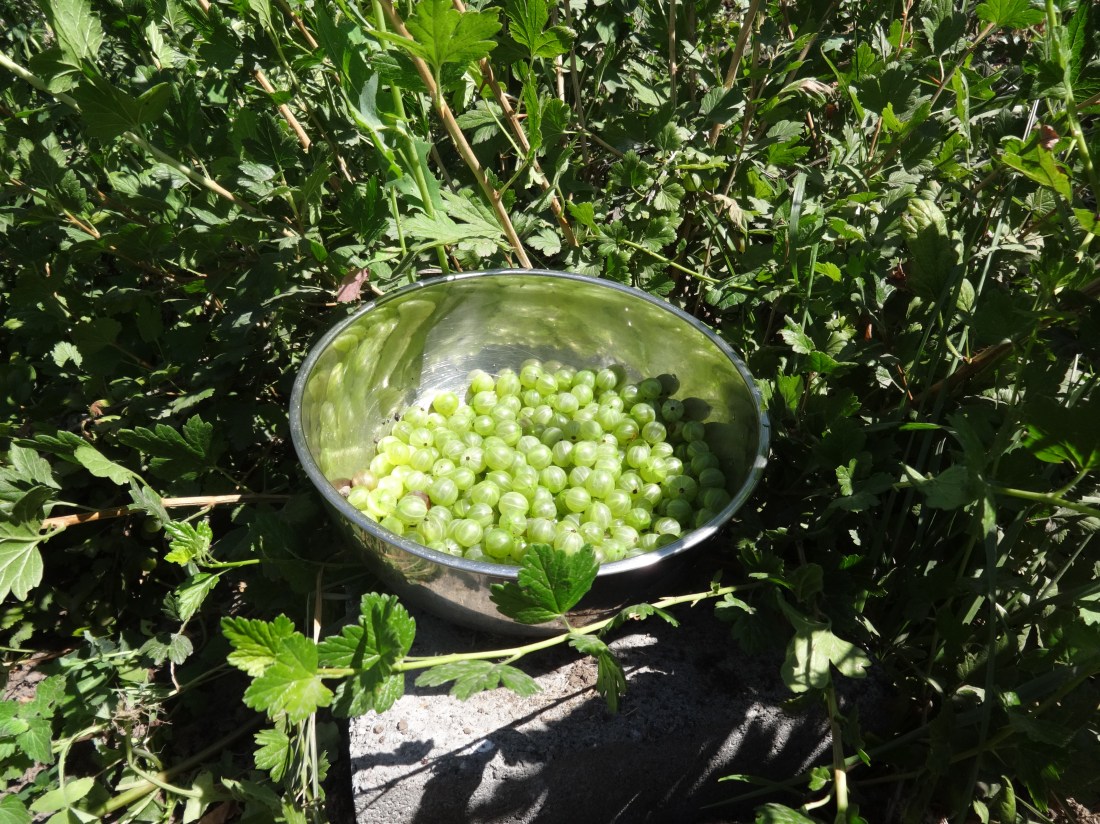
They say that firewood warms you three times.  First when you cut the wood, second when you split the wood, and third when you burn the wood in the winter.  I have determined that gooseberries require picking three times.  First when you pick the berries, second when you pick off the stem and the “tail” of the berry, and third when you pick a good recipe.  The first picking is the easy part. 

While I was picking and cleaning a bowl full of gooseberries, my husband picked some pie cherries at the neighbors.  He was back with a gallon in nothing flat.  I asked how he got done so quickly. He said he “knows how to pick the low hanging fruit”. 

The gooseberries were even lower hanging, the branches right next to the ground were completely full;  I picked just two branches and had a full bowl in about 10 minutes. I simply ran my hand down the branch, dropping the berries in the bowl.  Previously I believed I had missed the gooseberries and the birds got them all.  I had been watching and tasting the berries every few days, then there were none.  Until I was weeding and found a hoard of berries on the bottom of the bush.  Apparently the birds don’t look under things.         

I found many gooseberry recipes from the U.K. online.  Gooseberries are very British.   There were recipes for cobblers, crisps, tarts, and pies.  Plus, gooseberry gin!  One recipe described making gooseberry compote on a hob.  What is a hob?  A crockpot? A Dutch oven?  Turns out it just means stove top.  In contrast, I found zero gooseberry recipes in my own American cookbooks.   I remember gooseberry bushes as a kid, and hearing about gooseberry jam, and gooseberry pie.  But then, somehow, the berries fell out of favor. 

Why don’t I have a stronger recipe history for gooseberries?  It turns out that gooseberry plants carry White Pine Blister Rust.  Western White Pine is a very beautiful and large pine tree in western mountains of the U.S. and Canada. They are gorgeous, with grayish green soft and fuzzy needles.  If you look closely, each little needle bundle has 5 needles in it, giving it that fuzzier fluffier look.  Both Eastern and Western White Pines were enormously valuable lumber trees, until the blister rust started wiping them out.  The white pine blister rust came over with some white pine seedlings grown in European nurseries (at a time when U.S. nurseries couldn’t keep up with the demand).   The rust fungus doesn’t spread from pine to pine, but requires an alternate host (Ribes species, including currants and gooseberries).  To try to eliminate the disease, the U.S. started eradicating vast amounts of domestic and wild gooseberries and currants.  

During the eradication time, the growing of Ribes species was illegal under federal law, and war was proclaimed on the native species.  We even used the Civilian Conservation Corps to uproot gooseberries and currants throughout our forests.  Eventually, rather than eradication, we started developing rust resistant White Pines. 

I believe this is why I don’t have a cooking and recipe history with gooseberries. For decades they were not farmed commercially and weren’t sold in nurseries.  Eventually immune and blister rust resistant Ribes species were also developed.  Now gooseberries are easy to find in nurseries.  I am assuming that my gooseberry is a blister rust resistant variety.  Although I do not have white pines in my neighborhood, and there are also many wild currants around here.

My gooseberry bush is happy, the birds are happy, and I am happy to try to figure out how to use the plump and slightly sour berries.  I’m thinking of a gooseberry/cherry/oatmeal crisp. 

I found a recipe for a gooseberry and oat crumble (I think crumble is British for crisp).  Surely, I can just toss in some pitted pie cherries, and it will be fine!  But the recipe is British, and it requires golden caster sugar (?), demerara sugar (?), all the measurements are in grams, and the oven temperature is in Celsius.  It also says to use a “crumble dish” instead of a certain size baking pan.  Time to pull out the scale and do some more googling and some measurement conversions.  Hope I picked a good recipe!

Sources: 

Malloy, Otis. 2001.   White Pine Blister Rust.  Online. Plant Health Progress doi:10.1094/PHP2001-0924-01-HM. https://www.fs.fed.us/rm/highelevationwhitepines/Threats/pdf/whitepine_PHP2001_0924_01.pdf

Silver, Akiva.  2022.  White Pine Blister Rust and Ribes.  Viewed online July 30, 2022 http://www.twisted-tree.net/white-pine-blister-rust-and-ribes.

Link to recipe: https://ahohomemadefood.com/2018/06/23/127-gooseberry-and-oat-crumble/.

Fishing for Whales

                              	
Blues and Orcas are rare in the Strait of Georgia;
Dad and Eric troll for salmon, I watch for whales. 
Whale shadows slip between islands
leaving whale shaped waves, whale colored rocks.
I am an Orca tasting salmon:  
salt, crunch, fins scratch my throat.

Ocean bends into smooth troughs,  
soft waves tap, tease, tongue the bow.
Rain curtains hang gray,
drips make paths through seams 
and threads to find my skin. 
Sky, rain, and sea merge. 

Herring race in schools, dimpling the tide, 
seabirds dive.  The downrigger squeals, 
we jump for the rods- Dad cuts the motor,  
Eric snaps the pole up, pauses, 
reels– the chinook flashes silver, 
runs, rises.  I slide the net under tail 
and lift twenty live pounds to the deck.

Rain drips down my cheek like tears,
Eric clubs the fish, 
A whale blows in the mist.


[Photo Credit Vince Harke]

2013 Is Gone!

I inadvertently deleted the year 2013.  I’m sorry if that was a good year for you.  If you can no longer find evidence, or photos from 2013, it’s my fault.   During the summer heat I started going through photos, both digital and hard-copy.  I thought I should keep all of the electronic photos organized by year in one place on an external hard-drive.   Once sorted, I started deleting the bad blurry ones (there were so many) followed by deleting redundant and unnecessary photos, like pictures of other people’s dogs that I don’t remember.   Finally, I deleted what I thought was an empty subfolder.  But it turned out to be all of the year 2013.  Woops. 

I’ve been watching a lot of science fiction on Netflix lately and based on those fine plots I’m quite sure that when I deleted the folder, I deleted 2013 across the entire extent of the internet.  So, if you find that there is no reference to 2013 across the whole world wide web… it’s my fault.  If instead you start finding bits and pieces of 2013, then you will know I’ve been able to re-create parts of the year.   I just have to find my old nerd-sticks where I backed up old pictures.  And query all family members for replacements.  I’m not overly concerned.  What are my kids going to do with all those old pictures anyhow?  There are still upwards of 8,000 after deleting.  Back in the days of film cameras my parents took what seemed like a lot of pictures that now sit in cupboards and boxes.  Compared to that, with all of our easy picture taking tools, my photos represent an exponential increase.  Will my kids care that I lost a whole year documenting their young lives?   I think not.  I hope not.  Maybe not. 

My younger techy son, no longer a kid, says maybe we can do a data recovery.   Okay… but he says avoid using the external hard-drive until he can get to it.  WHAT?  I can’t access my draft blogs and my thousands of cool photos from all years except 2013?   Well, fudge and phooey.  So here I write, apologetically to the world (or at least to my friends) about my foul-up that may have messed up time as we know it.   Much like the Secret Service “inadvertently” deleting texts regarding January 6, I have inadvertently deleted a whole year.  It does make you wonder what the Secret Service was up to in 2013… now we may never know.

Dressing for Success in the Horse World

There is a thing in the horse world.  It goes by the highly technical term of “Matchy Matchy”.  In almost every event, in ways subtle and bold, your clothes and tack must match.  In barrel racing, you might have bright painted sunflowers on your leather breast collar and bridle, but you can bet that the colors will also be picked up in the saddle blanket and shirt, and maybe even on the horse’s protective leg wraps.    In a Western rail class, the silver conchos might be heart shaped, and match the bridle conchos, while the saddle blanket, hat, clothes, and boots will be color coordinated and match exactly.  You will see “matchy matchy” in some English events, too.  Eventers riding a cross-country jump course especially will be bright and matchy, maybe in a burnt orange shirt and matching English pad.  Even the dressage world, previously a world of white saddle pads, black tack, and white shirts, is allowing more subdued colors and a bit of sparkly bling on the bridle browband, and maybe even the back of the saddle cantle.  Just a bit. 

I actually love to ride with workmanlike gear.  I love saddles with more leather than silver.  I am fine with conservative black and white in a dressage class (especially since I rarely show dressage).  But for trail riding, I am not so much “matchy matchy” as “contrasty contrasty”.  I don’t mean just wearing hunter orange in hunting season.  I mean wearing purple breeches with a bright blue cowboy shirt.  I am fond of mixing an English saddle with a Western bridle.  Those of us in the know, call this “Wenglish”.   I like a bright orange and purple saddle pad mixed with a black and red tie-died shirt and a maroon riding helmet.   If I could find bright tie-died half-chaps, I would wear them over my boots.  In the meantime, I might wear knitted leg warmers over my boots, or in the summer heat I might wear bright knee socks pulled over the outside of my breeches. In a contrasting color, of course.  My photographer friends love it because I stand out in the scenery.  My Western friends laugh.  I think they are laughing with me, not at me, but I’m not really sure.  Anyhow, it’s fun, it’s unique, and its me.   It’s good to shake up the horse world a bit (even if it’s just with an English bit on a Western bridle).  Ride on!

(Photo credit Sue Wilson. Only a slight exaggeration over my normal trail riding gear!)

A Poem by My Dad; A Poem by Me

On Father’s Day weekend I think of my dad.  He died long ago now.  I think of him when I’m on a boat, near an ocean, and when I’m writing.  Writing runs in the family.  Following is a poem Dad wrote about Drayton Harbor, the bay by our hometown. Below that is a poem I wrote about Drayton Harbor.  Great minds think alike!

Drayton Harbor (By Jim Eames)

Spring tides haul back wide
Eelgrass sticks with herring row
First gulls hatch down chicks
Clam diggers shovel squirts

Baked mud warms the evening flood
Milk-oysters sport new 
Beached eelgrass ranks fecund
Swimmers mince barnacled feet

The tide floods green and rich 
Cutthroats flash at candlefish
Salmon peak summer fat
Sein boats bulldoze blunt waves home

The southeaster lashes chop
Water washes shoreward down
Seabirds flock in rest
Muffled dragger plod with lights

The mud lies brown and dank
Mother-mud that’s borne us all

*


Drayton Harbor at Low Tide (By Michelle Eames)


Ocean flows out—
The bay exhales   
Dakota creek wanders 
through naked tide flats.   
Sea stars and oysters hang tight 
To a few glacier-dropped boulders. 
Tide flats show scars 
Of old sawmill pilings, 
Rusty chains, fish nets and floats: 
History.  

Sand and clay merge 
Into a dark sucking goo,  
Holes gurgle as I walk past, 
Bubbling up from anemones, 
Ghost shrimps, tube worms, clams.
It’s alive, scent of salt and decay.   
Mud squishes up like tar
Claiming my oldest shoes,  
I feel a layer of shells 
Under the surface.  

Sea gulls and sandpipers 
Run into the distance—
The secret to walking on tide flats 
Is to always keep moving.       

*

Writing is like Dressage

Both take years to learn, and longer to master.
A little natural talent helps, but regular practice is a must.
A flexible horse with a good mind works for dressage,
A flexible mind with nimble fingers works for writing.
Soft hands, balanced seat, and subtle aids release the horse to dance.
Subtle thoughts, time to write, and creative fingers release the words to soar.

Photo credit Sue Wilson

Volunteers

I have a soft spot for volunteers:  Peace Corps Volunteers, public radio station volunteers, Back Country Horsemen Volunteers, therapeutic riding volunteers…  These are a tiny subset of a very large group of people I admire.  But the volunteers I see most in the spring are in my garden.  I wish it was a garden full of people pulling weeds, but instead it is a troop of volunteer plants coming up from the last year.

I believe in the messy approach to gardens, and to life in general.  In part because I actually like the busy mixed-up look, and in part because I am basically lazy.   My garden rows are crooked.  My plantings might be a row, or they might be a block.  But some plants love it here, and they come back year after year.

So far, this cool slow spring I have found two potato plants.  I weeded a clear spot around them and marked them with bricks, so I don’t run them over with the wheelbarrow full of weeds.  There is also a large crop of sunflowers coming up near the green house.  I never had much luck with sunflowers, until a chipmunk moved in and started stashing the bird feeder sunflowers throughout the garden.  For the last three years we have had large healthy yellow flowers with no effort at all.  Thanks chipmunks!

Yesterday I was pulling up some of the giant weeds that are starting to flower even before our garden is fully planted.  Amidst the jungle of weeds I found some cilantro.  That is another plant that continues to come up on its own.  I never buy cilantro seeds.

Some kale overwintered and it is now going to seed.  I may take that seed and replant it.  The same thing often happens with onions I miss during harvest.   We may yet get Swiss chard volunteers, and perhaps some squash volunteers.  I vow to pull up the squash volunteers promptly because you never know what they will produce.  The hybrids between summer and winter squash often result in some strange spongy gourds that don’t look quite edible.  I know this.

My next step for the garden will be to finish cleaning up the weeds, and finally finish planting what we want where we want it.  It will be a moderately messy disarray, of course.  Some of that mess will undoubtedly result in next year’s volunteer surprises.  Anything to save me some work.  Thank you to all the volunteers out there!