We’ve been without chickens for a couple years. Our last batch of older established chickens were slowly being picked off by something… an owl, a hawk, or maybe a prowling mammal. These were free range chickens, they had their own field, and we often forgot to close the hutch door at night. I don’t really begrudge the predators, they need to eat, too. When we got down to three chickens, I gave them to a friend.
We might have gone a long time without chickens, or forever, except for the price of eggs. And the potential for government or bird flu chaos. I know that home grown eggs are never cheaper than store bought eggs, even when eggs cost a lot. Partly because you must feed chickens for six to nine months before they start laying eggs. And you know that saying about cheap insignificant things being “chicken feed?” A bag of feed from the farm store actually costs a pretty penny. Plus there are other expensive inputs, like houses and chicken wire and feeders and grit and so on. Still, having some productive animals on the hobby farm seemed like a good idea this year.
Turns out, everyone else in Spokane county thought it was a good idea to get chickens this spring, too. Maybe there were fewer chicks available due to bird flu, or maybe everyone was naively hopeful that eggs would be cheaper if you grew them yourself. But when the chicks arrived at the feedstores, there were long lines, and they sold out quickly.
Plus, I’m a chicken snob. There are only a few breeds that I like. They must be calm, broody, and self-sufficient foragers. I don’t care what color eggs they lay, but I might want them to hatch some eggs in the future. A lot of chicken breeds are not broody (they don’t like to sit on nests or be good mothers). Of the chickens that I could find locally, the Speckled Sussex sounded like a good breed. A few weeks ago we got to the feedstore early on delivery day and finally managed to buy four very expensive Speckled Sussex chicks. Then one died. Life with chickens often involves death.
Finally, I found mixed run banties. Mixed run means the color, sex, or traits are a crap shoot. I love banties. They are tough little chickens, varied in color, and super-broody (we once had a little banty hen that hid and then hatched a nest of 15 eggs). They forage and eat bugs and are just busy little resourceful chickens. I bought three banties: a gold one (Goldie), a black one (Blackie), and a mottled one (Checkers). Just to keep up, we decided we should name the Speckled Sussexes, too. They became Speck 1, Speck 2, and Speck 3. We can’t tell them apart.
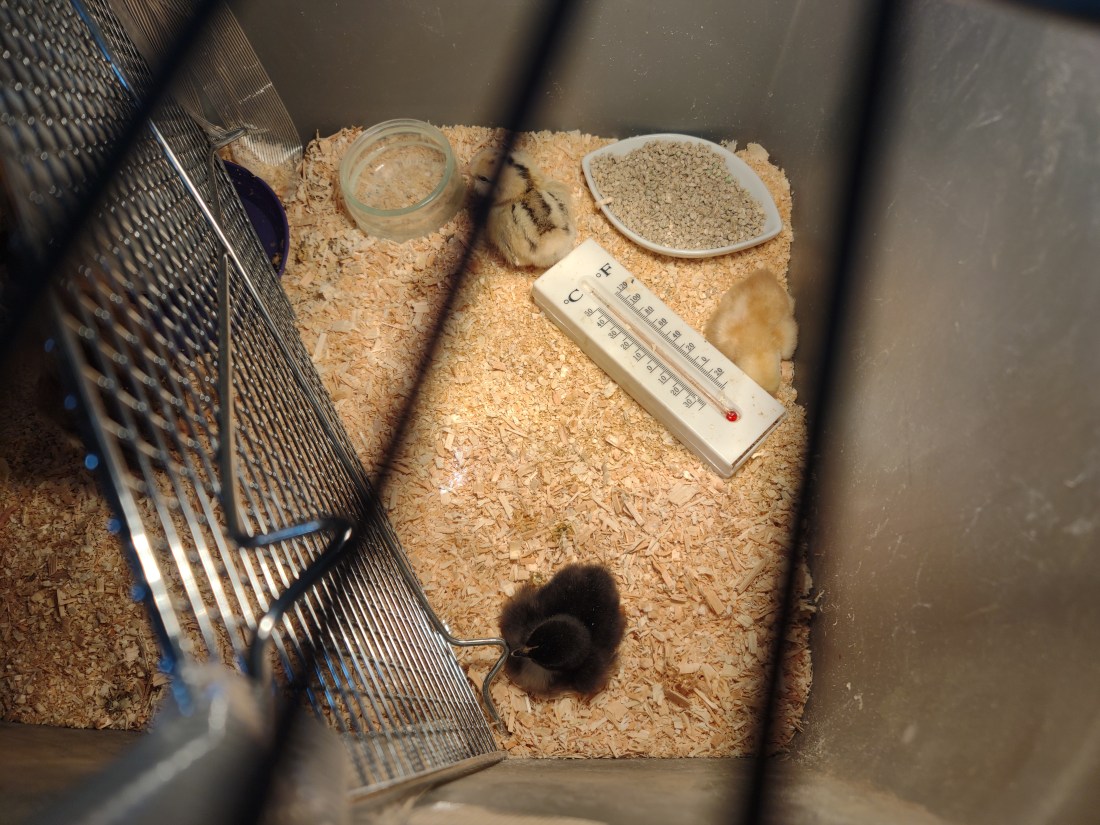
The older Specks were really kind of blah and boring. They simply ate and drank in the tub on our enclosed porch and napped under the heat lamp. They appeared kind of dumb. The banties, at a quarter of their size, were immediately scratching in the shavings and wandering around. They showed personality and cleverness. I divided the breeds at first, and Blackie was immediately pecking at the Specks through the wires. Blackie is probably a rooster.
After a few days I pulled out the divider in the rearing tub and wondered if the banties would be picked on by their larger cousins. Instead, the banties decided that their new roommates were perfect to run and hide underneath, between, or on top of. No space was too small for a banty to squeeze into. The chicks were going to be fine.
I’m looking forward to getting the chickies off the porch. They stink after a while. I have prepared the outdoor hutch, hung up a lamp, and added a run with a tarped roof. In this era of bird flu, it is recommended to keep wild birds and wild bird poop away from the domestic chickens. It will be a couple more weeks, though, before I can fully wean the little banties off the heat lamp. Then again, they are resourceful enough that they might just hunker underneath the Specks for warmth.
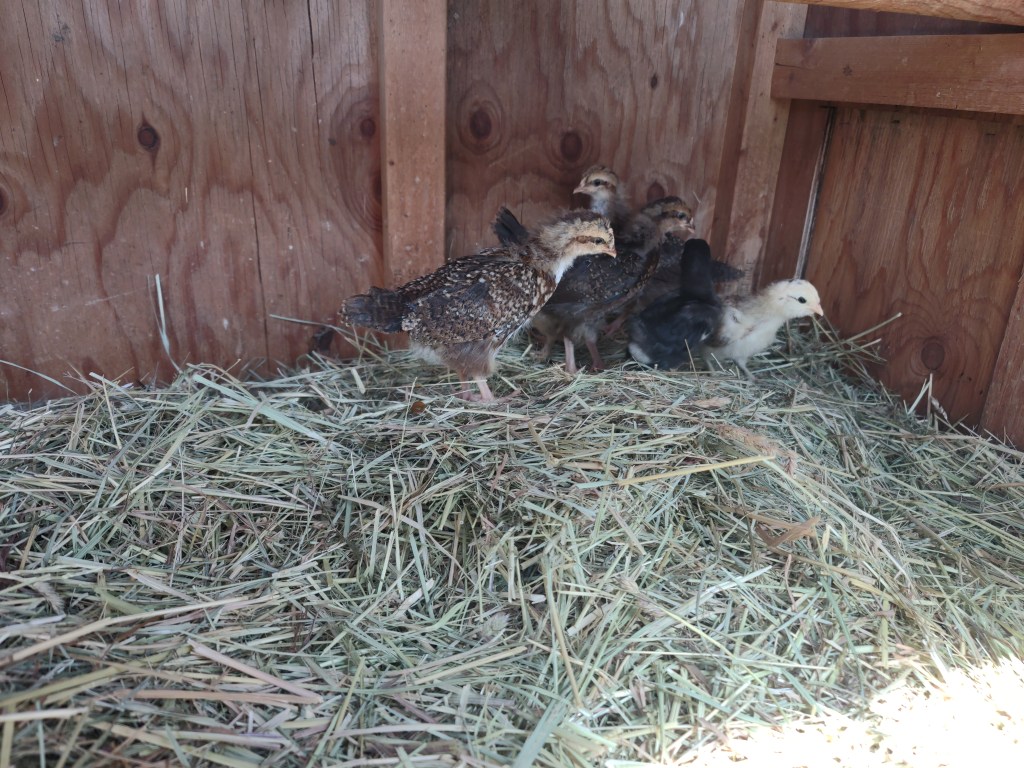
Speck 1, Speck 2, Speck 3, Blackie, Checkers, and Goldie (you can see her feet in the back) all enjoy their first moments in the chicken house. Or maybe they’re a little freaked out. But I’m enjoying their first moments in the chicken house…
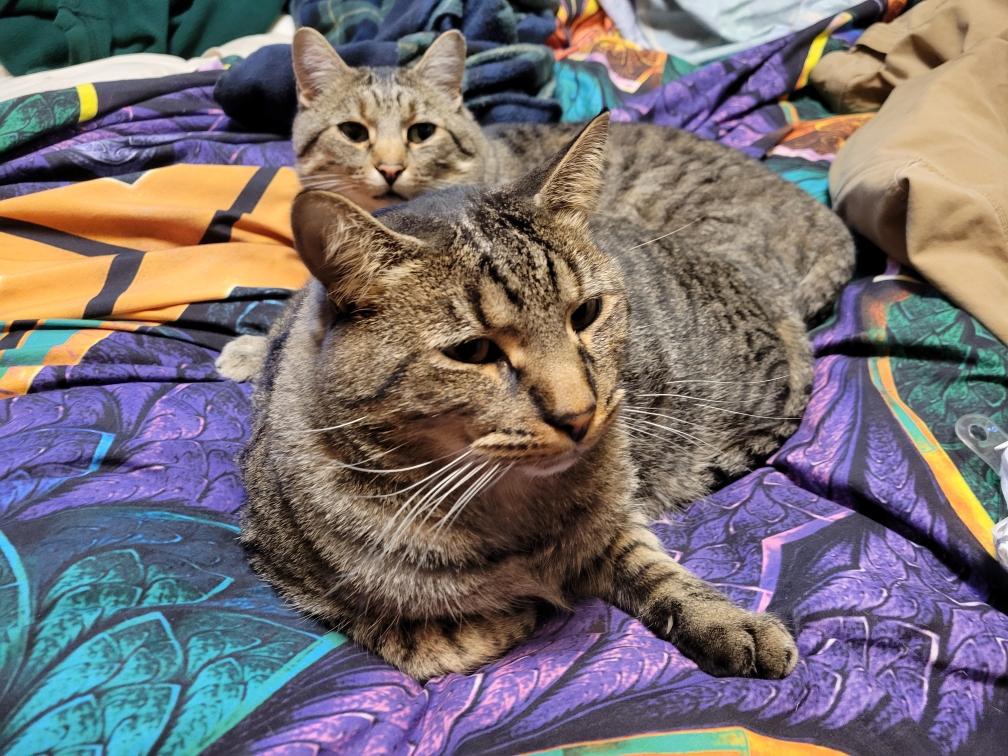
I’ve always been a dog person first, a horse person second, and only in recent years have I really begun to appreciate cats. We have had many barn cats over the years, all lovely and friendly animals. The goal of barn cats is to keep the mouse population down, but we still have many mice. Right now, we have two extra special cats: Purrcy and Squeaky. Both simply arrived in our barn. First Squeaky moved in, then a couple years later Purrcy showed up. They could be cousins based on appearance; they are very similar striped gray male tabbies. But in personality, they couldn’t be more different. Squeaky is shy, reserved, anxious about anything new or strange. Purrcy is bold, curious, fearless.
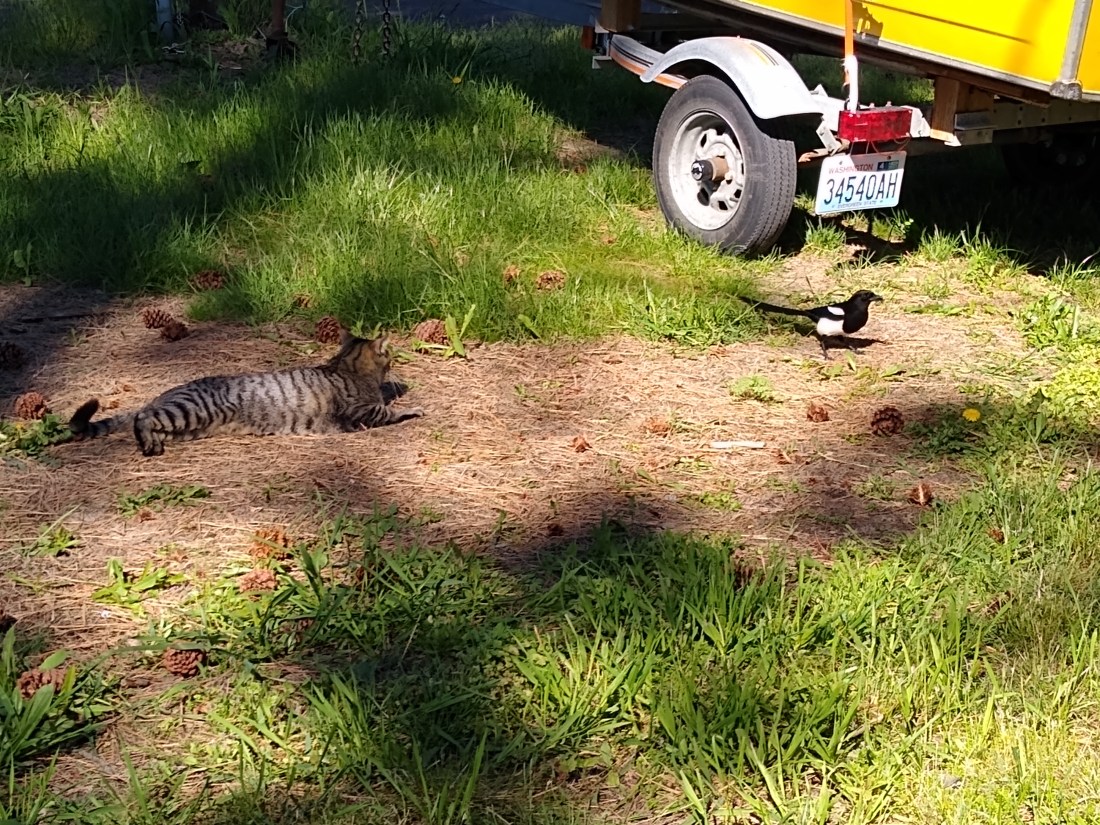
Although they started as barn cats, they both gradually morphed into indoor/outdoor cats and I have long considered making them into indoor-only cats. Indoor cats live longer, and they don’t eat wild birds. In the United States, outdoor cats kill about 2.4 billion birds every year (American Bird Conservancy). I really like birds, and Purrcy, in particular, is a skilled bird hunter. In addition, this year, we have worries of bird flu, carried by, you guessed it, birds. As best as anyone can tell with this new virus, if cats get bird flu, they die. Fast. And I like my kitties!
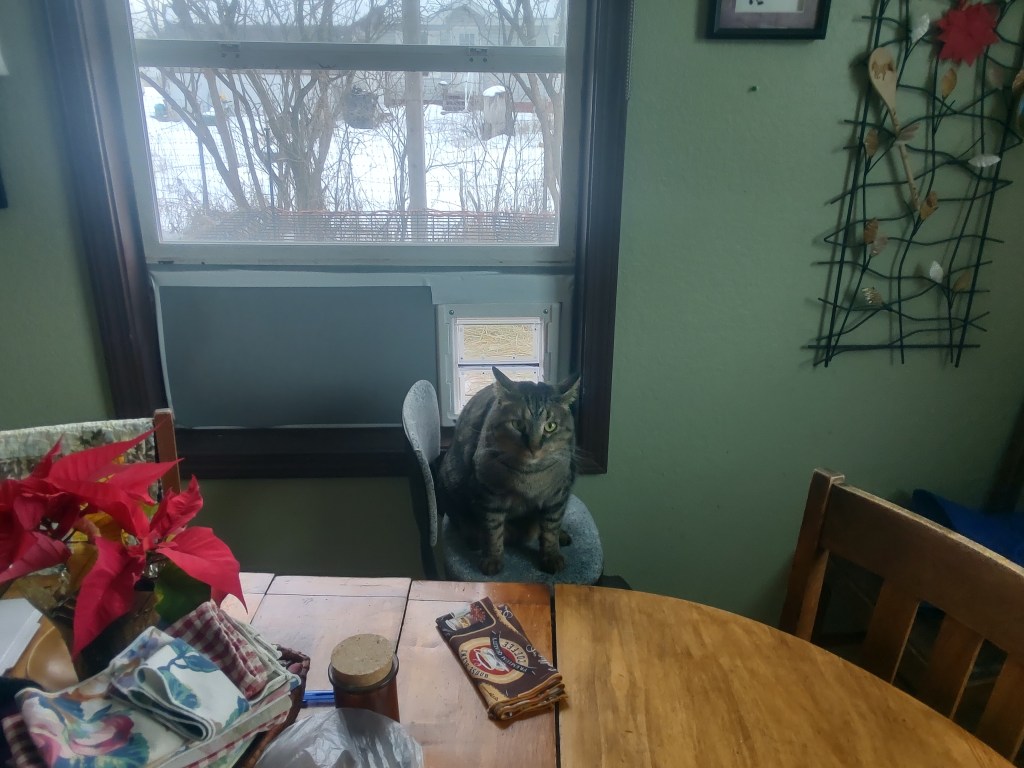
I’ve been planning the indoor transition all winter, and bird migration season is upon us. I knew it would be a rough transition for my cats, so I thought I would soften the transition by building a cat-patio (catio). This includes putting a cat door into a window, and then basically building a large cage outside. I ordered an insulated cat door and my mom and I started the project. My husband got to help with the sawing because I have a fear of cutting my fingers off with power tools, but other than that it is better for our marriage if we avoid construction projects together.
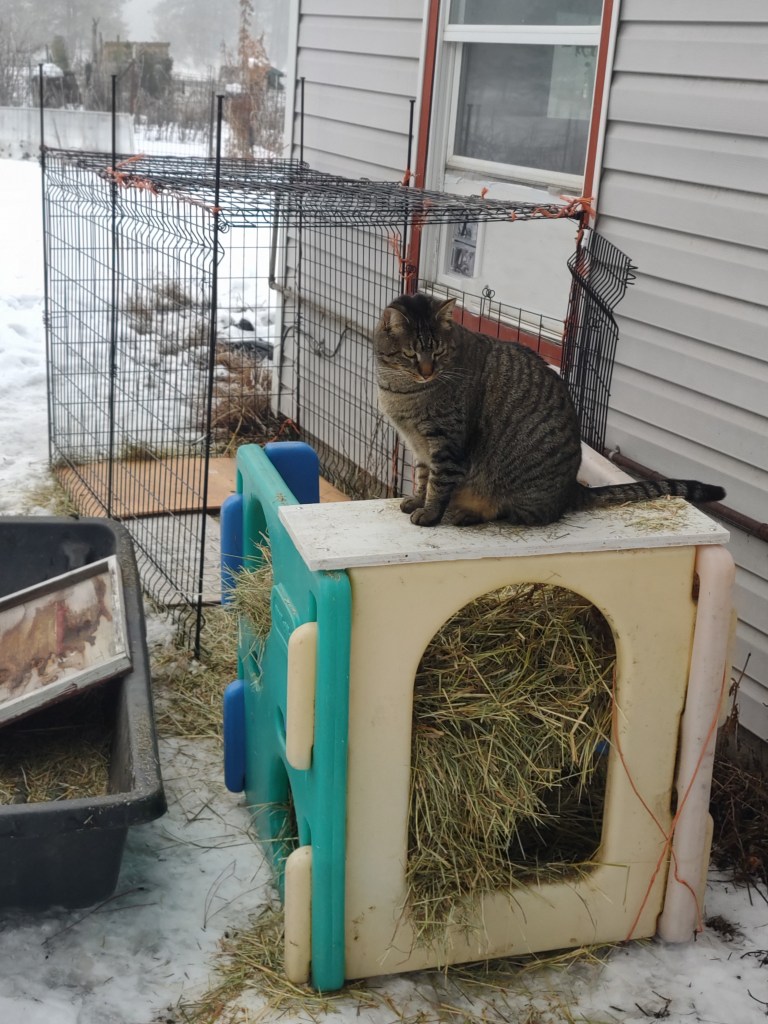
We cut the window plywood, painted it, attached the cat door, and added a layer of half-inch foam on the inside for insulation. Then we moved to the outside project. We built the cage out of yard fence panels and temporarily tied everything together with orange baling twine. In theory, if this catio experiment worked, we would eventually replace the garish twine with more subtle zip ties. In practice, we’ll see if I ever get around to it.
I repurposed a plastic yard kid toy under the window to make a bench for the kitties to step out onto from the cat door. Once everything was in place we were ready for the grand experiment to begin. My husband took off for a planned fishing weekend, and I was alone with the animals. Would the cats actually use the catio?
The first evening, after dinner, I introduced Purrcy, the bold cat, to the catio. I held the cat door open, put some yummy, canned cat food outside on the bench—he looked, hesitated, then walked out on his own. Soon he was coming in and out without help.
Later in the evening, it was Squeaky’s turn. I took him to the stool by the cat door, opened the door, put more yummy food outside—and Squeaky braced with his paws and claws spread wide, quickly becoming an immovable object. No way was he going outside, and I needed three hands just to hold him there. An hour later I tried it again, and I managed to push him out into the darkness. He ignored the food and started yowling, at one point climbing a fence panel like a monkey, looking for a way out. He dropped down and stayed in the corner close to the house, clearly upset.
Several times during the evening I opened the cat door and tried to coax Squeaky back in; no response. Purrcy also went in and out several times, seemingly checking on his buddy. Squeaky just hunkered outside, insulted, refusing to move. I wasn’t worried, there was warm hay in the catio and I knew he could survive the night, being a barn cat and all. Finally, before bed, I grabbed a flashlight and went out to visually check on Squeaky. I stepped out the back door onto our screen porch, and there was Squeaky, happy in his usual basket. How did he escape? He surely couldn’t fit between the fence panels. And cats don’t dig.
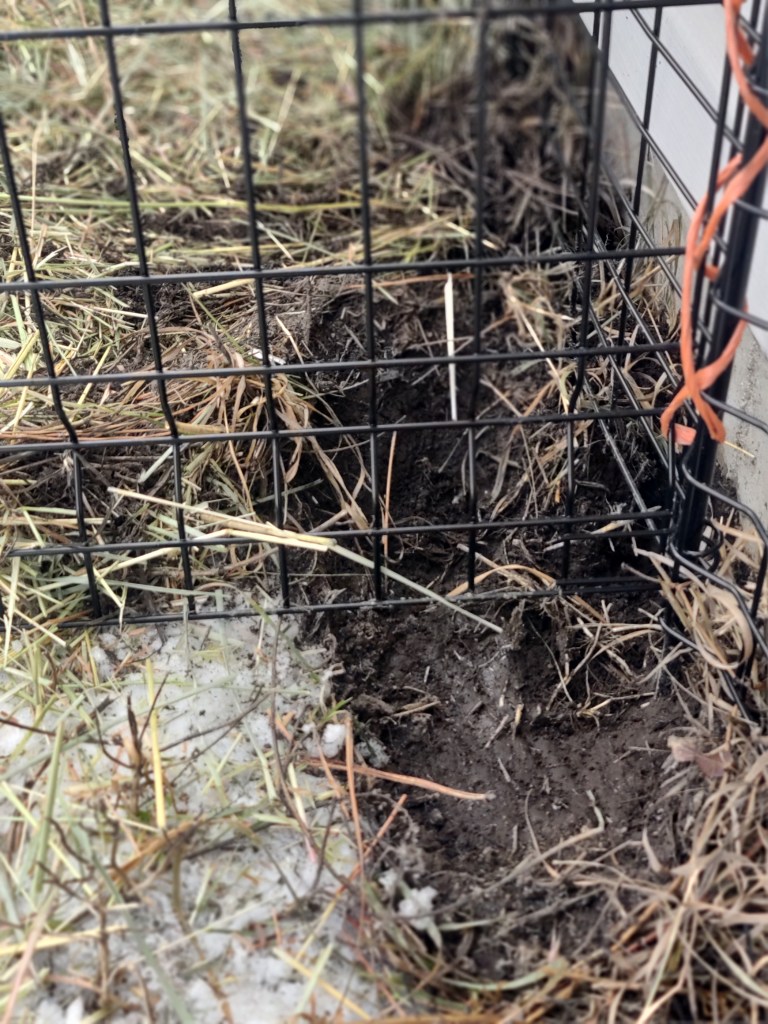
Turns out, Squeaky was a digger. He found the only thawed dirt close to the house and dug under the fence panels like a gopher. He was not staying in that repulsive cage. I was amazed and considered renaming him Sneaky.
That night, I put the plastic cover over the cat door to prevent cat escapes out through the newly dug tunnel and left the cats in the house all night. I expected a long and loud night. Typically, one or two cats will spend at least half the night on the bed, and then jump on me, or meow to be fed or to be let outside. At 2:30 Squeaky meowed to go out. Instead of letting him outside, I just pushed him out of my bedroom, shut the door, and figured he would quit meowing in a short time, then find a quiet spot to sleep. You may be wondering at this point how Squeaky got his name. He has a very strange, squeaky, non-melodic meow. And if you ignore his request for food, or to be let outside, he gets louder. The squeaky meow becomes a yowl, as if he is being tortured. The first yowl session lasted an hour before he finally quit. There were two more yowl sessions during the night, shorter, but plenty long enough to wake me up. One cat, probably Purrcy, decided it was time to get me up and stood at the bedroom door scratching and reaching his paws under, and somehow clunking the door, as if he were knocking. Between the yowls and the knocking, my dog and I barely slept.
Finally, morning came. I got up, started coffee, and let the cats go outside. I needed a mental break. I looked around the kitchen. The foam insulation on the window plywood was shredded, and bits of foam littered the floor. One cat wanted out that way last night, probably Purrcy, and was frustrated that I had locked the cat-door. Purrcy liked his catio.
My mom arrived and we went to work to fix the failings of the catio. First, we replaced the shredded foam. Then we put double-sided sticky tape all over a piece of poster board, and used that to cover the foam insulation. We thought this would prevent cat scratching, and it would also catch bugs, and possibly any humans that leaned against it.
Then we moved outside, discussed options, and decided to put a floor in the catio. We used scrap wood to make our floor, and used a large rock to close up the tunnel. During all of this activity, Purrcy kept going in and out of the cat door, checking on our work. He claimed that catio as his own. Once the fixes passed Purrcy’s inspection, we were ready for the next transition day.
Once again, I brought the cats in the house and was determined not to let them out. That night I left the cat door open and available for use and went to bed expecting to be awakened. Squeaky slept most of the night on my bed, with only a few meowing interludes that were short and moderate in tone. Purrcy wandered around the house, and in and out of the catio. The night went surprisingly well. My dog and I slept!
The next morning the cat door looked fine, and nothing was shredded. This was going great! By the next evening, Squeaky had figured out how to use the catio door on his own. Piece of cake! The experiment was working.
My husband returned home from his fishing trip, and I explained that the cats should now be permanent house cats. At the first sign of meowing to go outside, my soft-hearted husband wanted to let them out on the screen porch. The porch is enclosed, but it has a dog door. He blocked the dog door with the large dog food container and let Squeaky out. Squeaky figured out that the lightly loaded container could be moved aside. He was out and back in the barn quicker than we could say Sneaky Squeaky. I knew he would come back; his food was in the house. Eventually he did return, and we placed a heavier obstacle in front of the dog door. Squeaky spent time in his favorite basket on the porch, and he seemed happier.
Since then, our nights have been quieter, and we are more confident that our kitties will complete the transition to full-time indoor cats. They spend more time on our laps, and we find that they need some play time with us to expend some energy. We have toys spread throughout the house. Purrcy still wakes me up by jumping on me at some point before dawn, but when I push him out of the bedroom and shut the door, he finds something else to do. As I write this, I can hear the redwing black birds trilling outside and I see the California quail happily wandering in our yard, safe from our bird-eating cats. And hopefully our cats will be safe from bird flu.
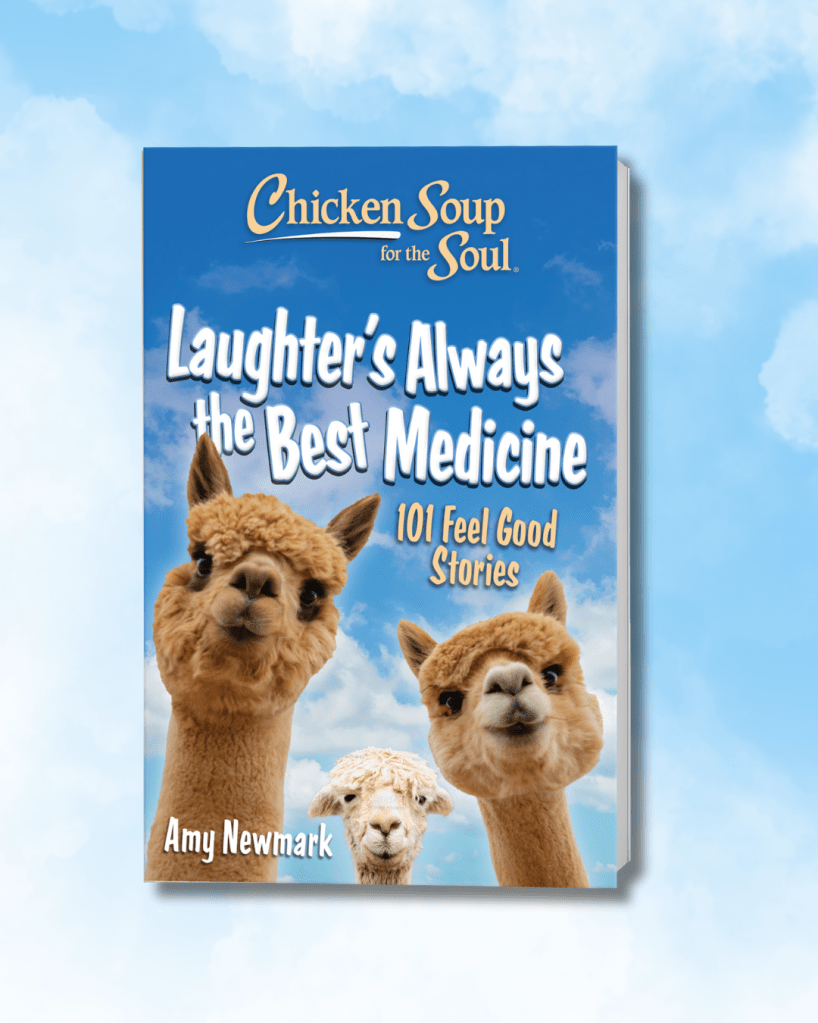
I’m excited to announce publication of my story in Chicken Soup for the Soul, Laughter’s Always the Best Medicine, 101 Feel Good Stories. My true story is about a family fiasco of roasting a pig in a pit. There are 100 more humorous stories by other authors in the book. We all need a good laugh right now.
The paperback book will hit bookstores on February 18. See more here: https://bit.ly/4gczg9A
Just for fun, I am offering a drawing for a free copy of the paperback book. All you have to do to enter is let me know in a message or a comment by February 27. You can comment on this blog, comment on my substack (@Michelleeames), comment on Facebook (Michelle Eames Writer) or send me a message thru email (michelle@michelleeames.com) or Messenger. The drawing will be held on February 28, 2025. I’m sorry that the drawing will be limited to the U.S. only, due to prohibitive international postage costs.
Speaking of money, I actually got paid for my story! It was a nice piece of change. Anyone can send in a story to Chicken Soup for the Soul. See their topics and guidelines here: https://www.chickensoup.com/story-submissions/possible-book-topics/. I’m sure I’ll send in more stories; making money is such a novel idea…
In honor of Black History Month, I’m sharing a short review of The Three Mothers, How the Mothers of Martin Luther King, Jr., Malcolm X, and James Baldwin Shaped a Nation, by Anna Malaika Tubbs.
I, like most Americans, knew about civil rights activists Martin Luther King, Jr., and Malcolm X. I needed a refresher on James Baldwin—he was a poet and writer that often addressed civil rights and human rights in his writing. I knew nothing about their mothers. As the author writes in her introduction: “The three women I speak of are Alberta King, Berdis Baldwin, and Louise Little— women who have been almost entirely ignored through history. … While the sons have been credited with the success of Black resistance, the progression of Black thought, and the survival of the Black community, the three mothers who birthed and reared them have been erased. This book fights that erasure.”
The author is right, I had never learned about, nor thought deeply about the mothers of these activists, or any activists for that matter. But obviously, the mothers rocked! They sacrificed to get their children an education. They supported their children in hard times. They taught their children to have strength in their convictions. Two of the moms outlived sons who died in violent deaths, and Berdis Baldwin also outlived James. My words give just the barest overview of the enormous challenges these moms and their children went through. I’ll just say that the book was well-written, well-researched, and I learned a lot about struggles in eras that had only been lightly touched on in my history classes.
I recommend this book. It took me a long time to read, not because it wasn’t good, but because as I often do with serious non-fiction, I read a chapter, then mull it over for a while. This book offers plenty to think about and is a good refresher on the civil rights struggles of the past, as we witness new civil rights challenges today.
One thinks of sewing as a gentle craft. Lots of thought, precision, and fine hand-work goes into it. Cloth is lightweight, as is thread. Needles are small. The machine does all the work, so no real strength is needed.
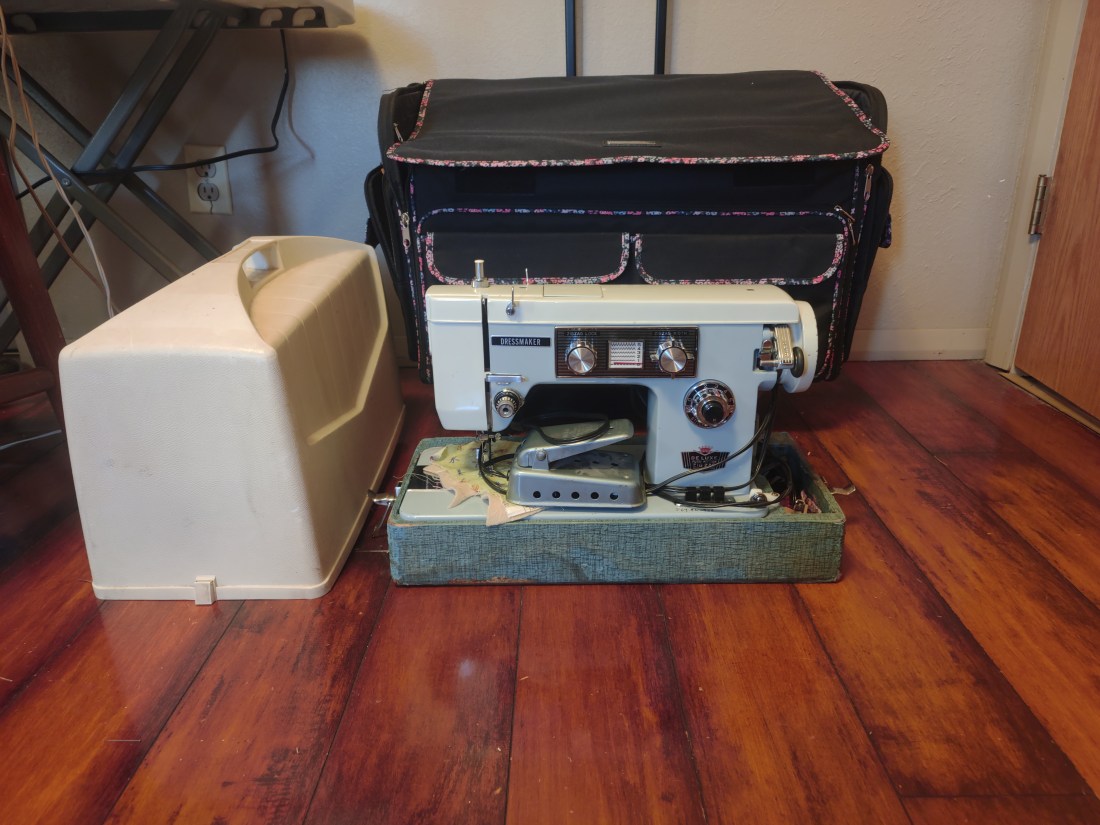
But when it comes to sewing machines at my house, we are talking substantial mass. You see, I like the old vintage machines. The all-metal, or mostly metal ones. None of that wimpy aluminum here (although I hear that a few lightweight vintage machines do exist). I mean machines made of steel. Or cast iron. Thick-walled tanks of machines. The kind of machine, that if you can’t get them working again, get new jobs as boat anchors.
Last year I went to several mending workshops put on by Spokane Zero Waste. I’m not a great sewer, but I’m a practical sewer. I can fix rips and holes. But at the workshops I borrowed a machine. I couldn’t figure out how to easily get my favorite blue behemoth machine from my car, across the parking lot, and into the mending rooms. I’m not as strong as I once was.
I noticed all the skilled and serious sewers brought their own machines: sleek, stylish, modern, and lightweight machines. From those skilled seamstress people I learned that there are ready-made sewing machine cases on wheels, with expanding handles, and numerous pockets for accessories and threads. Like rolling luggage, but squatty. I watched as the menders easily pulled their gear behind them in their brightly colored roller bags, and easily lifted their machines to the tables. I wanted one of those bags.
I looked locally and online for ready-made sewing machine roller-carriers, or even a piece of rolling luggage that might work. Then I measured my favorite blue beast of a vintage machine. In addition to being heavy, the machine in its wooden base is quite long. I would need an XXL size carrier. I finally ordered one of those wonderful bags and was happy the day it arrived. I was also a bit surprised at the sheer size of it… more the size of a camping icebox than the size of petite airline luggage. But I was ready. Have sewing machine (and bag), will travel.
A friend who quilts wanted to have a sewing gathering. A sort of play-date for crafty adults. I was in. I now had my travel bag. But first, I had to organize a project to work on–gather scissors, seam rippers, pins, cloth, everything I might need. I filled many of the pockets on my bag. Then I packed up my seventies-era machine to lift it into the roller bag. That went well, because it was a downward move from table to bag. I secured it with the inner Velcro straps, then, out of curiosity, tried to lift the bag. I can lift the beast machine by itself, but the roller bag was broader, awkward, and pushed my limits. It rolled very nicely, however. I rolled it out of my sewing room, into the hall, and stopped at the top of the stairs. Fourteen steps. Should I carry it down? Should I clunk it down a step at a time as if it were a washing machine on a hand-truck? I decided this was a job for super-husband. He carried the awkward bag down the stairs. I asked my husband how much he thought it weighed. He thought at most 30 pounds….? Really? I was sure it was 50. Once it was downstairs, I was able to maneuver it through the house, carefully down the three porch steps, and across the muddy lumpy yard to my car trunk.
My car has a big trunk. I grunted and lifted the roller bag up and in… feeling like I was pumping iron at the gymn…it sort-of fit, though I tipped it a bit to get the trunk closed. Perhaps I should have gone for the XL bag instead of the XXL.
But I got it done and drove off to join my friends for our sewing party. Maybe it wasn’t exactly a party, since it was too early in the day for alcohol… I got the case up her house steps by pulling it backward, using the hand-truck method, and wondering how long this bag was going to last with my rough treatment. I sewed, I watched, and I learned that quilters have cool tools and clever techniques. But they are also very meticulous and precise—not exactly my style. Nonetheless, I might be gathering some of those cool tools, not because I plan to become a quilter, but because I still have room in that XXL bag. I’m sure it won’t add any weight.
P.S. I finally weighed the great blue whale of a machine. By itself, without any extras like cloth and tools, it weighs 40 pounds. At least my husband wasn’t right in his guess, but then neither was I. We split the difference in our estimates. There must be a deeper meaning about life, marriage, and perceptions there somewhere… Anyhow, I think I will be able to work sewing-machine-weight-lifting into my winter fitness routine.
I don’t do New Years resolutions. It’s not that I don’t believe in improving myself, it’s more that I don’t like to follow rules and expectations just because everyone else is doing it. Just because it’s January first, doesn’t mean I must commit to an exercise program. Instead, I might commit to an exercise program in October. And finally get serious about it after Turkey Day, as I did this past year. For me, resolutions are similar to spring cleaning. Must I do it because everyone else is doing it? No. Spring is for outside work. But I often do some serious cleaning and sorting in the Fall or Winter, when I’m spending more time inside and noticing the clutter. It’s an opportunistic kind of cleaning, room by room as I feel like it. If I feel like it. I have a high tolerance for clutter. Eventually, though, the dirt and disarray gets to me, and I jump in for a serious clean. Eventually, I get things done on my own time.
Nonetheless, I often revisit my writing goals and expectations in January. I sometimes keep the goals in my head and I sometimes write them down. But I don’t call them resolutions. They are more of a plan for the year. My writing goals include general intentions, and then those are broken down into specific attainable steps. The general goals can be vague, and by themselves overwhelming, for example, “Publish a new book”. But if I break the goal down into small do-able steps, I can make progress toward the end goal.
The other difference, to me, between resolutions and goals is that I can change my goals and steps regularly, when needed. I revisit them as the year proceeds, as I get new information, new ideas, or new plans. These plans become to-do lists to reach the final result. Even when I haven’t formally called them yearly goals, I am constantly making and revising to-do lists for my writing progress.
Given all that, here is my first draft of my writing goals and steps for 2025:
Goal 1: Publish my new book of prose and poetry across Washington (I have a solid draft already).
Steps to get there:
Continue to research appropriate publishers and contests.
List the potential publishers on a matrix (I love matrices) to track submission information, dates sent, expected reply dates, and results.
Follow online guidelines to send submissions to the publishers and wait for response.
If no positive responses by about September, reconsider the plan.
Goal 2: Write more stuff.
Steps to get there:
Either through prompts, or on my own, do new writing several times a week, for at least an hour.
Continue blogging, about twice a month.
Continue my Substack newsletter, about once a month. Continue newsletter for one year, then revisit whether it is still enjoyable, and useful to connect with readers.
Think about a third book, probably a humor book about hobby farming.
Explore other forms of writing, maybe short stories.
Goal 3: Read more stuff.
Steps to get there:
Waste less time on social media, read more books.
Last year I focused on poetry, this year focus on humor, satire, short stories.
Do I have any Mark Twain books? Find some and read them. (Hey, I bet those are in public domain now, and I can find them free online!)
I was going to close this blog out with a final paragraph about the need to regularly revisit, revise, and revamp our goals, but it sounded, well… preachy. You don’t need me to tell you what to do. Instead, I’ll end with a quote by Mark Twain:
“Writing is easy. All you have to do is cross out the wrong words.”
I was reaching for my phone and scrolling social media at all hours of the day: when I woke up, when I went to bed, when I was in the bathroom, when I was riding in a car, when I was watching a movie… though, to be specific, it wasn’t as much checking my phone as it was checking Facebook. Facebook is the worst social media app for me. Once I pick up my phone, I find myself checking in to see what’s going on, and soon I am clicking on groups I don’t belong to, or clicking on ads, or just flitting around the media world, but not really noticing any one thing. I am convinced it’s bad for my focus and my memory.
It turns out, I’m not the only person thinking this way. I saw a recent article in the newspaper about focus and social media, and I happened upon the last half of this podcast about the harm from phone addiction, and how to address it: https://www.iheart.com/podcast/1119-the-middle-with-jeremy-ho-102531530/episode/are-you-addicted-to-your-phone-251920689/. Some of the solutions include ordering a special phone safe, so you can lock your phone away for designated periods of time. Or, adding apps that limit your access to other apps (like Facebook) for specified lengths of time—using your phone to address your addiction to your phone.
I am not jumping off Facebook at this time, because I find parts of it useful. Facebook is a very useful tool for my hobbies. I have learned a lot and enjoyed posts about upcycled fashion, horses and trail riding, fixing sewing machines, gardening, mushrooms… I’ve learned about self-publishing and chatted with authors around the world. I’ve seen what my friends are up to, but only the friends that are very active on social media. Because that’s how it works.
I’ve also wasted a lot of time looking at forwarded memes (and infrequently forwarding them myself) and laughing at Calvin and Hobbs or Far Side cartoons that I wouldn’t otherwise have looked for. Also frowning about political memes and stopping myself from commenting (usually) when I disagree. I don’t think commenting and arguing on social media changes anyone’s mind. It just stresses me out and saps my energy.
I will still use Facebook as a tool for sharing writing, or commenting to my friends, but I am cutting back. I am allowing myself some scrolling time in the morning and trying to avoid it for the rest of the day. I am leaving my phone out of reach, or in the other room. When I catch myself picking up my phone automatically, I allow myself to glance at whether I’ve received any text messages or missed a call from a friend, but then it goes back in my purse, or face down on the table, or in the other room—my version of a phone safe.
Instead of having my phone adjacent to me at all times, I have stashed books everywhere I can think of. There is a poetry book in each car, so that if I am waiting for an appointment, I can pick up the book instead of my phone. I have a non-fiction book next to my spot on the couch, and several on my bed-side table. I have a book of poems stashed in a drawer in the bathroom. With all of those stashed books, I find myself reading more, and scrolling less. I tend to read poetry and non-fiction books a page or a chapter at a time anyhow, so it’s working well. I’m also making a dent in my very large “to be read” pile.
Since starting this new effort, I have sometimes been a little slower to respond to my friends’ messages. As my phone is no longer a constant companion, I might miss some last-minute invitations. And I might miss some personal updates from friends that share on social media. I’ve also caught myself going backwards, and scrolling more, especially over the Christmas holiday. But I am intent on improving my ability to let go of my phone for long durations and allowing my brain to focus on other enjoyable things. I already feel less stressed. Plus, I’m getting lots of reading in.
Not long ago, I had a really good day, that turned into a really good week. This was after a fairly crappy year, during the tension of the election season, and I was in a funk. So I really noticed that good day.
On that day, four delightful things happened: 1) I tracked down an old family friend through Facebook; 2) the old friend (a poet) happily agreed to review a draft of my new book; 3) my younger son received a job offer; and, 4) Chicken Soup for the Soul sent an email stating that a story I had submitted made it through the first round of review, and was being considered for a humor collection in 2025.
Later in the week, more good things happened, the best being that my family friend followed through with a glowing review of my draft book.
I’ve never been one to keep a gratitude list. Instead, I just have a generally positive attitude and realize that I have wonderful things in life. But I don’t typically count and note those wonderful things individually. I am changing that perspective late in this challenging year. From now on, I will be looking for and noticing moments of joy, positivity, and laughter.
Rather than just putting my weight into the harness and moving on with my work, despite my funk, I will be looking for the delights along the way. On the frozen fog days, I will notice the ice crystals and the quiet air, instead of just bemoaning the lack of sun. I expect a lot of gray as I travel the days ahead but will cherish the bright moments of time with friends and family, and the little successes along the way.
I’ve always loved this Haiku by Mizuta Masahide, a 17th century Japanese poet:
Barn’s burnt down now I can see the moon.
I’ll be looking for the moon as soon as the frozen fog disperses.
P.S. I now have a newsletter on substack: Read. Write. Ride. You can find it and subscribe here: https://michelleeames.substack.com/. The approximately monthly newsletter will have thoughts on my (you guessed it) reading, writing, and riding. This blog will still continue.





 Michelle Eames