It Was Cold Fur Sure!

It’s funny how horse people start talking about horse blankets as soon as it gets a little cold.  There are different philosophies about blanketing horses in the winter, and there are many good reasons to blanket—but my fjord horses don’t need it.  Their fur is thick and long, and if you snuggle your fingers into their puffed-up fur on a below zero-degree day, it feels toasty warm.  They don’t complain, they are made for cold.  They do tell me that they need more food, though.  They also tell me the same thing in the summer.

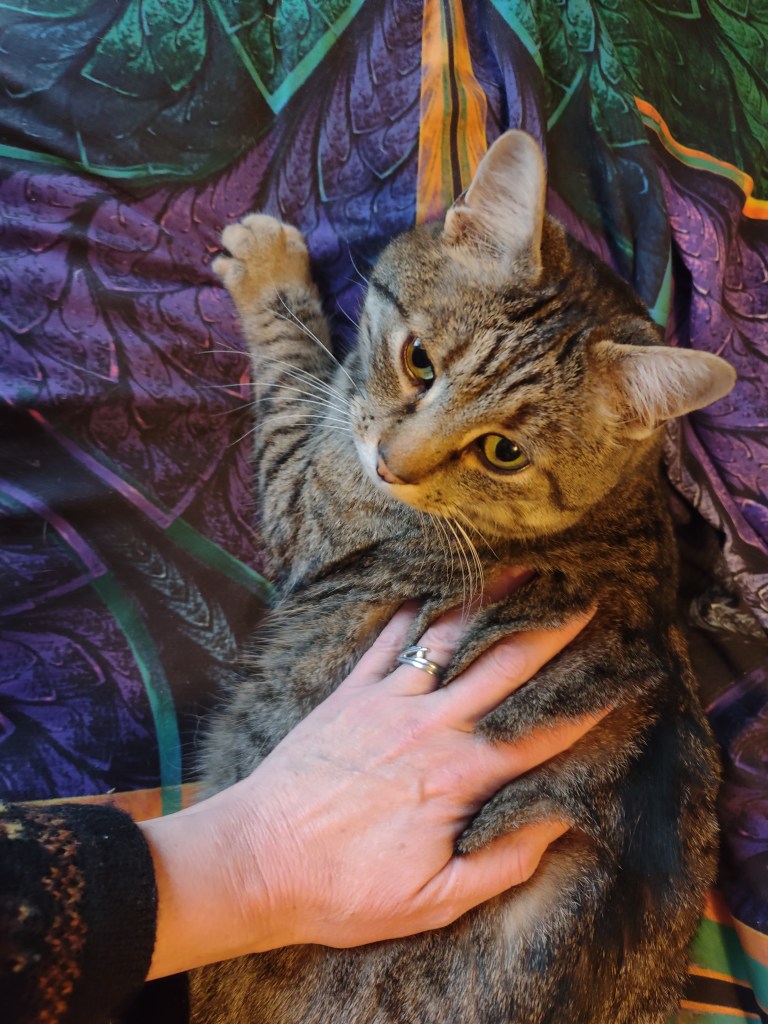
You would think it would be the same for one of my barn cats, Squeaky.  He also has a thick coat of fur; it looks as thick as the fjord horses.  But once it gets cold out, say below 20 degrees, he moves into the house at night.  Maybe his feet get cold. But he comes in grudgingly, spending a bit more time each day.  He really dislikes being contained. I’m sure he’s claustrophobic.  He is torn between freedom, and warmth.  Eventually warmth wins.  In the coldest of cold weather, he claims his place on our bed.  But he doesn’t sleep through the night.  And when he gets up to eat, or use the litter box, he tells us about it.  He meows in his squeaky voice.  He requests our presence at two in the morning, to make sure his food bowl is filled, or to open the door to let him out before he instead decides to run back upstairs.  Or sometimes he just wants a little comradery, a quick pet before allowing us to go back to bed.  Often, I don’t really mind the short late-night visits with the cat.  I don’t sleep well anyhow, and I’m okay with a walk around the house in the middle of the night.  It’s an excuse for a drink of water, or to use the toilet, or to peak at the thermometer– and really, it’s very calming to pet a cat in the middle of the night.  Although I admit it would be a lot more calming if I didn’t have to leave my warm blankets to do so.  

On the fifth night of the recent arctic blast, I think Squeaky was starting to go stir crazy.  He woke me up around midnight, so I could check his food bowl.  He woke me up a bit later, to pet him.  And then he spent some time chatting with the dog.  Eventually he got my husband up at two am, or maybe it was three.  My husband will typically catch the cat and shove him out the door, but Squeaky is sneaky and will instead run away back to the bed.  There were so many meows that night, I almost feel like he was serenading us, or telling us stories about mouse-catching adventures outside on warm summer nights.  Unfortunately, Squeaky does not have a melodic lilting meow.  As you might guess from his name, his voice is harsh and off-key. 

I think my husband and I were going a little stir crazy with the cold snap, too.  Because neither of us got mad at the cat waking us up multiple times that night; he just made us laugh.  When Squeaky does decide to spend a few hours straight in the bed, he is the best snuggler, curled up in a ball tight against our legs.  He doesn’t even mind being shifted to one spot or another, as long as we pet his warm silky fur in the process.  He gives us several meows in thanks, letting us know he appreciates those middle of the night check-ins and our short conversations. 

The Snow and the Rain

The new Mary Janes Farm issue for February-March should be out today. I have an essay published in the issue: Rain Coats. There are several nice essays in the “Keeping in Touch” section, in addition to mine. 

Below is my essay from the last issue, if you didn’t catch it in the magazine. It’s perfect timing to share, since we are supposed to get some serious snow tonight. 

Snow Secrets

There is something completely satisfying about finishing the outside chores during winter evenings, then retreating inside to the warmth.  Chores like making sure the horses are fed and bedded down, the water troughs are thawed, or just that last evening barn-check under the stars while taking the dog out for her late walk.  The winter nights are so quiet, especially when it’s snowing. 

I remember one night when the snow was falling gently, then coming down hard, then dumping even more.  Soon we had six inches in the driveway.  Usually, my husband volunteers for the snow removal duties, whether by shovel or snow-blower.  I always thought it was just because he was a good husband, and it was a heavy and time-consuming chore.  That evening, he was out of town and the snow clearing would not wait; I needed to get the car out in the morning.  My boys were little, but old enough to leave unattended for a bit with books and toys to occupy them.  

After dinner I dutifully suited up in snow pants, boots, hat, and mittens.  I briefly considered the snow blower, and then looked at the texture of the light and fluffy snow– a shovel would do for this task.   I grabbed the snow shovel, frowned at the expanse of driveway, then started in.  I prepared for heavy work and sore muscles. 

The first slide of the shovel across the driveway was smooth, like dipping a spoon in soft ice-cream.  The snowflakes continued to fall, sparkling like sugar in the porchlight.  I slid my second shovel path across the driveway, tossing the snow up at the end.   There was only the sound of the scraping shovel. No kids, no TV, no cars driving by.  I pushed the shovel again across the driveway, noticing how bright the snow was, with subtle colors of blue and gray softening nearby fence boards in the night.  Soon I had my rhythm going, making steady progress down the driveway.  Few of my jobs at home or work have such visible progress, this was an exception.  Each push of the shovel made a difference, soon I was halfway through.  I took my hat off.  The night wasn’t too cold, and snowflakes landed on my eyelashes.  I tasted the snow on my lips.  I paused a moment, leaning on the shovel, and looked across the yard to see the horses watching me from their warm clean stalls.  I took several rests, not because the work was so hard, but because the night was so serene.  Bright snowbanks grew in the gray dark, a toss at a time.  The air smelled clean and cold.  I finished the job quicker than I expected, doing the barest minimum so I could get back inside to the kids and the warmth. But I hated to leave the stillness.    

I discovered my husband’s secret that night.  Shoveling light snow on a winter evening is a delight.  Later that winter, I learned that snow-blowing had its own kind of repetitive satisfaction, guiding the machine while chewing through deep snow, watching it spray to the side.  That winter though, our snow falls added up, and the delight of the job faded with time, weighed down by wet heavy snow. The work got harder and harder as the snowbanks grew higher and higher along the edge of the driveway.  But I still remember that first snow, glittering and sparkling around me, flakes floating down and decorating my mittens on the shovel-handle, all sounds absorbed in the soft mounds of snow. 

Happy New Year and Happy New Book Year!

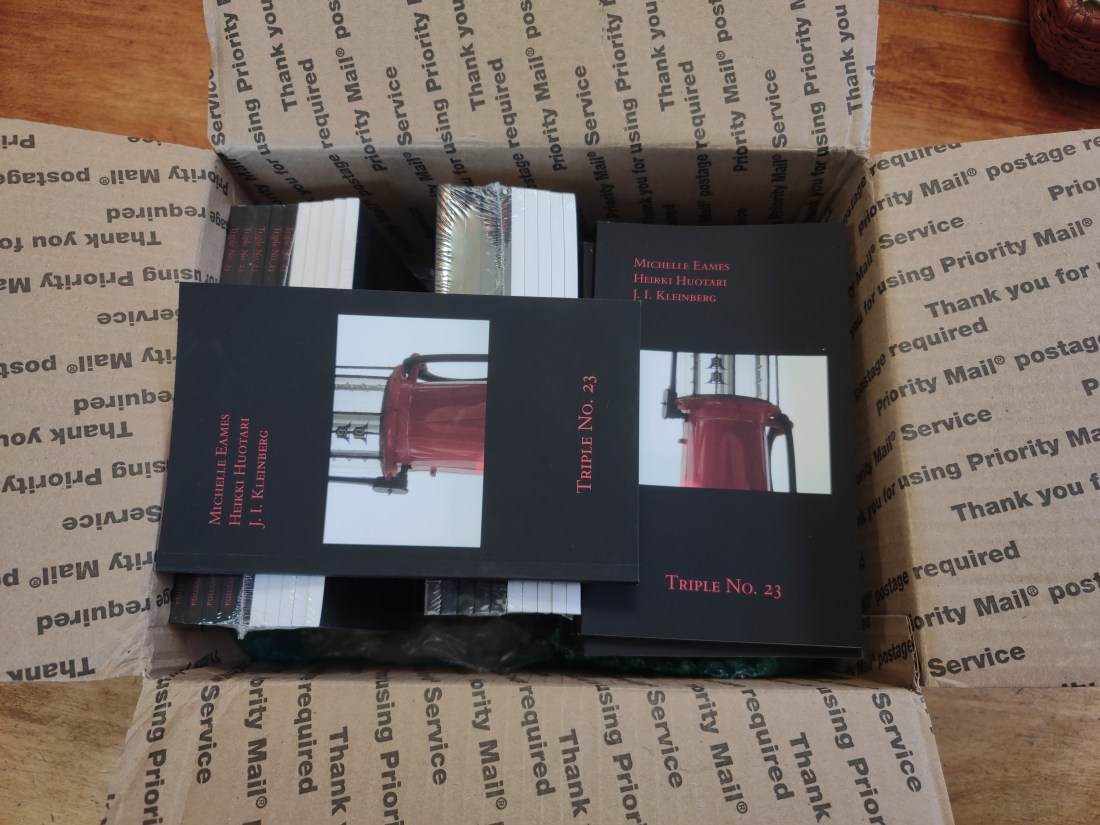
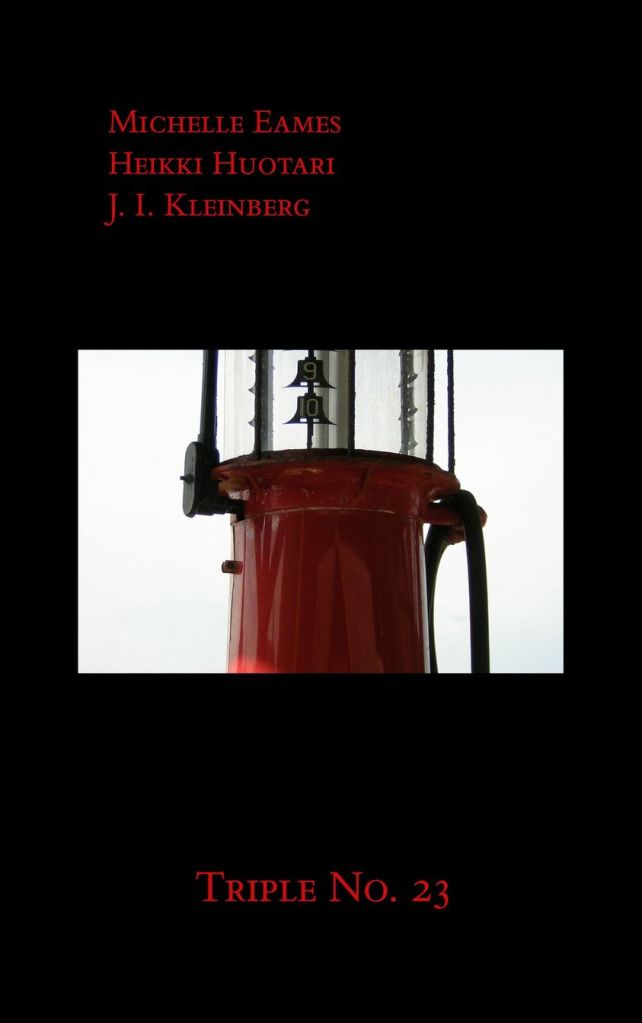
My fire poems are finally published! Ravenna Press has published Triple No. 23, with poetry chapbooks (short collections) by three poets (including me!). I was so happy to receive a box with my copies on the Winter Solstice.  It definitely brightened the longest night of the year.  Read on for details, and how to get copies.

My section of the book is titled Fire Triangle (Heat, Fuel, Oxygen) and includes 16 poems related to fire and wildland fire fighters, with several accompanying illustrations titled Arbitrary Borders by John Burgess, a graphic artist.

The second section of the book is titled Context for an Afterthought with prose poems by Heikki Huotari.

The third section of the book is titled Desire’s Authority with poems by J.I. Kleinberg.  This poet from Bellingham, Washington, writes collage poems, created with fragments of magazine text.  (They’re pretty cool; I might have to try some.)

How to get copies:

Option 1: If you would like a signed copy of the book, you can message, comment, or email me, and we’ll figure out the best purchase process.  The book is $12.95, and shipping within the U.S. is $5.00.  But if you’re close, I can deliver or meet you somewhere. I’m happy to provide copies until I run out.  Note that this option is the only way I get a bit of money, because, well, poetry.

Option 2: You can order the book from the publisher, here:   https://ravennapress.com/books/series/triple-series/

Option 3: You can ask your local bookstore to get you a copy.  And maybe they’ll order extras.  And maybe lots of people will buy them, and maybe we poets will be famous!!  But not rich.  Because, well, poetry.

Option 4: It should be available on Amazon, too. 

Again, Happy New Year and I hope you read lots of good books this year, including some poetry.

Purrcy’s Law

Murphy’s law says that if anything can go wrong it will go wrong.  We have a cat, Purrcy, and his law says that if anything can be done, it will be done.  If a plant can be tipped over, causing damage and debris across the living room, it will be done.  If a dog can be bothered until it chases him, it shall be done.  If a table can be jumped on, so it shall be.

Our friend Jerusha found Purrcy out by our barn meowing.  He hopped right into her arms.  We now blame Jerusha for all our cat challenges.  Meanwhile, my son Chris says the cat is mine.  I say he belongs to Chris.  But in reality, Purrcy belongs to each person he chooses, one person at a time.  He is his own cat. 

We already had a barn cat, Squeaky.  A few years ago Squeaky arrived the same way, he just showed up.  We of course always neuter our animals, so Purrcy could not be an offspring of Squeaky.  But they could be cousins.  Grey tabby cousins. You have to look twice to figure out who is who.  Squeaky is chubbier, has a wider face, and a shorter tail.  Squeaky has always been cautious and reserved, and only lets a few trusted people pet him. 

Purrcy was half grown when he arrived.  Squeaky was middle aged by then, and at the fat and lazy stage of his life.  Purccy would approach Squeaky with joy, shove his face at Squeaky’s nose, and ask to play.  Squeaky would meow his namesake squeak, and then leave.  Eventually, they moved on to wrestling for a few seconds, then Squeaky would tire of it and simply sit on Purrcy.  Squeaky was fat and it was a successful move to finish the match.  Finally, we saw the two cats sitting outside on a lawn chair close together.  A feline friendship began.

Gradually they got to the point where they could be near each other inside the house, and sometimes would even groom each other, licking on the lovely itchy spots under the chin and behind the ears.  It wouldn’t be long though before Purrcy would have enough of the love-fest and bat Squeaky in the face.  Then we would push the writhing mass of wrestling cats outside.

Purrcy is the most confident cat I have ever been around.  He loves and approaches everyone.  He will play with the horse’s tails.  He has tried to stalk the chickens, even though they stand taller than him.  He is fearless around our dogs. He teases our dog Cookie and Gramma’s dog Penny.  He taunts them by running from them in the living room, then disappearing behind the couch, to suddenly rush out the other side and bat the dogs on the head.  Then he scampers back under the furniture again.  The dogs love it, but get over excited and we send them outside.  This generally solves all of the animal problems at our house: send them outside.  It used to work with the kids, too.  And my husband. 

In the house Purrcy is always looking up trying to figure out how to get to the top of furniture and shelves.  He has not been on top of the fridge yet, but he scopes it out daily.  He has found a hidey-spot in a basket on top of the armoire in our bedroom.  He typically knocks things off my dresser as he finds his way up.  My son says he regularly knocks over water glasses in his room.  The other night I was in bed, but not asleep, when Purrcy walked over my body like it was a bridge, and then stepped up on my bedside table.  I grabbed my full water glass and held it tightly on the bed while Purrcy crashed around and explored everything on the table.  Soon, he hopped back down to me, put his head in the water glass I was holding, and started drinking.   He drank a lot from my glass.  It’s not like we don’t have animal water available in a bowl downstairs.  The next morning he came in again, and hopped up to get another drink from my glass.  This time I reached over and held the glass steady for him as he drank. Luckily I was awake enough to be his support staff, and prevent the glass from being tipped over.  And as I lay there, I wondered how many other times he drank from my glass, and I would later take an unknowing sip?  Bleck, cat germs!  The next night I changed out my water glass to a water bottle with a lift-top on it. 

I believe that Purrcy is a reincarnation of our old black poodle Buster.  Buster was also a confident animal that loved all people immediately.  Purrcy has claimed the spot on the top couch cushion that Buster used to lay on.  This is the best place to lay and survey both outside and inside the house.  Like Buster, Purrcy begs for food and eats everything except vegetables.   I am also quite sure that Buster is disgusted that he came back as a cat.  In the hierarchy of life according to Buster, cats rank out far below poodles.    Purrcy begs to differ.

If It Weren’t For Bad Luck

I broke my arm coming off my horse in September, then in late November I tried to walk when my foot was asleep and fell and broke the same arm again, in a different spot.  My doctor called the second break freakishly bad luck.  I kept waiting for the third bad luck; I didn’t have to wait long for my son to cut himself on his index finger, requiring an emergency room run and sutures. I’m hoping we are done with bad luck for a while.  In the meantime, here is an essay about luck.

Bad luck comes in threes, and it feels lately that I am surrounded by bad luck. I remember the song lyrics: “If it wasn’t for bad luck, I wouldn’t have no luck at all.”* I keep counting my bad luck.   I count in threes, then when more bad things happen I count in nines, then twenty-sevens.  My bad luck is increasing exponentially.  It’s not just the little things: a malfunctioning light switch, a twisted ankle, a trip cancelled due to snow.  It’s the big things: a car in the ditch, death of a family member, dealing with another broken arm.  Then I add in the other bad luck and challenges my friends and community are struggling with, more death, another war in the middle east, or potential toxins in our water.   There is so much to worry about.   I’m not sure what to do except drink chamomile tea before bed and hope I can sleep; or on the worst nights, pour myself some whisky before bed.  Maybe I should just stop getting out of bed and bring the whole bottle in with me.  The bad luck multiplies like mosquitos in a marsh in spring, and the mosquitos are carrying West Nile Virus.

I am forcing myself to look past the bad luck.  If I don’t count it, maybe I won’t dwell on it.  I’ve decided to count my good luck instead.  I’m sure good luck will beat bad luck, because rather than coming in threes, it comes in fours.  Of course, I’m making that up.  Afterall, four-leaf clovers are lucky, and they have four leaves.  In an exponential race, fours will always win over threes.   And even-numbers are so much more shareable: imagine four chocolate graham crackers.  No crackers worth their salt break into threes.   Four graham crackers, quartered, make sixteen pieces.  So symmetrical. So calming.  Sixteen pieces of sweet, good-luck crunch.  I’ll start my list of four pieces of good luck: my broken arms were simple breaks, no surgery was necessary.  It’s winter, the best time to be inside and resting, the best time for broken arms.  Since I won’t be making homemade gifts for Christmas due to my broken arm, I can visit galleries and buy art for friends and family instead.  The planned eye surgery I had in the midst of all the unplanned injuries has improved my site in my right eye.  Now I can more clearly see my list of good luck growing as fast as I can count.

I was so sure of myself and my new-found luck-counting strategy that I looked up lucky numbers on the internet.  All answers can be found on the internet, right or wrong. Unfortunately, it turns out four is considered an unlucky number in many Asian cultures.  The Chinese word for four sounds the same as the word for death; a number to be avoided.  But the Buddhists talk about the four noble truths, and the eightfold path.  Together, these ideas recognize that suffering and anguish exists, and that there are ways to live that lessen the suffering.  There are ways to be in-the-moment.  Four truths, and eight guidelines.  Eight.  An even number divisible by four.  See, there is something special about my good-luck number.

Perhaps luck is not in counting at all, but in my attitude.  I have always been an optimist.  I thrive in my optimism.  I hide in my optimism. I stick with things long past the time a normal person would give up, because I believe it will get better.  I believe there is room for compromise, and talking, and working things out.  Mostly.  Unless you push me too hard.  Or you bother my kids.  Then you will find it unlucky to push my limits.

Sometimes attitude is all about rituals and taking time.  In The Gambia, they have complicated greetings.  Before talking about anything else, you must ask how the family is, how the day is, how the work is, how all of the people of the village are doing.  The answer is often a variation of “Peace”, or “Slow slow”.  But my favorite answer is: “Here only.”  The family is here only.  The day is here only.  The work is here only.  All of the people of the village are here only.  I love the simplicity of the phrase.  All these challenges and bad things are going on, the peanut fields need weeding, the lunch isn’t cooked yet, the water needs hauling, the baby is sick, but life is still continuing; it is here only.  That’s where I need to be.  Here.  Here and now.  Here only.  No good luck, no bad luck, just here.    

I often pretend I have it all together and nothing bothers me.  But it’s not true.  I try to live in the moment, but I don’t succeed.  I’m a total worrier.  I worry about things I have no control over.  I worry about other people.  I worry about our government.  I worry about kitchen cupboards and whether there are enough screws in them to hold them on the wall.  When I count my worries, whether by threes, or by fours, I can’t sleep.  With a roof over my head, a warm bed, and a whole weekend to relax I can still worry myself awake.  I could find a new drug that allows me to sleep, but then I’d worry about the side effects.  Maybe I can calmly develop steps and solutions to solve each worrisome problem as I lay sleepless.  When I try to do that, it takes all night.  So I get out of bed, move to the couch, take an herbal remedy that may or may not work, and sometimes I fall asleep.  Sometimes it’s the change of scenery, change of cushion, change of location that allows me to sleep.  I am not just here only, I am there only. 

I still wait for the day when life will calm down, and only good things will happen; the day I will just have good luck.  But I think this only happens in fairy tales, and even then, there are evil step-mothers and scary giants.  Until that perfect day when all my luck is good, I will try to embrace what is here, only.  I will count my chocolate graham crackers and share the pieces with my friends.  The Buddhist poet Masahide wrote one of my favorite sayings: Barn’s burnt down-/ now/ I can see the moon.  The next time I wake up in the middle of the night worrying about my bad luck, or needing some ibuprofen for my arm pain, I’ll go downstairs, open the blinds and look for the moon. 

* “Born under a Bad Sign” by Booker T. Jones and William Bell, sung by Eric Clapton, among others.

[photo credit pexels.com]

It’s All a Blur

It’s been a long fall already.  The broken arm is healing nicely, but it’s not 100 percent yet.  Initially I was told to avoid lifting completely, but at my 6-week follow-up I was told to lift nothing heavier than a gallon of milk.  I will now and forever estimate weight in terms of gallons of milk.  My friend and I determined that an English saddle is about 2 gallons of milk, and a Western saddle is about 3 gallons of milk.  I guess I am not quite ready to ride, or at least not to saddle.  Also, I just figured out that cleaning out horse hooves with a hoofpick definitely hurts.  I know I’ll be ready to ride when I can properly groom my horse (plus lift two gallons of milk).

As if I wasn’t messed up enough, I had a planned eye surgery on Halloween.  That went well, however as the retina healed on my right eye, I was told not to lift anything (again), not to exercise, to avoid falling, and to avoid any jarring activities.  This included avoiding driving on bumpy roads.  The doctor clearly has never experienced our gravel road. Anyhow, this added more limitations to my already limited activities.  Sigh.    

Right before my eye surgery, our local library system had organized a small writers’ conference.  One of the classes I took was about podcasting.  After the class, I determined that I would never be a podcaster.  Too much new stuff to learn.  Plus, I’m a writer, not a talker.  But I did learn that there are more kinds of podcasts than I ever knew. 

Right after my eye surgery everything was blurry.  So even though my arm was healed enough to easily type and write, I could barely read.  Instead of reading or writing, I started listening to podcasts.  Lots of podcasts.  I listened to fiction podcasts, comedy podcasts, chick-lit podcasts.  I must admit that none of the fiction podcasts I found hooked me, although it was fun to explore the options.  But I did take time to listen to several writer and author podcasts.  They were helpful, interesting, and I learned some things about craft and process that I didn’t know. 

Here are the podcasts and radio shows I regularly listen to, and spent a lot more time with during the blurry time:

I also listened to several writing and book podcasts and radio shows, and really enjoyed the following author interview programs:   

Now my eye is better, my arm is improving with physical therapy, and I figure I’ll be ready to get out and ride just as the weather turns really bad.  Come on Spring!!!

[photo credit: pexels.com]

Tastes of Home

In late October I travelled to my hometown of Blaine, Washington, to read from my book at the local library.  Sixteen folks attended, 13 of them were family, one was a classmate, and two were strangers (that I now count as friends).  I had a blast! I felt loved and supported, and I sold one book.  To my cousin.

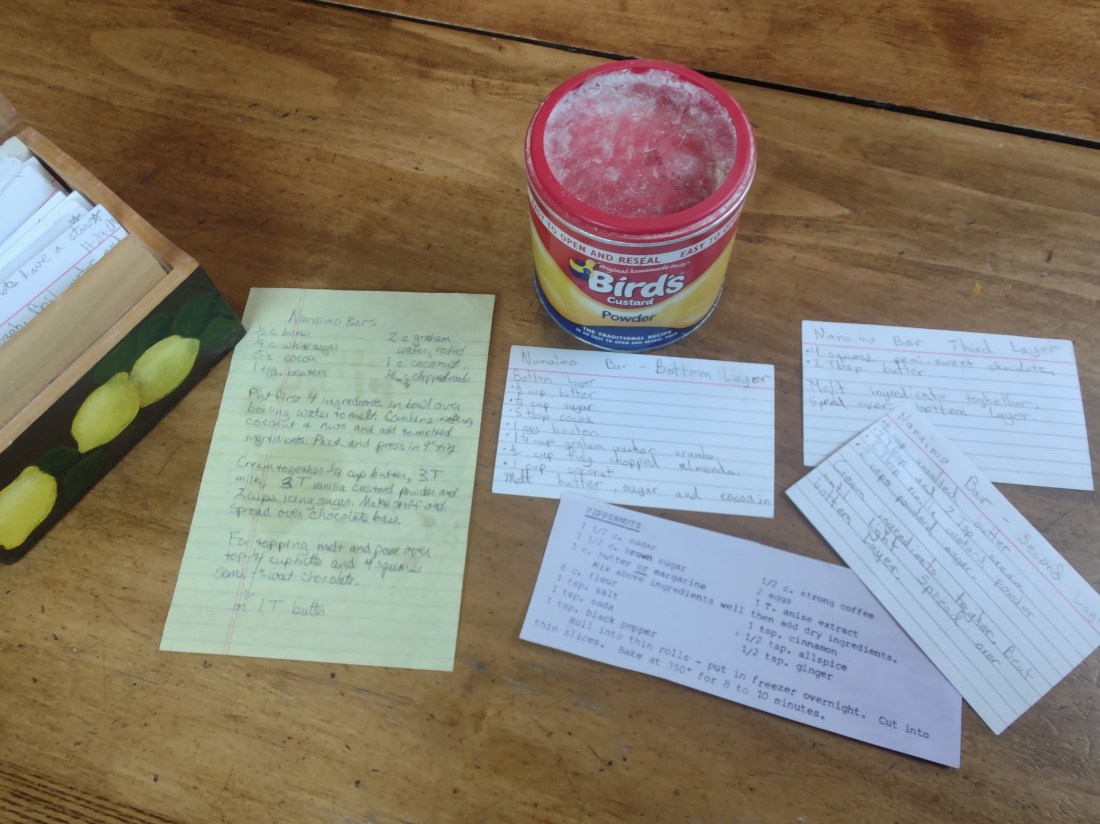
As always when I visit my hometown, memories flood back.  This time it was food memories. I must have been hungry. And it was desserts that I thought of.  Like Nanaimo bars, that originated in the town of Nanaimo, British Columbia.  Blaine is a border town, right next to Canada, and there are and were many Canadians in the community.  Therefore, at school functions and bake sales, Nanaimo bars would show up.  These rich 3-layered bars with chocolate and custard are delicious.  So delicious that when I started teaching my oldest son to bake, I pulled out an old grade-school recipe book and taught him how to make them.  We even made sure we had the correct custard powder to make them exactly as the recipe required.  They became my son’s favorite dessert, his specialty.  My son was a math geek at an early age, and one time he decided to calculate the number of tablespoons of butter in each Nanaimo bar square.  Trust me, you don’t want to know. 

Blaine also has a lot of people of Icelandic heritage.  Even we folks of Norwegian heritage learned the intricacies of making Vinarterta, a scrumptious Icelandic cake made with numerous layers of thinly rolled cookies, Italian prunes, and a light frosting.  It is cut into tall squares and is visually gorgeous with the dark and light stripes of fruit and cake.     

I also remembered these little spice cookies that my Icelandic-heritage friend shared with me in middle school.  They were tiny brown cookies that were perfectly round, the size of a thumbnail.  Months ago, I had asked my friend for the recipe, and she said she didn’t remember them.  My online searching at the time didn’t turn up anything that looked right.  But visiting Blaine reminded me of those little cookies.  I was on the search again.  I was pretty sure the cookies were called Pfeffernusse.  That’s Icelandic, right?

Turns out I was wrong.  They were not Icelandic.  I finally found a recipe that looked right, and the website said they were Mennonite/German cookies.  Woops. Pfeffernusse is German, and the translation is pepper nuts.  They actually have black pepper in them.  You know how sometimes we transpose letters or numbers and things come out kind of backwards?  My brain transposed the wrong friend into my memory.  It was my Mennonite-heritage friend who shared the lovely little brown spice cookies with me, not my Icelandic-heritage friend.  My sister-in-law helped me track down a family friend’s pepper nuts recipe.  I recruited my younger son and his girlfriend to help me make them once I returned to Spokane.  They are still good! 

We ate and gave away all the Pfeffernusse/pepper nuts cookies.  It’s okay though, because they are super small, and therefore have zero calories.  Now what am I craving?  It’s cold and rainy out, so maybe something warm… Clam Chowder is another classic Blaine recipe.  I remember clam-digging for horse clams at low tide in cold rainy weather. Just thinking about that is making me cold. A cup of hot cocoa sounds much easier right now.

P.S. A better blogger would have included the cookie recipes along with beautiful pictures of the baking process in a clean gorgeous kitchen with fancy gadgets like a stand-mixer. But that is not me. I found the classic Nanaimo bar recipe, linked below. I’m having challenges with the direct link to a Pfeffernusse recipe, but go to Thefrugalgirl.com, and search for Pfeffernusse. Or I can type up the recipe my sister-in-law found upon request. And finally, I don’t actually have a Vinarterta recipe, because other family members make this one. But if you really want it, send me a note and I’ll find a Blaine recipe for you.

https://www.canadianliving.com/food/baking-and-desserts/recipe/classic-nanaimo-bars

Penmanship

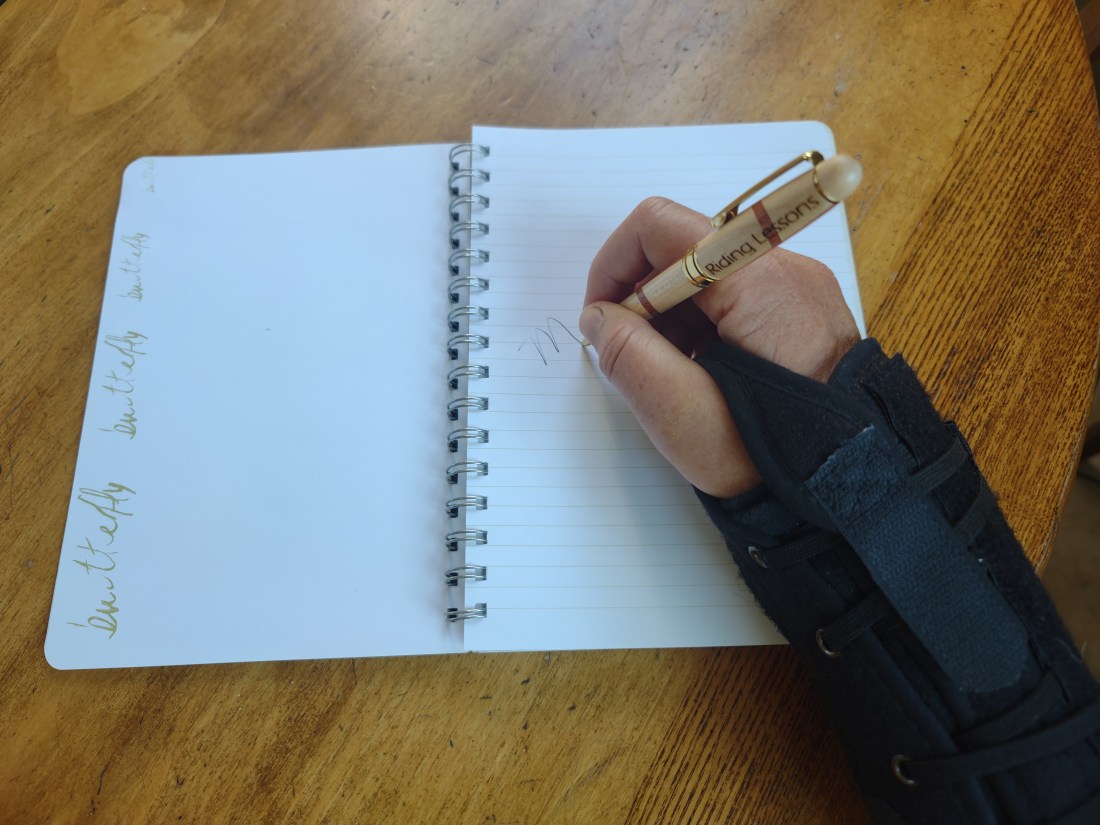
I broke my hand a few weeks ago.  I didn’t realize how much I used my dominant hand.  Learning how to sign, or even just initial, documents with my wrong hand was hard.  The initials were large, square-edged, rough, robotic.  The letters had none of that smooth roundness of automatic cursive we have all used since second grade. 

At least some of us learned it and used it.  I remember watching my younger son’s printing when he was beginning to learn to write.  Large, square-edged, rough, robotic. But his teachers said just wait; wait until he learned cursive.  Our grade school taught it when other schools were phasing it out.  I watched, when he finally learned, how the writing got smooth, organized, pleasing to the eye.  Something connects in the brain when you don’t lift the pen from the paper. Even his printing improved.

I remember when I was learning creative writing.  A teacher said use paper, not a computer.  Keep writing no matter what, even if you are just repeating, “I don’t know what to write.”  Keep your pen moving on the paper.  I did that for years, writing in notebooks, both good stuff and garbage.  The trick is not to lift the pen out of the journal.  Write your stream of consciousness. Later, you go back and pull out the good bits, and those become the start of pieces that you then improve on the computer.  The process works, the pen connects to a deeper part of the brain.  But eventually I changed to free writing on the keyboard instead.  Have I lost something?  Maybe. Although at the moment, keyboards are way easier than writing long hand.

Now with a broken hand I’m noticing the different connections to my brain.  The left-hand connection is slow, like a shorted-out wire.  I needed to find a way to write my to-do lists or take notes from a phone call.  My left-hand penmanship was giant, messy, and nearly indecipherable.  We had debates within the family on what my notes meant.  I often wasn’t sure myself.  Scribbling wasn’t working.  Typing was better, with some finger movement allowed on my right hand.  I finally started using the task list on my google calendar, instead of my usual long list of hand-written notes in a notebook.  I had to keep my to-do list somewhere, or I was lost.  The computer version works well, I may continue it after healing.

Initially, I wondered how I would make it through my reading and signing event in Blaine on October 21 with a broken hand.  Luckily, on my recent visit to the hand specialist, I got a better brace that allows more finger movement.  Typing is much easier now, and I can slowly, though a little awkwardly, sign a book with my right hand.  Or should I call it my write hand?  At least now, my penmanship is mostly readable. 

1. Chaos Theory *, **

* Definition from Oxford Languages: noun; the branch of mathematics that deals with complex systems whose behavior is highly sensitive to slight changes in conditions, so that small alterations can give rise to strikingly great consequences.

**Definition from Michelle: noun; the branch of animal behavior that deals with typical horses in a group during a random trail ride.

Chaos reigns.  I met some old family friends to ride. I thought it would be an easy ride because their horses were old, as were the riders, as am I, and my horse has been a good boy all summer. However, two of the horses were a handful, they were worried and hot from being in a new location. One horse, the Arab, was being ponied (led), from the gray mare.  The gray mare was a good soul, but there was a lot going on. The ride was tense, though my horse Vali was good, while the little Haflinger was busy and prancy with her rider.  We started at an uphill walk to settle the horses.  Betty (not her real name), the rider on the nice gray mare, struggled to lead the Arab gelding who was bucking and rearing and pulling. I watched as her horse reacted to the bucking and rearing horse beside her, as her saddle started to slide sideways. Chaos continued as the Arab acted up; I saw Betty let go of the lead rope, as she slowly fell sideways, slipping down with the saddle landing between two horses. I started to dismount to help and catch the loose horse just as Vali jumped, spooked, reacting to all the chaos and the loose running horse. I was off, hitting the ground hard.  Betty was off. The third rider was still mounted on her tense prancing horse.

Now there were two loose horses as I sat on the ground trying to catch my breath; the wind was knocked out of me. Finally, once I could breathe, I assessed my body. My right hand hurt. But I could stand, and went over to try to catch my loose horse so I could help. The remaining rider dismounted. Three riders on the ground. Two loose horses. Chaos decreased once I caught my horse. I held my horse, reins around my elbow, and held the gray mare with my left hand, while she was re-saddled.  Then the two hot horses, the Arab and the Haflinger were led back to their paddocks a short distance away. Betty on the gray horse and I planned to continue our ride. Because that’s what I do, follow through on my commitments, even when it hurts.  Oddly, as we started out, I felt my glove on my right hand getting tighter. I pulled it off with my teeth. Betty saw the two lumps swelling either side of my wrist and insisted we stop riding. We led our horses the short distance back to the horse trailer. As the ladies apologized, I loaded my horse, fully saddled, since I was sure I couldn’t lift the saddle off one-handed. I drove the short distance home with one hand.

At home my mother helped me unload and untack while my husband called to find an urgent care clinic. A small bone in my hand was broken. I have a brace and an ace bandage wrap until I can get to the specialist. I am learning how to do things left-handed.

I am calling this my season-ending event. A few weeks of healing will interfere with the best riding weather of the year. I am confident my horse did nothing bad, he just spooked when I was unbalanced– normal horse behavior. He’s still a good boy, and gets an early winter break this fall.  My friends were so worried and apologetic that their horses were buttheads and hurt my hand. It comes with the territory: chaos, reins, and horses.

2. Call Me Lefty

I figure doing things left-handed is good for my brain– establishing new synapses. I figure it is good for my coordination– learning to pour coffee left-handed without spilling. I figure it is good for my patience– learning to do things slowly, step by step.  I can drink coffee or manipulate the computer mouse, but not both concurrently.  I need to accept slowing down, doing one thing at a time, breathing, and finding my Zen.

Meanwhile, I am learning to use dictation In Word.  I didn’t know that capability existed. Thanks to my techy kids for pointing that out.  I did learn that Word dictation would not allow me to use the word “butthead”.  It typed out as ****head. What the!!!!  If they are bleeping that mild word from my vocabulary, we are not going to get along at all.  Turned out there was a setting for allowing or not allowing sensitive phrases.  Thanks again, techy kid.  Good thing we figured that out, since I tend very to be specific and technical in my speech.  Goldarned butthead software. Don’t censor me!

I am also learning to use the mouse with my left hand, because dictation only gets me so far.  I wonder how many words per minute I will be able to type with one good hand and limited motion in a couple fingers on the other.  I’m sure I’ll figure it out, and it will be good for my brain.  More new synapses.  I will let pain be my guide.  If my hand hurts, I won’t do that move again.   If my back hurts after shoveling manure one-handed, that chore will have to wait.  That is all I have, until I get into the specialist.  Nothing happens fast when dealing with the medical world. Healing is slow.  Appointments are slow. Typing is slow.

3. Don’t Act Like a Horse

I was telling my horseshoer about my unplanned dismount, and that my horse was just acting like a horse and wasn’t really at fault.  I was off balance.  He laughed and explained that his apprentice has been using that phrase for human behaviors lately.   For any unthinking emotional response, he says, “Stop acting like a horse!” I’m totally stealing that.  If I’m at a gathering and my friend leaves me with a bunch of strangers, and my inner introvert gets nervous about doing small talk, snap out of it.  Don’t act like a horse!  If several friends are going to a concert, and I don’t want to go with the herd, but feel like I should anyway, stay home.  Don’t act like a horse!  If everyone is driving too fast on the highway, and I get anxious and feel like I should do the same…Don’t!  Stop acting like a horse! This will be my new phrase to live by in anxious, unusual, or reactive situations.  Don’t act like a horse.  Don’t react emotionally.  Breathe.  Find your Zen and walk your own path.  Now, if only I can get my horse to “stop acting like a horse”. 

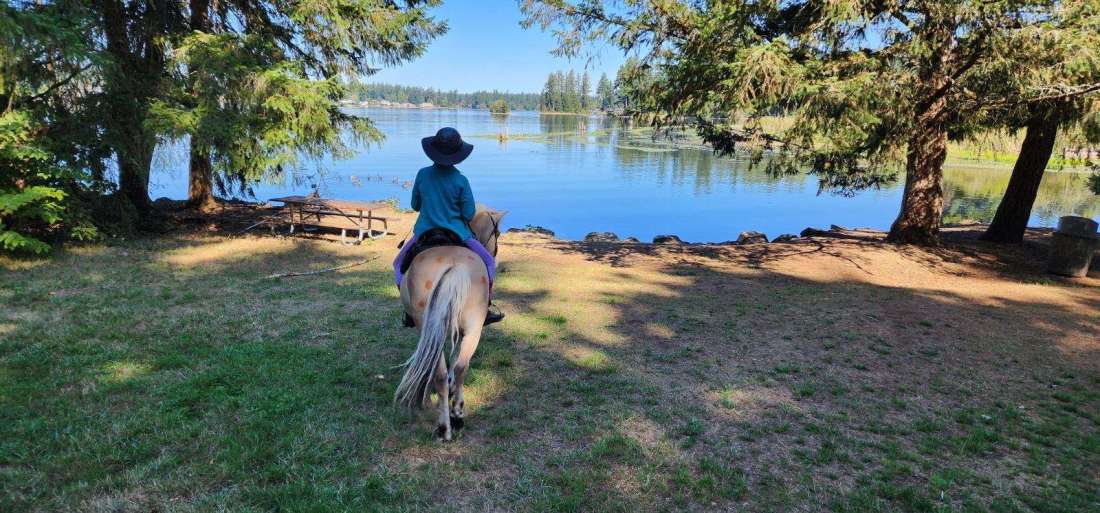
 [Photo Credit Sherry Lund- on a good day, not a chaos theory day…]

Once in a Blue Moon

We will have a blue moon, the second moon in a calendar month, on August 30, 2023.  This reminds me of a conversation with my son Mac, when he was very small.  I love when kids are adamant about what they know.  At least until they are teenagers, then its not quite as cute.

Blue Moon

“Mom, where’s the moon?”
“I don’t know.”
“Maybe there’s a blue moon.”				
“Maybe, but it isn’t really blue.”
“Daddy said there was a blue moon.”
“I’m sure he did, but it just means there are two moons in one month.”
“When’s the moon blue?”
“I don’t know.  We’ll have to look at a calendar.  It isn’t really blue.”
“Then why is it called a blue moon?”
“I don’t know.”
“Maybe there’s a blue moon tonight.”
“‘Blue moon’ is a phrase; it means something that doesn’t happen often.  We go to the mall once in a blue moon.”
“What color is the moon?”
“White, or yellow, or orange.”
“Daddy said there’s a blue moon.  I’m going to ask him.”
“Okay.  But it isn’t blue.”
“You’re wrong!”
“Maybe.  That happens...once in a blue moon!”


[photo credit pexels.com]