So Many Books, So Little Time

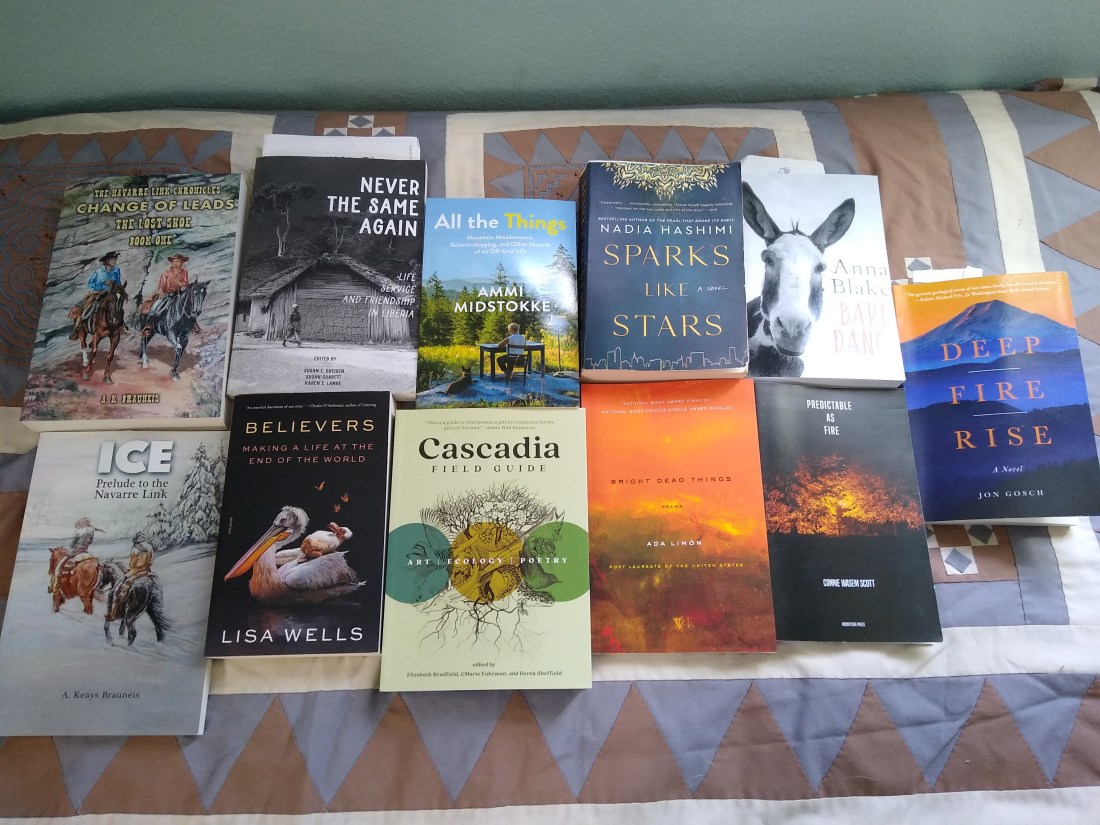
It’s been a fun month, but I bought too many books.  Is there such a thing as too many books? Not really.  I visited some friends on the west side of the State over the last month.  I bought some books and was given some books.  I bought some books from a woman selling at a festival, because I was curious how the selling was going, and if I might want to do something like that in the future.  After querying her in great detail, I thought I should buy a book, then she gave me another. I hope her books are good; I haven’t cracked them yet.  Most recently, I bought even more books at Spokane’s Get Lit festival, a celebration of writers and readers. 

My “To Be Read” (TBR) pile is large now.  It is larger than my bedside table.  This doesn’t even include the books already in my collection that I haven’t gotten to yet.  I’m going to need a whole TBR shelf in my library.  If I’m not careful, I might need to buy a whole new bookshelf.  Possibly a bigger house with a larger library. Because you can never have too many books.

I’ve been reading more non-fiction lately.  But one always needs a murder mystery on standby.  And I attended readings of several local writers at Get Lit, and one should always support local writers by buying their books.  Sometimes I want to read some poetry, and I found some amazing new poets (that even my non-poetry-loving friends might like, especially Ada Limon, the U.S. Poet Laureate; and Laura Read, a local Spokane poet.  Ha, I just noticed “Read” is her last name.  I must read some Read!).  I didn’t actually buy a book from every author I listened to at Get Lit, there is only so much room in my shopping bag.  But I definitely tested the weight limits of my cloth bag. 

Of course, I tend to read several books at a time.  Especially non-fiction and poetry, I pick those up, read a bit, and put them back down.  For fiction, especially good fiction, I will read for hours at a stretch.  But then what happens to my books after they’re read, since my house is small and my library is smaller?  Some I share and want back so I can admire them on my bookshelf, or, more rarely, so I can read them again.  Some I share and ask folks to pass them on to the next person.  Some end up in our Little Library in front of my mom’s house.  Eventually, when the Little Library gets stagnant, they may go on to a new life in someone else’s Little Library, or in a thrift store. 

I now must keep a list of books I’ve read and books I want to read, because my brain is full (not because I’m old and forgetful, mind you, it’s just full of knowledge). I have learned that if I keep my book list on google docs, I can access it from my computer, and also from my phone.  This is super handy in a bookstore!  Especially since there are so many other potential good books to tempt me—much like a bakery, or a candy store, but the temptations aren’t so sugary.  They are, however, more expensive.  

Because I like books, a few of my friends will ask me for book recommendations.  This can get awkward because I can never remember author names or book titles.  I have to be standing in front of my bookshelves to jog my memory.  Other friends give me recommendations on their favorite books; some might be fantasy, not my usual genre.  But I will try them just in case my tastes have changed.  Books are like friends; we need all kinds.  And friends are like librarians. 

Selling Books is a Lot of Work, and a Lot of Fun! 

I am making progress with the distribution and selling of my self-published book “Riding Lessons, Things I Learned While Horsing Around”.

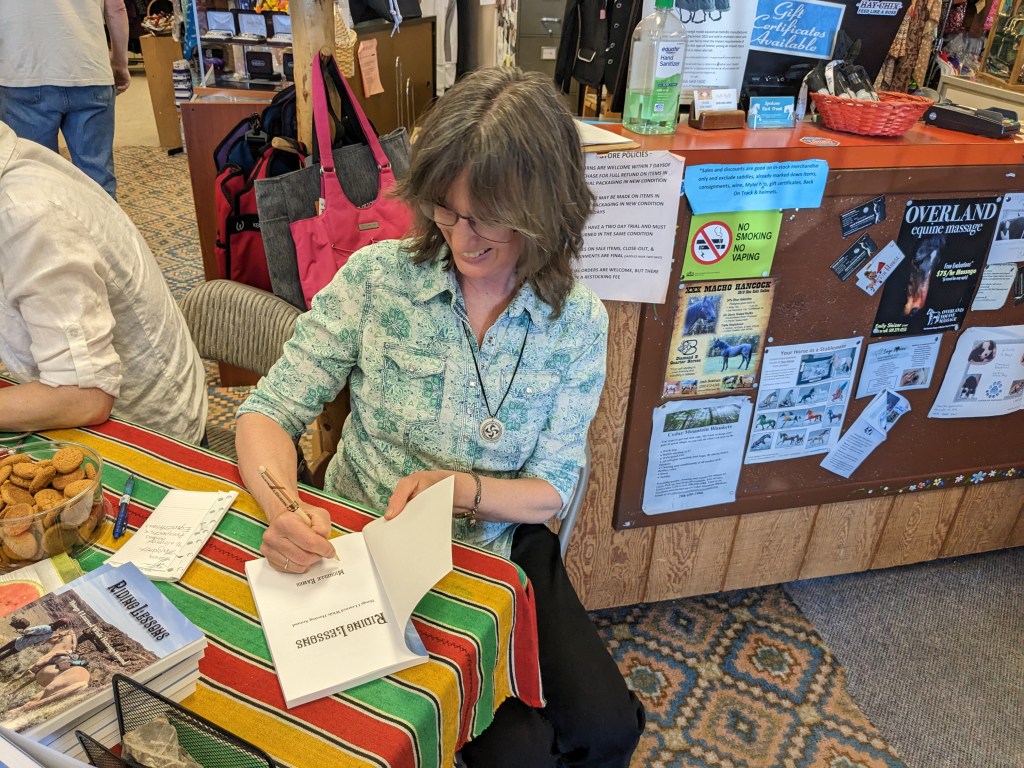
I will have a book signing event at Spokane Tack Trunk on April 30, 2023, from noon until 2 pm.  Morgan Shank will also be signing her children’s horse book at the event. Drop by to shop for tack or fun horse-themed accessories, buy a book or two, and have the books signed by the authors.  This should be fun! Please come visit, because if Morgan and I are left unattended in a tack store for too long, we might buy saddles. We do not need new saddles. And also there is a chocolate store next door. That could be trouble.

I now have my book in six retail locations, with the most recent being the Well-Read Moose, in Coeur d’Alene, Idaho.  In addition to that location, my book is carried at Orca books in Olympia, and at three Spokane area bookstores (Wishing Tree, Second Look Books, and Aunties).  And of course, the book is carried at Spokane Tack Trunk. 

All of the retailers have been super-friendly, helpful, and supportive.  I’m still surprised at how much time and effort it takes to market a self-published book.  It’s fun, and it’s work.  However, I get to buy books when I visit bookstores… this may explain why my profit to loss margin is not in the black yet…

I have received very positive reviews on Amazon, and in person.  Even non-horsey readers love the humor in my book.  My next book will be a collection of poetry and essays.  I think.  I’ll let you know as that progresses.  Per normal, it seemed like it would be easy to pull together a lot of my old pieces into a new book, but it’s not.  It’s work.  

If you have already bought my book, I hope you enjoyed it!  If you aren’t really one for buying books, ask at your local library and get them to buy it.  Hmmm… I should visit my local libraries.  More work. More fun. The good news is that my home-town library in Blaine, Washington, does have my book.  That makes me smile!

I look forward to more fun, more work, more selling, and more writing. Also shopping, as I visit new places that might want to carry my book.

Duct Tape and Baling Twine

After my “Farewell to the Red Boots” blog, my friends came through with some great advice.  They advised me on other good boots to buy, where to find red boots, and how to find them cheap (look on ebay!).  My kind of friends!  But more importantly, they described how to fix the leaky boots.  I am always trying to eke out one more week, one more season, or one more year to save money.  Notably, this also saves resources. 

My friends suggested patching my boots with E6000, a very strong glue.  Or Gorilla Clear Grip Waterproof Adhesive to apply a patch, or to use on its own.  I love having fix-it supplies around the house.  We may already have some E6000, and I’ll be shopping for the special Gorilla glue.  This will add to my ever-present availability of duct tape and baling twine.  With all of the above, I should be able to fix most everything around here, except car and truck engines.  There you need tougher stuff.  Like hose clamps. And a hammer.  And a big bank account for the real mechanic.

But for other things, baling twine is very useful.  I use it to fix fence, tying the mesh to the posts.  My older son hates blue baling twine.  When I used it on his pheasant pens, he gradually cut it off and replaced it with wire.  He’s right in that it looks funny, and it doesn’t last more than a couple years.  But its free!  And I have an unending supply! He needs to come visit, and replace the twine on our recent fence repairs.  It will make our place look so clean and finished.  Ha!  We still have the crooked and saggy fence lines and mismatched materials to deal with.  This hobby farm will never look like a manicured and formal Thoroughbred breeding farm in Kentucky.  We just don’t have it in us.

Duct tape remains useful all around the house and farm.  I’ve used it to protect the water trough heater wires from horse nibbling.  I’ve used it to hang electric fence insulators on the mesh fence between the posts.  I’ve used it for shoe and boot repair.  My younger son even used it once to create a duct tape rose.  All things can be accomplished with duct tape.  Although out in the weather it really is a temporary kind of fix, it falls apart over time.  But temporary can last for years around here, until that duct tape project works its way to the top of the to-do list.  Our to-do list is very long.

One time at my office we had some server issues.  Servers are the big computer thingy’s on trays that connect all the computers in an office.  They hide them in secure computer rooms. When they malfunction, the office computers don’t work.  And when you work in a small sub-office, the strangest people end up working on those things.  Like me.  With in-person, and remote help from our IT staff, we ended up stringing cables from one server to another server 10 feet away.  It was a mess of wires strung across the room.  It made me laugh, it looked so rinky-dink.  I especially was laughing because they had me helping.  I am not techy.  Nonetheless, we got a temporarily functioning system, with a web of wires that we had to duck under.  And when we finally got it finished, I added some baling twine and duct tape.  Just because.

Then there’s my barn roof.  It’s a small hobby-farm barn, just one story tall.  We’ve had some fierce winds over the years, and several aged shingles have blown off.  We tried some quick and dirty nailed on repairs, that again blew off.  Last year I considered re-roofing the barn. Then I learned how much professional repairs or re-roofing costs.  Surely I could get another year or two out of the current shingles.  So I you-tubed how to properly (sort of) replace missing shingles.  Oh… one must pull the nails out of the previous row, then tuck the new patch shingles underneath, and re-nail everything.  Got it.  The other key ingredient was roof tar.  We’re not talking a couple calking tubes of tar, we’re talking a gallon can of the nasty black goo, and a thick putty knife.  And of course my husband and son claim to be scared of heights, so guess who got to do this job?  Yup.  Me.  Add roofing contractor to my resume, right after computer hard-ware technician.

Weirdly, I enjoyed being on the roof, prying up nails, re-placing shingles, and spreading black goo all over.  With my mom’s help as the ground crew, we got it done.  It is not beautiful, and the new shingles don’t match the old shingles, but it’s on the back side of the barn; no one will ever see it.  I must admit, that after tarring the heck out of the roof, I had a craving for chocolate cake with dark chocolate frosting.  Roof repair and frosting a cake are more similar than one would think. Especially the way I frost cakes!

So there we have the list of items to fix almost everything:  E6000 glue, various Gorilla glues, Duct Tape, Baling Twine, and Roof Tar.  Let’s be clear that you can’t find lengths of baling twine in any old hardware store, but I’m happy to send you some.  Free.  Please. Take some baling twine.

[photo credit Margaret Eames]

Farewell to the Red Boots

Every hobby farmer needs some rubber boots.  Mud goes with farms like mallards go with water.  And on our farm, even more so, since due to the layers of basalt rock just below our shallow soil we get large seasonal ponds and expansive puddles.  Rubber boots are a must.  Cheap rubber boots are fun, and you can find them in bright colors, but they only last a year or so before breaking up at the bend points of the heel or over the top of toes.  Sometimes one just wants to splash through puddles like a kid, without getting wet socks.  Other times, Oly the Elder will hide in the middle of the pasture pond when I’m trying to herd him back to the paddock, and I have to go in for him.  However I think he knows exactly how tall my boots are, and he stays just deep enough so I can’t reach him. Boots matter around here.

In about 2016 I bought a pair of red neoprene lined boots.  I bought them on clearance, through REI.  The brand was Bogs, and the model was “Tacoma”.  That sounded appropriate, since Tacoma is a city in the rain belt of Washington, so I figured they had to be waterproof.  The boots had a low heel, although the heel wasn’t really tall enough to qualify as a safety riding heel.  But they were better than most rubber boots.  Also, they were warm with the neoprene lining, so were good in snow.  They were tall, to get me through a snow bank or a deep puddle.  They even had a decent arch to support my feet on long walks on our muddy road.   Best of all, they were a stylish bright red color.  I loved those boots, and I wore them almost daily from fall through spring.     

Last week I wore them in a deep puddle while repairing a fence, and found they leaked at the left heel.  I was devastated.  My favorite red boots were failing me!  They only lasted eight years!  I haven’t truly investigated the leak yet, maybe they can be patched, but patches don’t usually last.  I will eke out the spring season, avoiding deep puddles as much as possible, and search for a new pair next fall.  But I am sad.  I am sure I will never find such a lovely pair of boots again, with such a bright color and long-lasting water-proofness.  And, of course, at an affordable clearance price. 

For now, I am offering my thanks to the best farm boots ever! Soon our ponds will be gone, and I will be digging out my best pair of light-weight leather summer riding boots. But the snow season and mud season will come again.  I’m crossing my fingers and my wet toes that I can find new mud boots that will last as long as the red Tacomas.  But I am not hopeful. 

The Common Cold

As I sort through my old writings, I notice a lot of pieces about being tired, or being sick. The woes of a working mom with small kids. During the recent covid-hermit times, with the wearing of masks and constant hand-sanitizing, I didn’t catch colds. This week I relearned how miserable a plain old-fashioned head cold can be. I know I can’t complain, it’s just a cold, but, bleh, I’m sick and tired of it all. I think I am finally getting better, and my brain is less congested than before. I can think again. Below is a piece I wrote in 2007, at a time when I was reviewing a lot of federal water projects. It still rings true today.

The Common Cold

As if it wasn’t enough to be slowed down to a barely functioning level, with no help from kids and co-workers, but your voice gives you away by dripping with nasal tones, so that people on the other end of the phone start sniffling in sympathy.  Your nose flows a waterfall, moving along braided streams of reddened skin to the mouth.  The only way to control the flood is to go home and sleep with your head turned on the pillow, and a carefully engineered arrangement of Kleenexes on the downstream side of your nostril to act as levees and coffer dams to contain the flow.  The Army Corps of Engineers should be that good. 

Out of Scraps, Arise Poems

There is a poetry exercise that involves taking a page of a book, or a newspaper article, or other written material and “excising” or blacking out everything except the words of a poem that remain.  It’s like carving away at a block of wood until you reveal the figure inside.  It can be a fun and surprising process to learn what concise insights come out of a potentially long and boring article.  The final poem topic may or may not be related to the original article; you may end up with something entirely different. 

In the process of writing my book, I had some old double-spaced printed versions that stacked up a couple of inches high. We cut the pages into bits of scrap paper, the perfect size for making grocery lists.  One day my son and his girlfriend pulled out the pile of printed scrap paper and started crossing out words.  They ended up with a number of pretty cool micro-poems. 

If you’ve read my book that generated the scrap paper (Riding Lessons, Things I Learned While Horsing Around), you might be able to recognize which stories the phrases came from.  I must admit it’s a bit weird to see that some of the original meaning is still retained at about 1/100th of the length.  Maybe I use too many words…  In contrast, others of the micro-poems were more philosophical. 

From their total of 20 micro poems (which is such a lovely round number), I provide six of my favorites below. 

1 

Once upon a time, 
I had
All the daylight
Saddle, good 
Horsey necessities.  
Then I got 
Mac 
And said 
I wasn’t catching naps.


2

Miles apart
To meet 
It hurt bad.
But I ignored it, 
Jumped
To the other.


3 

Can do things
Like flying a moment on
Controlled precise movements.


4

My friend
Her daughter, 
Ponies, and
Loving 
Suffered through
The same summer
Injured once
Spent time.


5

Things were 
Very
Crisis-oriented
I was worried, it was still
Horses.


6 

Great
Speed and strength
Pegasus
Power and speed.

Walking Haiku

I have heard of walking meditation, where one walks intently, noticing each step, feeling each breath, and finding a meditative calmness as you move.  Thich Nhat Hanh, a Vietnamese Buddhist monk and global spiritual leader explains it this way:

“Each mindful breath, each mindful step, reminds us that we are alive on this beautiful planet. We don’t need anything else. It is wonderful enough just to be alive, to breathe in, and to make one step. We have arrived at where real life is available—the present moment. If we breathe and walk in this way, we become as solid as a mountain.”

(https://www.lionsroar.com/how-to-meditate-thich-nhat-hanh-on-walking-meditation/)

I’ve tried meditation before, walking and otherwise, but I’ve never mastered it.  I never get to that entirely calm state of noticing the breath with a calm mind. My busy thoughts always intrude. Or, alternatively, I go too far into a relaxed state and fall asleep.

I have done a lot of walking this winter, first when I signed up for a walking challenge to support The Nature Conservancy.  I walked 70 miles in January.  The more I walked, the more I liked it.  I found it calming.  I often walked in my own neighborhood, alternating directions, one day heading north on our roads, another day west, another day east.  I found I moved quickly and anxiously at the beginning of each walk; my thoughts were busy, worrying, problem solving, or thinking about what I had to do at home.  Somewhere in the middle of my walk, often at the point where I turned toward home, my edge was worn off.  I walked more slowly.  I was not impatient to get home.  I noticed the bird songs, and the trees.  The more I walked, the more I liked it.  A habit was forming. 

In February, a friend asked me to join her in a walking challenge. We invented our own challenge with our own rules.  Our plan was to walk at least five days a week.  We would track our miles, and give a donation based on our mileage to a local conservation group.  And, during or after each walk, we would paint or draw, or write a haiku.  My friend is an artist, I am a writer.  We also committed to check in with each other frequently, since that reinforced our commitment to each other to walk, write, and draw.

Having an informal challenge helped us both get out of our houses.  I felt that meditative calmness once again while walking in my neighborhood.  But I also discovered that composing a haiku while walking brought on a similar calm and thoughtful state.  The haiku could be about anything, it could be silly or serious.  When I forgot to carry pencil and paper, I would memorize the three lines of haiku while walking.  I would repeat the lines to the rhythm of my steps, line after line, step after step, to remember it long enough to write it down at home.  I found this was another way to focus on the moment.  Mindful walking, mindful words.    

Thus, I have invented a new meditation technique: walking haiku.  Haiku is fun, it is simply playing with words and syllables.  There are 5 syllables in the first line, 7 syllables in the second line, and 5 syllables in the third line.  And if I slip in an extra syllable or two, no biggy.  That’s called poetic license. 

My cell phone is dead
I walk and listen to birds
Nothing to distract me.

Playing with this short poetry technique while walking helps me with concentration.   My goal is to notice what is around me and write a short piece about it.  It might be about the sound of a great-horned owl hooting off in the woods; it might be about the blister forming on my heel because my sock fell down in my boot, or it might be about how cold I am on a blustery late winter day. 

Walking in rubber boots
Socks fall down. I get blistered, 
Still nice in the rain.

I find “walking haiku” increases my focus and helps me notice the rhythm of my foot steps.   Serious haiku poets might scoff at my unique and odd short poems, but the goal is not to write the highest form of the art.  It is to walk, breathe, notice, compose a poem, or chant a poem.  And if I end up getting some exercise out of it, even better.    

Split Personality

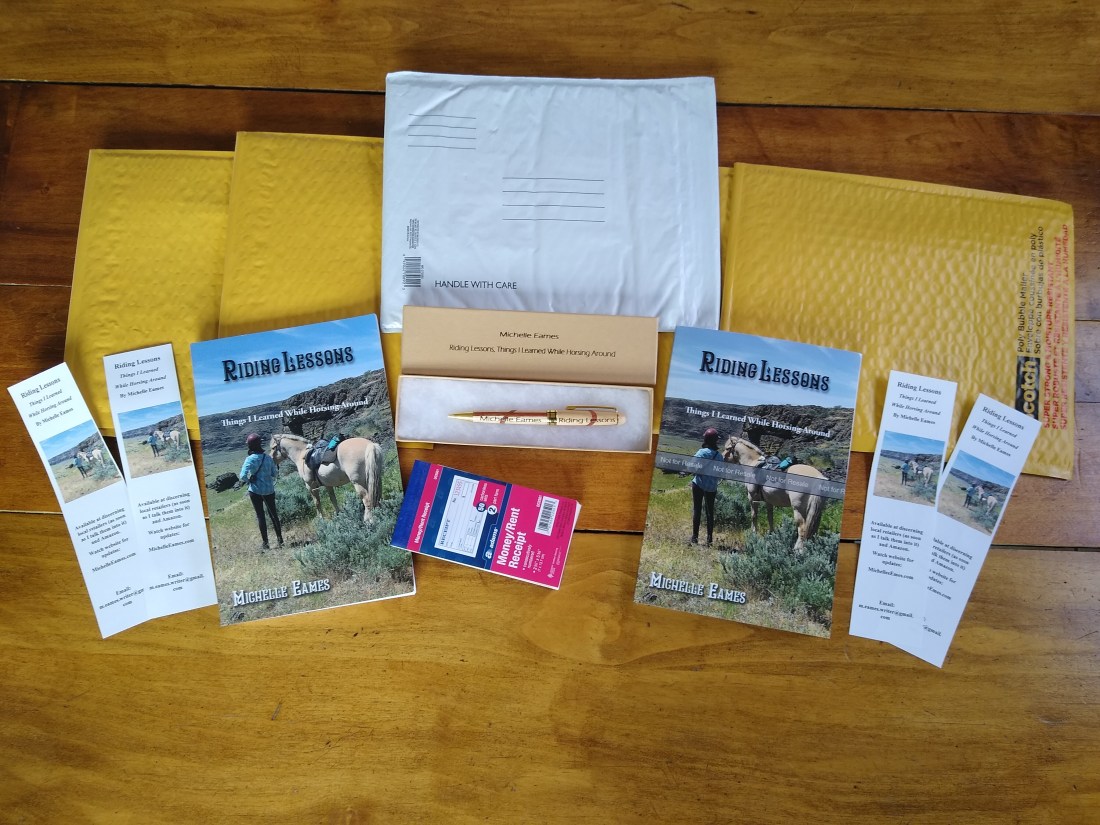
It’s been quite a week.   I received the first box-of-books Monday (see more about Riding Lessons, Lessons I Learned While Horsing Around, on the other tab of this website.) I’ve been working on the “publicist” part of the self-published-author-split-personality.  Actually, what I’ve enjoyed most was catching up with new and old friends as I shared announcements about the book.  

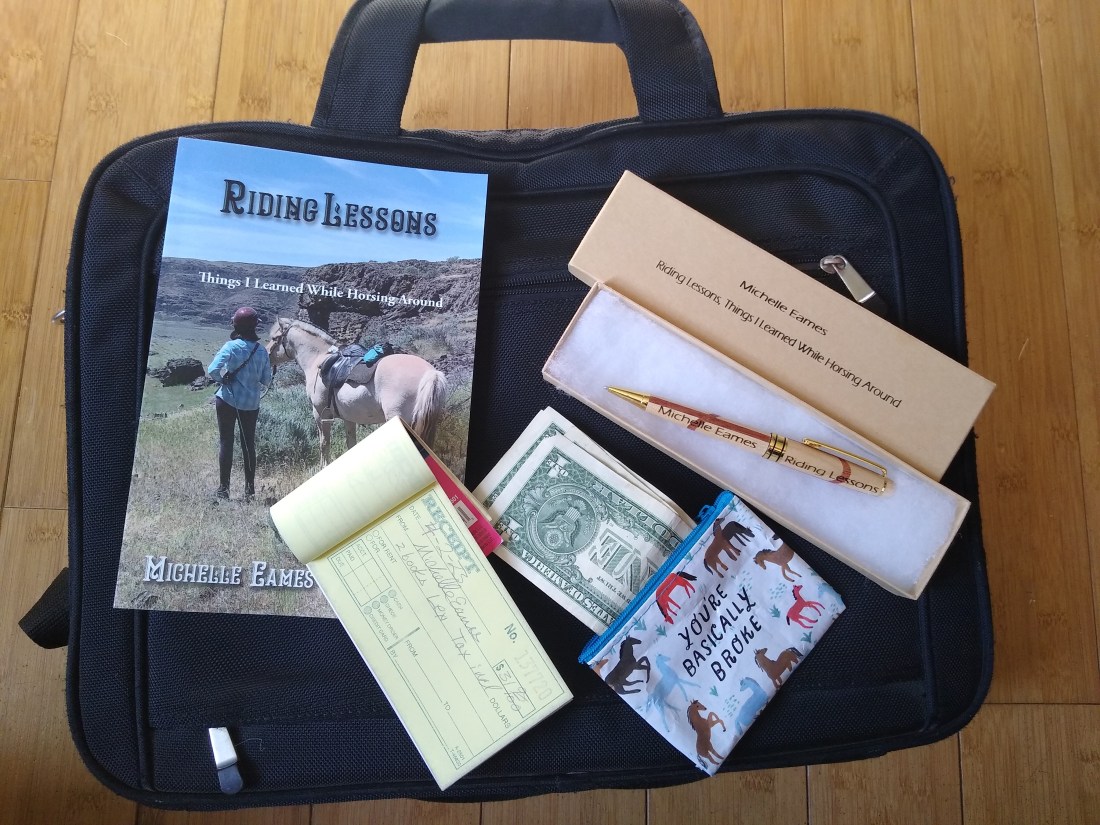
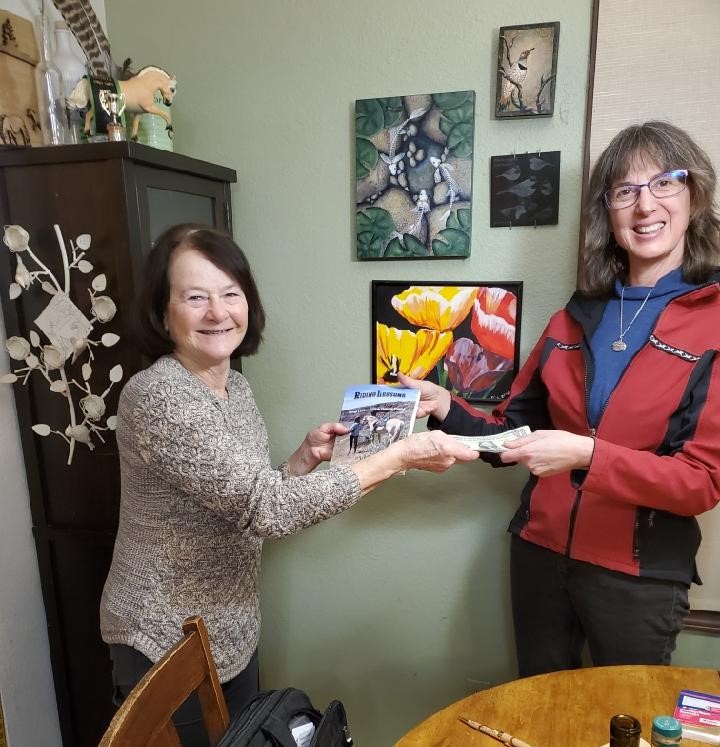
We had a first book signing, first sale, and first receipt writing.  It was our neighbors, Chuck and Karen, but it counts, right?  Plus we had wine. 

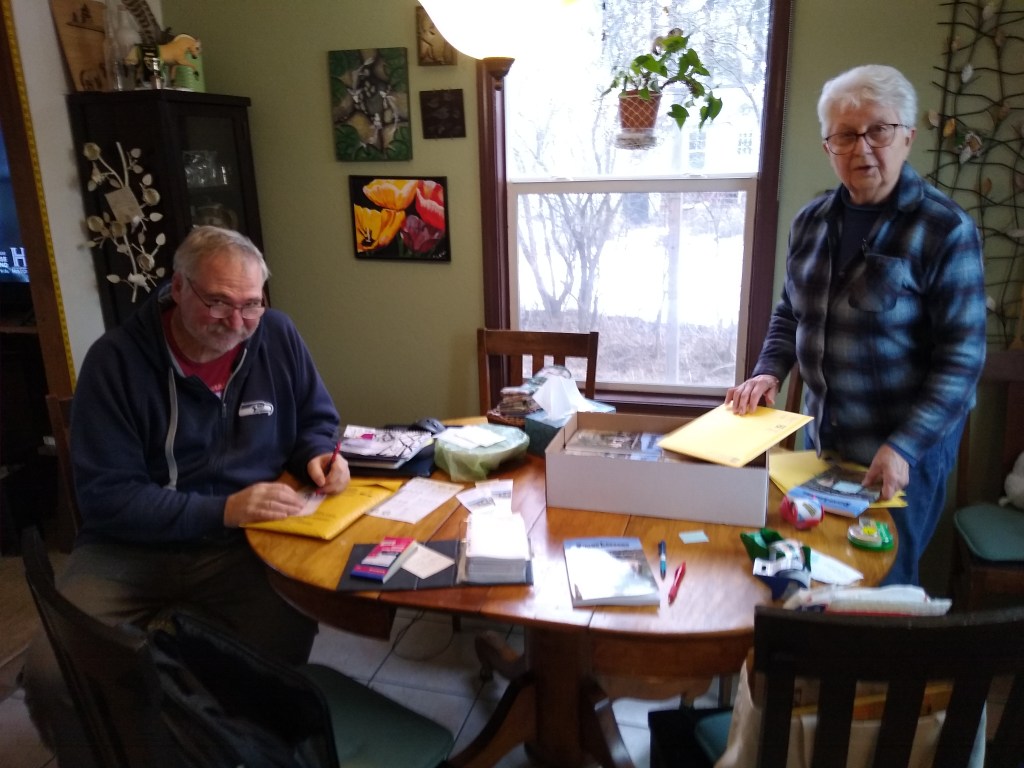
My Mom and husband made up the initial book distribution staff.  I took over distribution later in the week to get books to friends who had requested copies, and to bring gift books to key helpers.  I have driven the car everyday this, week; this is a strange thing for this post-covid hermit. I even put on nice shirts and jewelry!

I absolutely enjoyed checking in with bookstores and retailers.  I love book people.  And I got the warmest, kindest, reception at a local tack store, Spokane Tack Trunk. 

I think it was Russel at Gray Dog Press who said book selling is not a sprint, it’s a marathon.  To put that in horse terms, this is not a Quarter Horse race, it’s an endurance ride.   We are trotting along at a steady speed.

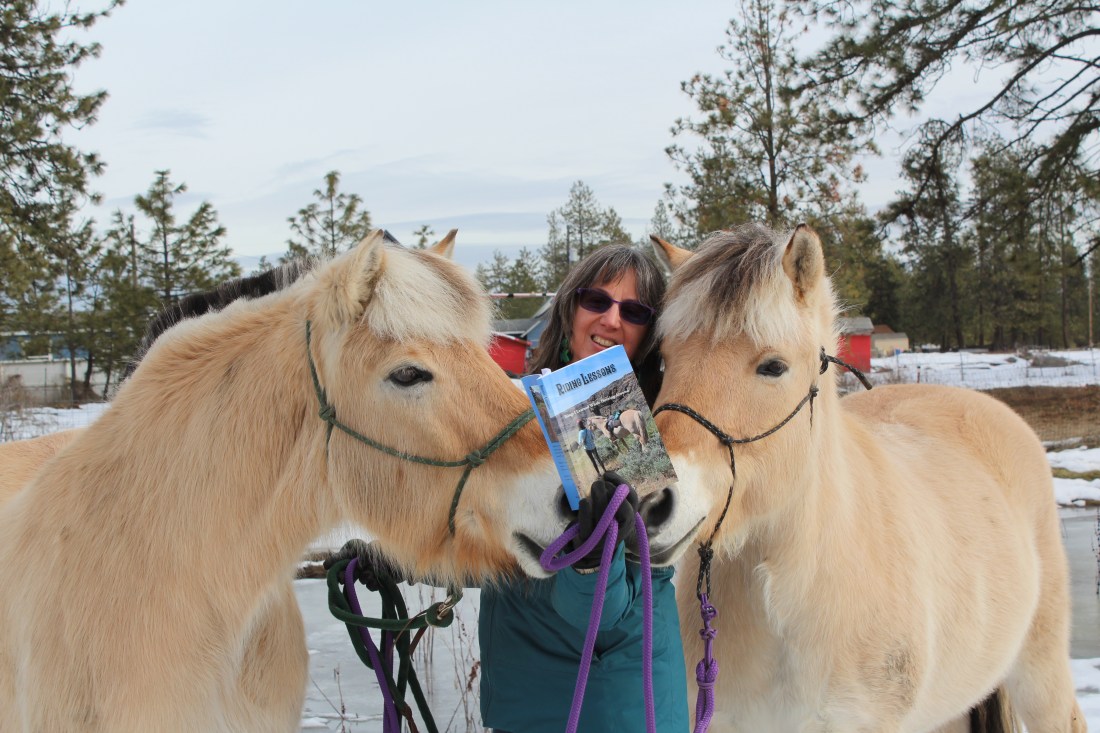
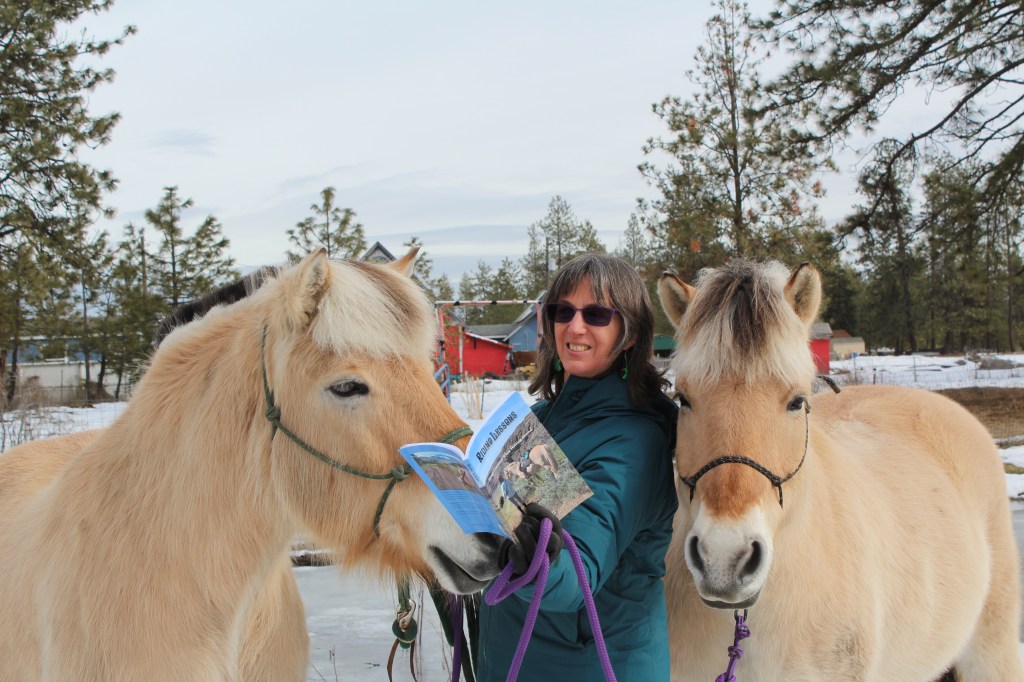
Meanwhile, it’s been a long winter, and my horses are bored.  So I let them read the book. 

[Horse photo credit, Chris Frederick.]

How to Self-Publish a Book—Michelle Style

A famous writer, when asked how to write, answered:  Butt in chair.  Okay, it looks like several writers and bloggers have used that, or borrowed that, but I’m giving the quote Anne Lamott, because I like her.  Anyhow, as I’m about to publish my first (self-published) book, I’m reflecting on the process.  It was a long process.  So the first rule of book writing by Michelle Eames is:

Allot Yourself a Lot of Time

It feels like I’ve always written, starting way back in high school, though my writing has often happened in fits and starts.  I journaled with pen and ink by hand.  I moved the good stuff to the computer, slowly over time.  I have mostly evolved to writing directly on the computer now.  Thank you, high school typing classes!  As I look back at the early drafts of the bits and chapters in Riding Lessons, Things I Learned While Horsing Around, I notice some of the first computer versions were dated 2002.  But some pieces were undoubtedly written before that. Eventually, I had enough on the horse and humor theme to start to pull it together into a longer work. 

Vacation from Work to do Writing Work

When you get a lot of pieces of your book ready to compile into something big, spend some focused time on pulling it all together.  I remember spending most of one Christmas vacation working on finishing and compiling some pieces, and then a government furlough, and then finally retirement. Even with that vast space of time floating in front of me upon retirement, it still took a lot of time to finish the book.

Try Publishers, Expect Rejection 

Once I had a solid draft together that I liked, I started sending it out to mainstream publishers.  This is done by researching the kind of books the company publishes, and then sending query letters with sample chapters to the editors.  The research is time consuming.  The waiting for answers, and more often non-answers, is time consuming.  I sent queries out to 10 potential publishers over a year and a half and received no positive responses.  I did get one complimentary note, along with the “no thank-you”.  Animal humor is a bit of a niche market, and I am not a famous writer. Yet.

First Readers, First Sharing

Decide to self-publish but decide to do it right.  First, make sure more people than your mother actually like the book.  Share with “Beta Readers”.  My beta readers included a horsewoman (my aunt), and a non-horsey friend.  Both were avid readers.  And both were obviously biased, but I made them pinky-swear to be honest in their assessments.  In short, they liked the book.  And they helped with editing, a lot.  Incorporate the edits. 

Start Building Your Market Early

After receiving a wonderful birthday gift from my son, an interview with a successful self-published fantasy writer, I asked the author all about marketing and process.  She recommended developing a website and a following on social media.  With my son’s help, I started a website and blog.  Turns out, I like blogging.  This was not a hardship. 

Learn to Wait and Wait Some More

To continue your professional journey, hire an editor, thereby beginning to dig the deep hole of writing and publishing costs that you may never recover from.  Learn how much editors cost (a lot!).  Ask previous teachers and published writers that you know.  End up with a friend of a friend that is new to editing, so moderately priced.  Hope for a quick turn around so you can get this book out the door and down the road in the next week or so.  Then wait for her more sane schedule.  Incorporate the edits.

Find a Publishing Company that Helps Self-Publishers

After receiving only rejections from mainstream publishers, get more serious about self-publishing.  Ask local writer friends how they did it.  Research some more.  Find self-publishing blogs.  Read them.  Eventually, follow the advice of friends and find a local publisher that does layout, some printing, and talks you through the self-publishing process.  Read your manuscript draft one more time and find more edits.  Fix the edits.  Finally share the draft, photos, and cover ideas with the local publisher.  [Gray Dog Press, you are worth your weight in gold!]  Continue to study how Amazon works for paperbacks and ebooks, and Ingram Spark for distribution to retailers and libraries.  Wait some more.

Start Small with a Small Business

After talking to published writers, artists, friends, and googling self-publishing sites, determine it’s in your best interest to get a business license.  This is in part to claim potential losses on your income taxes. Pay for state license.  Notice that there seems to be a lot of costs, and future income from your book may be low.  Buy fun things at the office store, like a receipt book. 

Review. Edit. Repeat.

Receive a pdf copy of the laid-out book. Read it from front to back, and again from back to front.  Ask a friend to read it.  Find more typos and edits and improvements.  Ask publisher to incorporate edits.  Wait some more.  Finally get a “proof”, an actual printed copy of the paperback book.  Ask someone from your writer’s group to do a final proof-read.  Find more typos, edits, and improvements.  Resignedly, ask publisher to fix these new edits.  Hope that all mistakes are now found.  Determine that you are done reading the book, and now will only review for big layout problems.  Wait some more for the printing of the first run of the book.

Become a Book Market Analysis Guru

Before the final printing, the publisher asks for a price to list on the back cover.  Time to do some more serious research, instead of saying, “Oh, I dunno… fourteen bucks?”  Visit the local bookstore and ask staff about prices.  Look on shelves.  Look up similar books on Amazon.  Compare prices for paperbacks and ebooks.  Actually find an author who writes books similar to yours, compare her prices.  Lose sleep over final pricing.  Summarize your findings with your writers group and ask their advice.  Follow their advice.  Sleep again.

Find out how to write a book description.  Find out how to use key words in the book description.  Keep long lists of people who want the book, people you will email when complete, potential Facebook and blog posts, and potential local retailers.  Become the queen of spreadsheets to track all of the future steps and tasks once the book is published. Also track costs.

Become an Electronic Upload Guru

Once the local publisher provides digital layouts for Amazon Kindle Direct Publishing (KDP), and Kindle ebooks, figure out how to upload to Amazon.  Review electronic “proofs” from Amazon.  Find layout mistakes on the ebook.  Request edits from publisher.  Upload again.  Pay for an actual paperback proof from Amazon.  Wait for arrival, despite having payed extra for the quicker shipping option.  Pause on Amazon until proof received.  Tap fingers on desks and feet on floor while waiting.  Butt is still in chair while checking the shipping tracking link several times a day.

Then, the publisher finishes the electronic documents for Ingram Spark paperback and ebooks.  Upload to their more complicated system.  Pay them some money.  Wait for their review before hitting “Publish” button.  All while waiting for Amazon proof, and while waiting for the local publisher print run. 

Finally receive Amazon paper back proof.  Determine it’s fine.  Push the “publish” button on Amazon KDP page.  Wait for their review and their “go live” date. 

Finally Publish and Become a Publicist [This should happen next week!]

Pick up the first 100 printed books from the publisher.  Take a moment and celebrate with a shot of whiskey.  Ceremoniously sell the first book to a friend. Give her a receipt because you are a small business, and you have a receipt book.  Then get back to work.  Start mailing out promised gifts, promised signed copies, and working through that marketing spreadsheet.  In between marketing steps, think about the next book.  Place butt in chair.

How to Find an Agate

Go to your favorite beach. Hold a moon-snail shell to your ear.  Hear the agates calling you in soft waves.  Sift thumbnail sized rocks between your fingers, pushing past the dull layer to the dark damp colored layer below.  Look past the seaweed rocks, sunset rocks, deep-water-black rocks, white shell rocks, shooting star rocks.  Look past all the colors of the northern lights, night sky, and gray waves.  Find the gem layer: turquoise rocks, ruby rocks, jade rocks, sandstone shining with diamonds.  Set aside the frosted blue beach glass, and smooth-edged porcelain, all tamed and returned by the ocean.  Dead shore crabs guard the real agates, pinchers at the ready.  

Rest.  Feel the waves of agates calling you.  Lift each possibility to the sun to check for clarity.  Throw the opaque almost-agates back to let them ripen longer in the sea.  Look up at the logs, the sand-rubbed smoothness, the ants.  Begin to gather shells with holes in them instead; look for some beach string to make a mermaid’s necklace.  Watch for sun glints on agates, on waves.  Fill your pockets with treasures, driftwood bits, and more colored rocks.  Who cares about the agates today.  Tomorrow, find a sunny beach.  Sit down by the driftwood.  Look for agates.