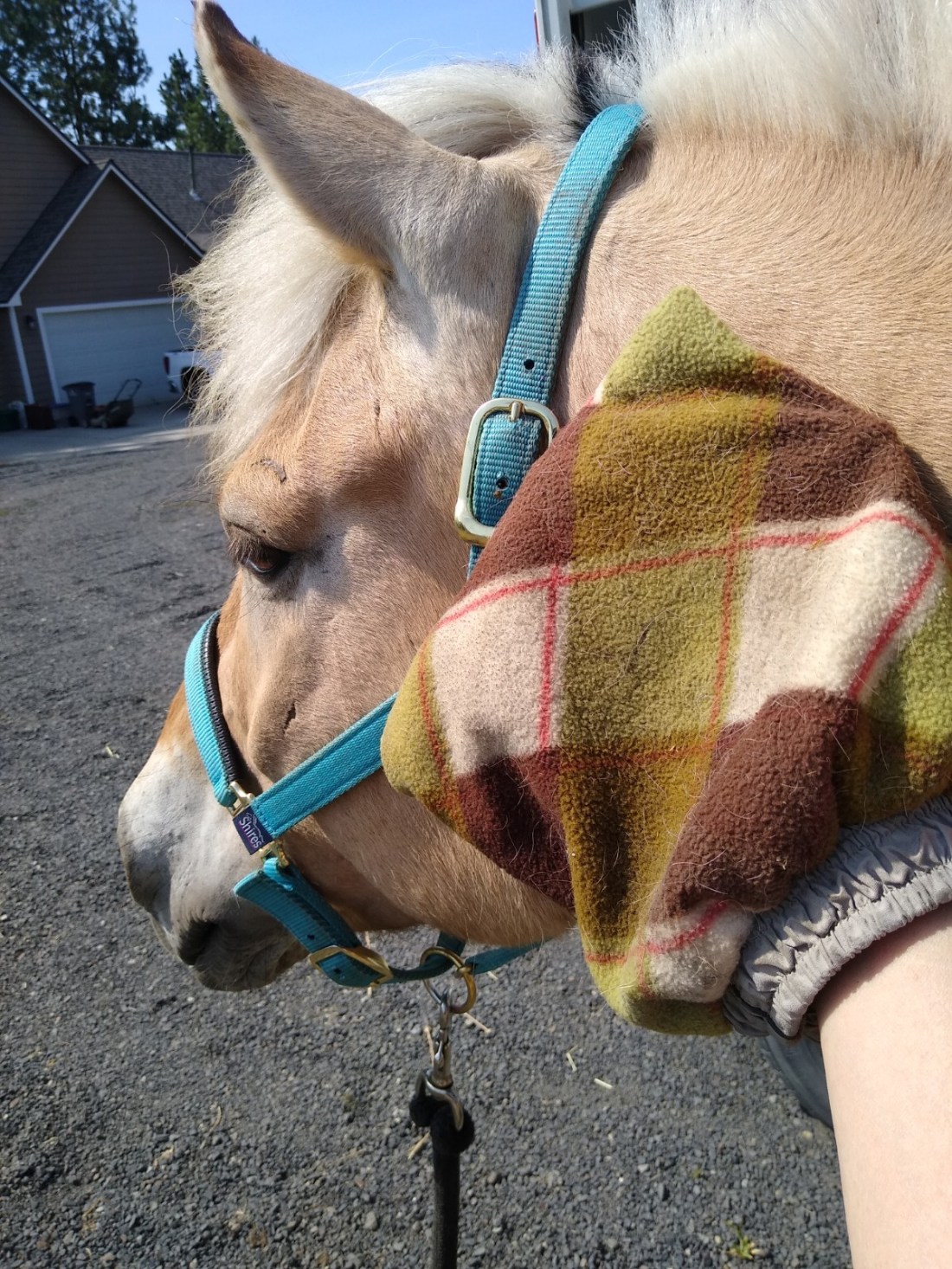
How to Make an Upcycled Fly Mitt (for applying fly spray to horses)

Flies and horses go together like champagne and bubbles; you can’t have one without the other.  Sometimes the flies are a minor nuisance, and sometimes they come in hordes, cause eye infections, or bite chunks out of the horse’s haunch.  Fly spray can protect the horse, for a while, anyhow.  Some horses will stand nicely for application from a spray-bottle; other horses are quite certain the sound and sight of the spray bottle is death itself coming to get them and will not stand quietly.  And by not stand, I mean, rear, bolt, kick, spin and all other physically possible movements. 

For those reactive horses, or for the areas around the face where you can’t spray easily, there are fuzzy fleece mitts lined with plastic, to apply the repellent by hand.  These cost between 4 and 17 dollars. They eventually get grossly dirty from the oily spray and the dusty horse, or they wear out.  Or, if you are like me, you lose them somewhere in a dark corner of the tack room or horse trailer.

A friend and I were discussing how to make fly mitts for free.   All you need is: 1) A sewing machine (preferably a vintage machine because they are the coolest); 2) a sturdy medium-sized plastic bag (preferably washed out and re-used) that is wide enough to spread your hand out in, and deep enough to reach over your wrist; 3) a scrap piece of gathered waistband from a worn out clothing item, or a piece of elastic; and, 4) a piece of scrap fleece, or an old towel, large enough to make a cover over the plastic bag. That’s it.
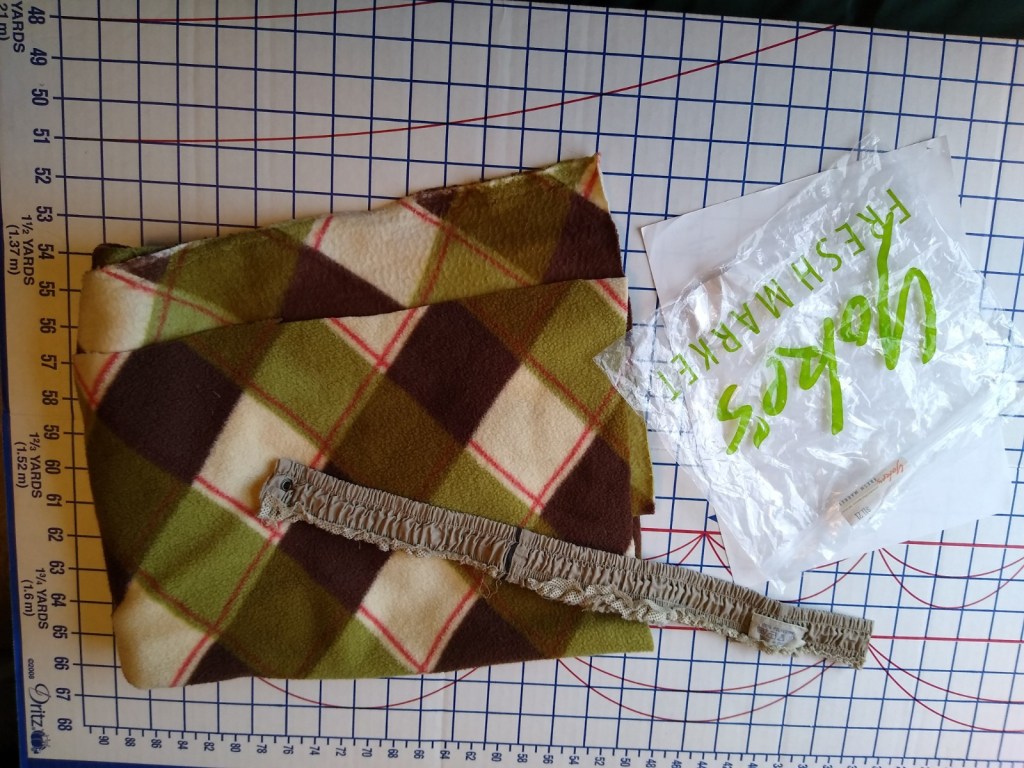
To make the applicator mitt, fold the material, and using the fold as one side, cut out the material about ¼ inch larger than the plastic bag on all sides (don’t cut through the fold).  Determine which side is the bottom of your mitt.  Sew the old stretch waistband to the bottom of the material, pulling and stretching the band out as you sew, so that it will be gathered and narrower than the top when finished.  Then sew up the remaining side and top seams.  I used a narrow zig zag stitch, to allow a tiny bit of stretch to the seam.

If you are using elastic instead of re-using a waistband, make the bottom side of your cover material about 1.5 inches longer.  Sew top and side seams of cover first, then fold up a casing for your elastic, at least ¼ inch wider than the elastic.  Sew along the edge of this folded hem, leaving about a 1-inch gap in the seam.  Measure out the length of elastic to fit comfortably over your wrist.  Use a large safety pin to thread the elastic through the casing.  Sew elastic ends together.   You can then sew together the one-inch gap in the seam, or if you are lazy like me, just leave it open.  It won’t be obvious from the outside.

Once the fleece cover is done, simply push the sturdy plastic bag inside.  If some of the plastic bag is hanging out, that’s even better because it protects your skin from the spray.  You may want to add a safety pin or two to affix the bag to the fleece.  Take it outside, apply the spray to the mitt, and rub the spray on the horse.  Once the mitt has the oily spray on it, you can store it in a larger gallon size Ziploc bag—washed out and re-used, of course.

So, now it’s done.  You can do it, too.  If at the end you look at the mitt and think, “Is it not beautiful?” As in, it looks a little funky and your seams are crooked, don’t worry.  My second mitt, in particular, has some imperfections.  That’s because I thought I needed pull my other vintage machine out for some exercise, and for some reason, the zigs were not zagging consistently.  But no one will notice once I turn it right-side out.  And the horses are not perfectionists about zig zags, they just want the flies to go away.

The cover should be washable (though maybe outside in a bucket, since fly spray is usually strongly scented), and the internal plastic bag can be replaced if it wears out. 

Reduce. Reuse. Re-apply the repellent as needed.

Of course, I needed to test my two prototypes. I gave one to my horsey friend Levi and asked him to review the product.  He gave it a “two hooves-up” and stated, “Anything that keeps my human from spraying that icky fly spray directly into my face is a good thing.”

I queried my own horse, Vali, about his thoughts on the mitt.  While he thought it was effective for application of fly spray, he recommended not using crinkly plastic for the inside lining.  When he hears plastic crinkling, he thinks it is a granola bar wrapper being undone, and it should be shared with him.  He was disappointed to discover that the fly mitt did not come with a treat.    Therefore, he rated it only one head-toss.

Regarding my own thoughts on the mitt, I thought my bag should be longer, or it should be safety pinned to the edge of the mitt.  The inner bag keeps squishing up inside.  So far I’m living with that problem, because I have not managed to remember to bring two safety pins out to the horse trailer where the mitt is currently living.  Knowing my memory skills, it may never happen.

Nonetheless, despite the criticisms, the fly mitts are working fine.  On my last mountain ride, I had 20 mosquito bites on my lower leg, and no obvious bites on my horse.  I should have applied the spray to myself. Or maybe worn armor.  Hmmm.  I wonder what I can upcycle into mosquito armor?
Flip Flop Season

At our house we play seasonal games with ourselves.  I’m not talking scrabble, or monopoly, or even poker.  This is the game of “How long can we go?”  In the fall, it’s “How long can we go without turning on the heat?”  A few days ago, we lost the game of “How long can we go without putting the air conditioners in the windows?”  This year it was July 7 for downstairs, and July 8 for upstairs.  I think that was later than last year. It would be interesting to look at trends over time… but did I write those dates down? No.  

Our house, a boring rectangular two-story 80’s house, does moderately well in the heat.  Especially downstairs.  The house is built on a cement slab that helps hold the coolness for a while.  When it starts getting hot, we manage the heat by closing-up the house during the day, and opening windows and doors at night.  We especially open every upstairs window since leaving downstairs windows open overnight doesn’t quite feel safe.  Then, in the morning, we shut windows, shut curtains on the sunny side of the house, and hope the house stays cool.  But there is a limit to this passive cooling system. (Is it really passive cooling if I am running up and down the stairs opening and closing windows and curtains and strategically deploying fans?  That feels like active cooling to me.) 

But after about three days of 90-degrees or above weather, we need the air conditioners.  Since we don’t have a central heating or cooling system in this house, we use those heavy, awkward, ugly, window air-conditioners.  One in the kitchen/dining room downstairs. One in the office upstairs.  We used to suffer gamely with the heat upstairs, using only the window opening/closing method, until COVID forced some serious teleworking on my part.  I definitely needed cooling in the upstairs office.  So the old air conditioner moved upstairs, and we bought a new quiet one for downstairs.  The quiet one is lovely.  The noisy one is functional.

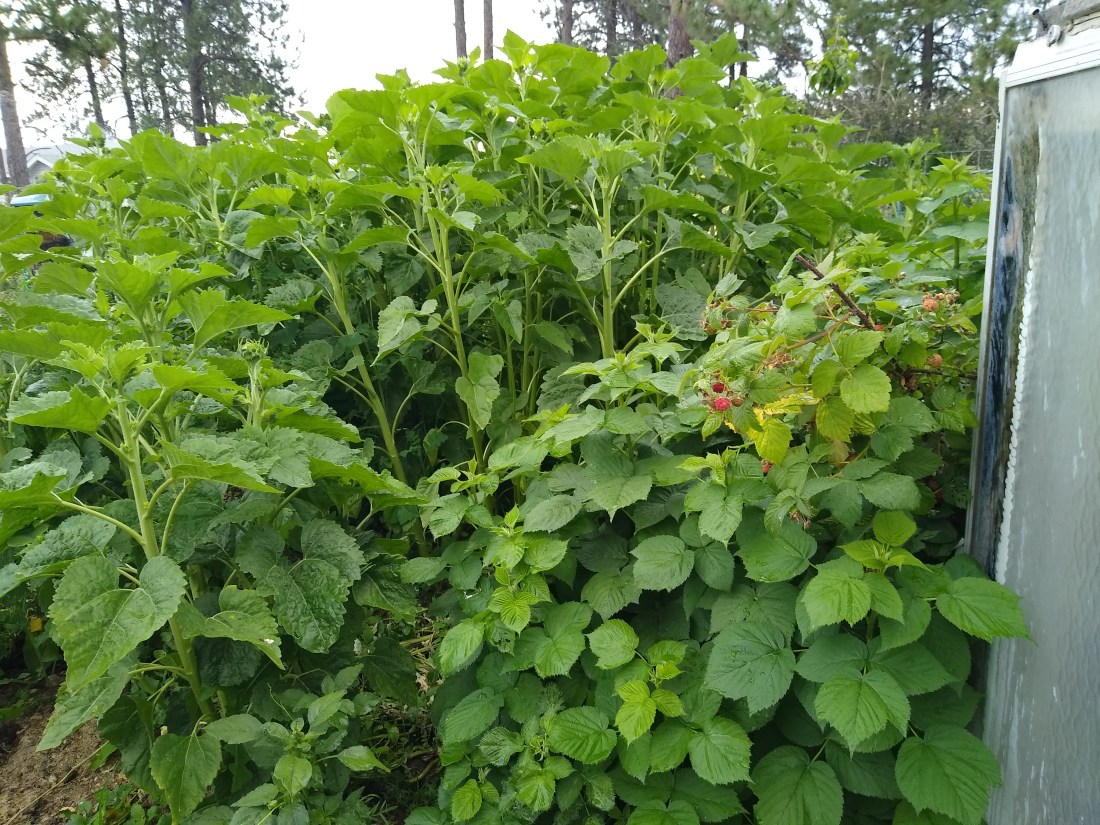
We also play the “How long can we go?” game with watering lawns and gardens.  That explains why newly transplanted trees often don’t do very well in my yard.  Only the fittest survive.  Last year I finally installed a drip irrigation system that reaches some of the perennials and bushes and trees in and around the garden area.  Did you know that raspberries and volunteer sunflowers try to take over the world when they get adequate water?  I didn’t know this.  Now I do.   

We bought a couple of apple trees this spring and set up a sprinkler system near them.  We really want them to grow, rather than die, given that they produce more fruit when they are alive.  Now that area is getting lots of water.  But the rest of the yard?  We’re kind of hoping some of it goes dormant.  This spring the weather was perfect for growing grass, resulting in the need for near-constant grass mowing.  We do try to keep the yard immediately around the house green, but further out our goal is simply to keep the grass short.  We even mow part of the pasture because the fjord horses don’t eat it fast enough.  They tell me they are willing to try to eat everything down, but then they would turn into marshmallows with pony legs.  I wish I could let them graze the pasture hard, since we are in a wildfire prone area.  Now that the grass is drying in the heat, the horses can graze more, but still not as much as they wish. 

With the significant warm-up this week, we begin the flip flop season. And I don’t mean the plastic shoes.  I mean the flip-flopping of chore time and outside recreation time to the morning; and indoor computer, TV, writing, or craft time in the afternoon.  I don’t like this schedule as much; I prefer to do writing and computer work first, and outside activities later in the day.  I am trying to adjust.  The horses are adjusting well to their longer grazing in the morning, then spending their afternoons in the shade of their stalls.  They do spend a lot of time staring out at the pasture longingly, or staring at the kitchen windows, mentally urging us to come out and feed them again.  I understand.  In this heat I wish someone would bring me ice cream every hour of every day.    

[I tried to get a good photo of the air conditioners, but they were just too darn ugly. Instead, I included a picture of the well-watered sunflowers and raspberries that are discussing how to take over Spokane, as a first step on their path to world domination.]

Peanut Butter Cravings

You can’t go wrong with peanut butter.  Okay, maybe you can go wrong– peanut butter whisky and peanut butter beer sound disgusting.  Other than that, though, all peanut butter foods are delicious: peanut butter granola bars, peanut butter cups, peanut butter brownies, peanut butter no-bake cookies… the deliciousness never ends. 

But peanut butter in savory foods?  Yes.  Something changes when you cook it, it becomes more like a rich spicy gravy.  The other night we had peanut butter noodles.  You can use Asian rice noodles, or whole wheat noodles, or other non-gluten noodles.   We added broccoli and snow peas to ours.  Peanut butter sauce on noodles is good warm or cold.   There are lots of recipes out there in internet land, just look for a simple one.  Here’s a hint, though—add more peanut butter than the recipe asks for. 

One recipe to consider: 

https://www.allrecipes.com/recipe/11835/peanut-butter-noodles/

When I have been on various healthy diet kicks, for example when I was avoiding dairy to decrease sinus problems (it did help), the peanut butter noodles became a comfort food.  Like macaroni and cheese without any cheese.  It has a similar mouth feel.  In an Asian restaurant, I will often order Chicken Satay, and not for the chicken.   The chicken is just a carrier for the peanut sauce.  I should probably just order the sauce on the side and request a spoon.

But my real comfort food, although one that I rarely make, is Domoda.  This is from my Peace Corps time in the Gambia, West Africa.  It is the best meal, a spicy peanut butter gravy over rice.  With or without meat or chicken.  It was definitely one of my favorite Gambian foods.  The recipe is very similar to the Asian peanut sauces, but it is made in larger quantities.  This is not an appetizer; it is definitely a main dish.    

I have a scribbled-on worn out and well-loved paper recipe that I kept from our Peace Corps newsletter.  I use it as a guideline, and I have a couple African cookbooks to compare recipes.  The classic recipe is very spicy, I often add scotch bonnet peppers.  Sometimes too many… my tolerance for hot peppers is not what it once was.

In the Gambia, we would eat this in a large flat bowl, eating with our hands, several people sitting around and sharing the same bowl.  Sometimes we would use a spoon.  We’ve served it this way with various family and friends over the years.  Once when my aunts were visiting, we added the dimension of butchering an old chicken, and making chicken Domoda.  It was so tough we couldn’t chew it.  But the sauce was good. I don’t think even my immediate family would go for the communal bowl in this era of covid.  Now we serve out individual dishes. With spoons.

I found a good-looking recipe online. I haven’t tried this one, but it looks like the real thing with all the right ingredients. Except they don’t mention a home-butchered chicken.  https://www.daringgourmet.com/domoda-gambian-peanut-stew/

If you decide to try this recipe, use old-fashioned peanut butter, the kind without extra oils added, the kind where the natural oil separates off and you have to stir it in.  Because that is how you know it’s done: the oils come to the top of the pan.  The oil will be a pretty red color from the tomato paste.  Also, add extra peanut butter. 

I’m definitely craving Domoda now, but my chickens are looking at me nervously.

DIY Writer’s Retreat

I haven’t been writing much.  The spring weather has been calling me outside with gardening, weeding, watering, and of course trail riding.  My writing has suffered.  But I watched for a window on my calendar and saw a mostly-free Wednesday and Thursday.  My husband planned to be out of town golfing, and the weather was going to be too hot for riding.  I would make my own writer’s retreat.

Writers’ retreats are usually group affairs in exotic, or at least fun, locales.  Writers come together, write in their hotel rooms or quiet common places, and maybe share readings of their work.  There might be facilitated writing exercises. My writers’ group has tried this by meeting up at a member’s cabin on the river, but we ended up just chatting, eating good food, and drinking wine.  We decided that for actual writing, we were better off alone. 

I hadn’t really done this before, setting aside a large block of time to prioritize my creative process.  I tend to write in the mornings, but it’s haphazard, and often comes second to other things on my “to-do” list.  I usually write regularly, but my task list has been long lately, with travel planning, or house maintenance planning, or working on the business and marketing side of writing.  I really needed a block of several hours to focus on the creative part of writing.   I knew what I would work on, a couple of early draft blog posts (like this one!), and a collection of poems and essays about living in Washington that I’ve started to pull together.  I had projects ready, but I thought my personal writer’s retreat needed something more.

Like good food.  So I made some rhubarb oat bars the night before.  My retreat also needed some good drinks- we have a very large selection of teas, so that was covered.  We also have alcohol, but that was not desirable in the morning during my planned work hours.  Maybe if it was an evening retreat, and my writers’ group was around… oh wait, we already determined that doesn’t work.

Then there were the other ever-present distractions that I had to remove.  I logged out of Facebook.  I logged out of my emails.  I moved my phone to another room, so I wasn’t tempted to check for messages too often.  Off it went to the bathroom, where I could hear the message notifications (in case one of the roofing contractors called back) but I had to physically get up out of my chair to check them.  That slowed down my urge to constantly look and see what I was missing out there in internet-land. 

The morning of the retreat, I read a bit of a novel over breakfast to get in writing mode.  I kept another book beside me, Cascadia, a collection of poems and essays about the Northwest.  I planned to turn to that if my brain got stuck.  Then it was just me, the keyboard, and my printed drafts of poems and essays.  I love words, sentences, and playing around with lines and paragraphs.  Once I get into a manuscript, I can focus for quite a while. Off I went into my retreat away from the world, into the words, for several hours.  When I found myself thinking of other tasks that were calling my name, as I always do, I wrote them down on my ever-growing to-do list, then went right back to the writing. 

I would have preferred it if my office was cleaner before I started, as a way to clear my mind, but that didn’t happen.  It was tempting to use that cleaning task as a last minute procrastination, but I just left the piles of books and paper where they were, a comfortable clutter to shove aside when I need to move to the chaise instead of the desk. Really, I am most comfortable with some clutter surrounding me.  I have the messy kind of brain, not the OCD brain.  The disarray in the room matches the words and thoughts bouncing around in my mind.  My version of creativity is not neat.        

That was it, a few hours alone, letting the words flow.  I knew if I got stuck, there were writing techniques that would work for me: 1) free writing, about anything and everything, for a discrete length of time; 2) find a line in a book (like Cascadia) and write on from there; 3) read a little bit, then write some more; 4) make a cup of tea, grab a snack, look out at the trees, then come back to my desk; 5) change location, move to the chaise, or move outside. 

And it worked.  I wrote for several hours over two mornings.  I didn’t get stuck.  I edited and revised poems, essays, and wrote a blog.  I delayed the busy tasks that tend to fill my brain, tempting me away from writing.  I found my Zen writer’s mind.  Plus, I ate rhubarb bars. 

Unsubscribe

I get so much junk mail.  I guess it’s because I’m intermittently generous and give to good causes or political causes.  So how do they reward my generosity?  They tell all of their friends, allies, and similar groups.  Soon, I am getting more mail, not just from the groups I have given money to in the past, but a plethora of groups I have never heard of.    

Now that I’m retired, I don’t like it when my day is scheduled with lots of appointments.  I want to be free to pick my activities, to putter around the house starting, or not finishing, several projects at once.  I want to base my day on the weather, doing outside projects when it’s cool, or warm, depending on the season.  I want to do inside stuff when it’s too hot or too cold outside.  I don’t want to watch the clock any more than is necessary. 

I’m like that with my donations, too.  Now more than ever, I want to give what I want, to who I want, when I want, without being pestered for more, more, more donations.  Especially if the group is an unknown entity.  Get me off the mailing lists!

I have found that it’s actually a lot of work to get off mailing lists.  Here is how I have been trying to do it so far. 

  1. I gather up the junk mail.
  2. I sort and set aside mail from my favorite groups, those that I know I will give to again when I’m ready.  I may toss their junk mail for now, recognizing it will come again, like night follows day.
  3. For the other junk mail groups, if there is a donation card, with a “no-postage necessary envelope”, I will write a note on the card next to my address: “Please remove me from your mailing list.  Thanks!”  Then I mail the card off, without a stamp, and without a donation.  Sure, this group will be paying my postage, but better them than me. If they are sending me unsolicited mail, they can pay unsolicited postage.
  4. Some groups expect me to provide the stamp for the donation envelope.  Have you looked at the cost of a stamp lately? (Okay, I haven’t either, so I looked it up: 63 cents!)  Multiply that times the volume of junk mail I would like to be rid of… it adds up!  I won’t waste a stamp on unwanted junk mail.  I will, however, make a stack of this kind of junk mail in my office.  Now and again, I’ll go through that stack, find their website, and search the website for “remove from mailing list”.  Or, if that doesn’t work, I will use the “contact us” option and request removal from the mailing list, providing my name and address exactly as it appears on the junk mail.   I often get a response back saying they will remove me from the list.  Hooray!
  5. So far, there was only one group that neither method worked for.   It was a draft horse rescue. They didn’t seem to have a website, at least not that I could find.  I just tossed their junk mail. If I receive it again, I will dig deeper.  It makes you wonder if they are a legit entity anyhow, since they have no email address and no website.

I’ve been doing this for a couple months, and I’m still getting a lot of junk mail.   The groups that do respond often note that it takes weeks or months for my removal request to work its way through their systems.  Crossing my fingers that it works, even if it’s slow.   

I’m also working on eliminating unnecessary emails from my life.   Last winter, I had an inbox full of thousands of emails.  I was losing important things, like emails from my local book printer.  Again, it was often groups that I’d given money to, or bought something from, or simply had signed up for their emails over time.  But they ask again and again and again.  Some send email information daily, weekly, monthly…   I needed a break.  Therefore, I have been hitting the “unsubscribe” button on a lot of emails.  The button is often next to their incoming email address, or sometimes at the end of the email in very small print.  My inbox still fills up, because there are many issues I continue to track, or may decide to put money toward in the future, but it’s so much more manageable now.  The unsubscribe button is my new best friend!

Sometimes I worry I am guilty of this information overload myself: sharing blogs, or sharing posts, or sharing emails about my writing and my life.  I guess I don’t have an unsubscribe button.  But you all can do it through Facebook, just unfollow me.  And if I send you emails about my blog (all six of you!) you can request removal from my personal list.  Of course, if you follow my blog directly through WordPress.com, I believe you have all the control. So, now that I think about it, you can “unsubscribe me” after all.  Hopefully your email inboxes aren’t as overfilled and overwhelming as mine was, and your junk mail is more controlled than mine is. Anyhow, I hope you still enjoy my blogs. If not, you know what to do!

ADDENDUM:  Coincidentally, as I was writing this blog, I started reading a book by Eve O. Schaub, The Year of No Garbage.   This was one of my Mothers’ Day presents and is a really interesting book.   One of the early chapters included a section about junk mail.   Per the book, here are some additional ways to rid your mailbox of those pesky envelopes and catalogs:

  • To opt out of unsolicited credit card applications, go here:  optoutprescreen.com.
  • To opt out of direct mail marketing such as catalogs, magazines, and donation requests, go to two free links: DMAchoice.org, or Catalogchoice.org.  A third option is to sign up for a phone app (PaperKarma.com) that is initially free, then costs. 

I’ll be checking out all of these options as I continue the battle to streamline the junk I have to deal with.  My time is valuable, and I want to spend it on important and enjoyable things, like writing and eating chocolate, not cleaning out and going through never ending junk in my mailbox and inbox.  Plus, it’s such a waste of paper!  And electrons!  Once this problem is solved, I’ll start to address the clutter around my house.  Ha ha, just kidding! Warm weather has arrived, and there are gardens to weed and trails to ride.

My Super Support System

Maybe your favorite support system is your dog, or your girlfriend, or your favorite buddy at work.  Everyone needs a support group, those folks that say, “Atta girl!” when you most need it.  Those folks that give their time.  Those folks that show up.  Whether we call them support systems, support staff, or support friends, our lives flow better when they are around. If we are lucky, we also have support family.

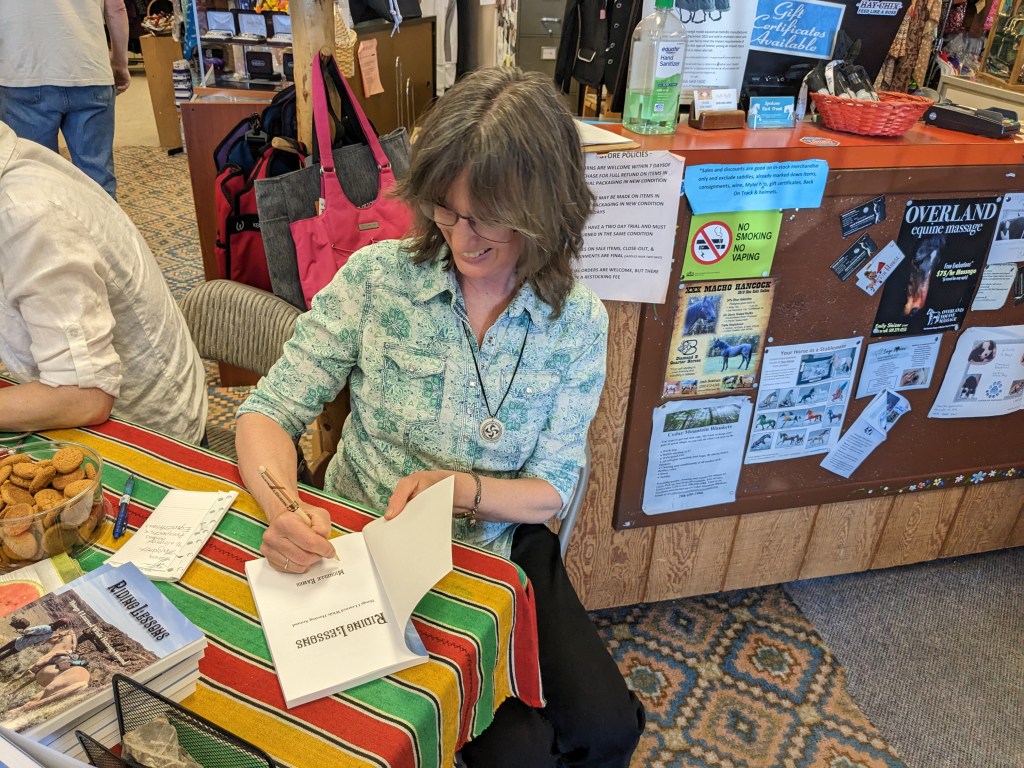
In my writing world, I feel like my support system people have been working overtime lately.  I had my first book signing event in April, at my favorite tack store (Spokane Tack Trunk), and it was a grand success.  The Tack Trunk staff were kind and friendly. I sold books, I signed books, and I shopped in the store during the slow moments, spending all my earnings.  My friend Morgan sold and signed her books, too.  But more than the selling and the signing, I was amazed that people showed up.  My friends showed up.  Morgan’s friends showed up.  People from my writers’ group showed up (even though they already had copies of my book), and they brought friends.  Some of my horsey mentors showed up with their friends.  My local son and his girlfriend showed up just to say hi.  For a fun surprise, my San Diego son showed up to give me support along with a bouquet of flowers!  I felt like a dancer after a Broadway show, receiving flowers and bowing to the crowd!  Even a few strangers showed up for the book signing.  I know I’m making it sound like hundreds of people showed up, where it was maybe more like 25 or so, but I sold 12 books!  I would have been pleased with three!  Needless to say, I’m not rich yet, but it was a good day.

Thanks to all my friends, family, and supporters.  I feel loved, appreciated, and happy.  I am enjoying this writing adventure. I have my large support group to thank for pushing, prodding, cheering me on, and simply showing up as I continue my journey as a writer.    

Thanks!

[Photo credits Pexels.com, and Mac Frederick]

So Many Books, So Little Time

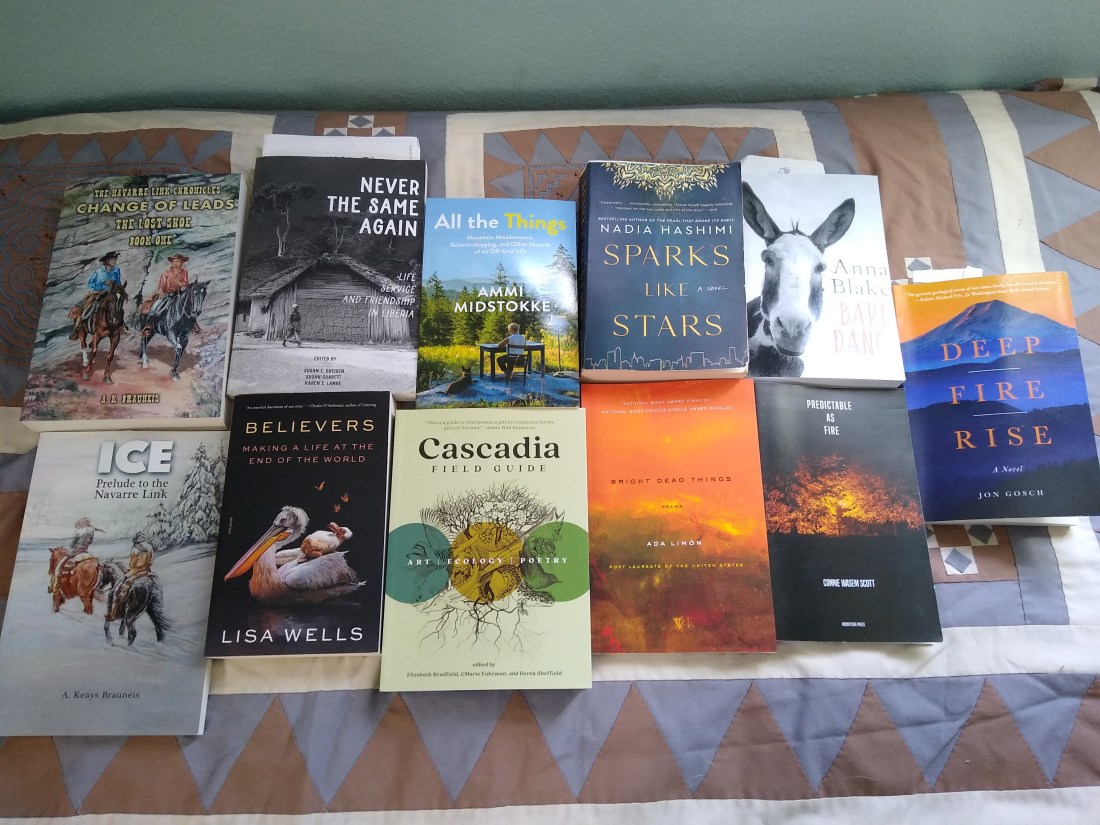
It’s been a fun month, but I bought too many books.  Is there such a thing as too many books? Not really.  I visited some friends on the west side of the State over the last month.  I bought some books and was given some books.  I bought some books from a woman selling at a festival, because I was curious how the selling was going, and if I might want to do something like that in the future.  After querying her in great detail, I thought I should buy a book, then she gave me another. I hope her books are good; I haven’t cracked them yet.  Most recently, I bought even more books at Spokane’s Get Lit festival, a celebration of writers and readers. 

My “To Be Read” (TBR) pile is large now.  It is larger than my bedside table.  This doesn’t even include the books already in my collection that I haven’t gotten to yet.  I’m going to need a whole TBR shelf in my library.  If I’m not careful, I might need to buy a whole new bookshelf.  Possibly a bigger house with a larger library. Because you can never have too many books.

I’ve been reading more non-fiction lately.  But one always needs a murder mystery on standby.  And I attended readings of several local writers at Get Lit, and one should always support local writers by buying their books.  Sometimes I want to read some poetry, and I found some amazing new poets (that even my non-poetry-loving friends might like, especially Ada Limon, the U.S. Poet Laureate; and Laura Read, a local Spokane poet.  Ha, I just noticed “Read” is her last name.  I must read some Read!).  I didn’t actually buy a book from every author I listened to at Get Lit, there is only so much room in my shopping bag.  But I definitely tested the weight limits of my cloth bag. 

Of course, I tend to read several books at a time.  Especially non-fiction and poetry, I pick those up, read a bit, and put them back down.  For fiction, especially good fiction, I will read for hours at a stretch.  But then what happens to my books after they’re read, since my house is small and my library is smaller?  Some I share and want back so I can admire them on my bookshelf, or, more rarely, so I can read them again.  Some I share and ask folks to pass them on to the next person.  Some end up in our Little Library in front of my mom’s house.  Eventually, when the Little Library gets stagnant, they may go on to a new life in someone else’s Little Library, or in a thrift store. 

I now must keep a list of books I’ve read and books I want to read, because my brain is full (not because I’m old and forgetful, mind you, it’s just full of knowledge). I have learned that if I keep my book list on google docs, I can access it from my computer, and also from my phone.  This is super handy in a bookstore!  Especially since there are so many other potential good books to tempt me—much like a bakery, or a candy store, but the temptations aren’t so sugary.  They are, however, more expensive.  

Because I like books, a few of my friends will ask me for book recommendations.  This can get awkward because I can never remember author names or book titles.  I have to be standing in front of my bookshelves to jog my memory.  Other friends give me recommendations on their favorite books; some might be fantasy, not my usual genre.  But I will try them just in case my tastes have changed.  Books are like friends; we need all kinds.  And friends are like librarians. 

Selling Books is a Lot of Work, and a Lot of Fun! 

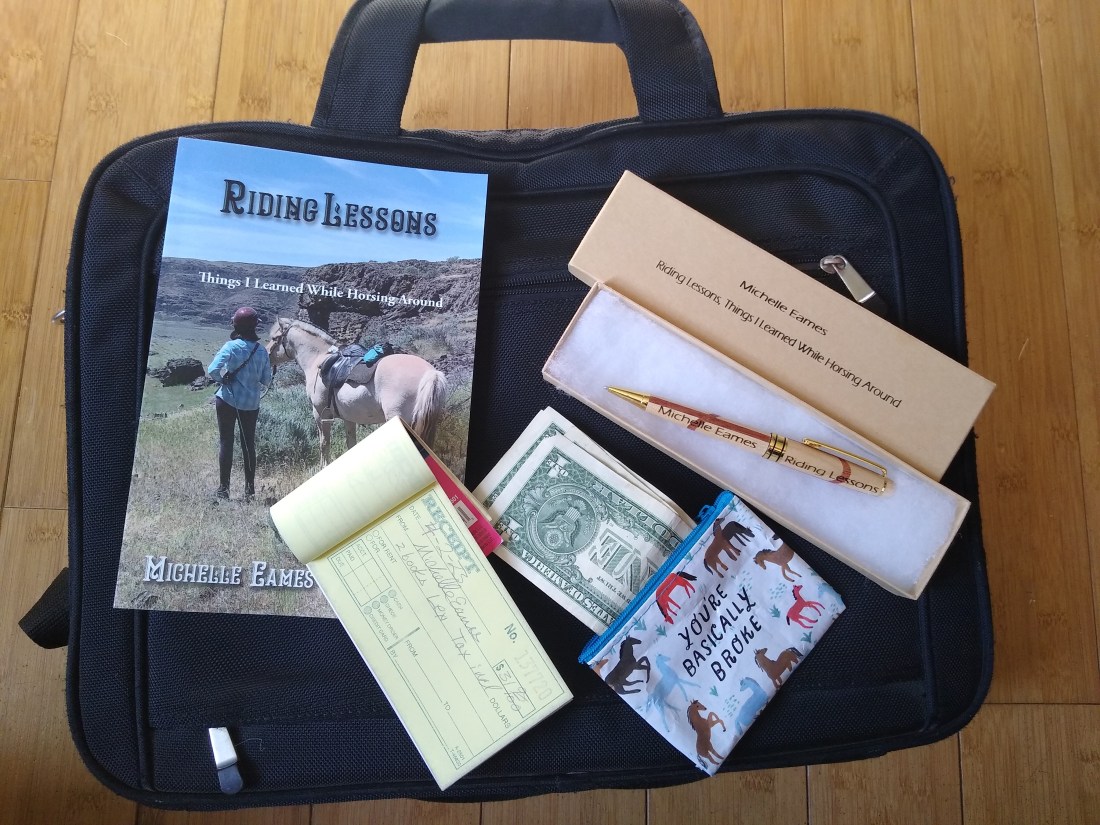
I am making progress with the distribution and selling of my self-published book “Riding Lessons, Things I Learned While Horsing Around”.

I will have a book signing event at Spokane Tack Trunk on April 30, 2023, from noon until 2 pm.  Morgan Shank will also be signing her children’s horse book at the event. Drop by to shop for tack or fun horse-themed accessories, buy a book or two, and have the books signed by the authors.  This should be fun! Please come visit, because if Morgan and I are left unattended in a tack store for too long, we might buy saddles. We do not need new saddles. And also there is a chocolate store next door. That could be trouble.

I now have my book in six retail locations, with the most recent being the Well-Read Moose, in Coeur d’Alene, Idaho.  In addition to that location, my book is carried at Orca books in Olympia, and at three Spokane area bookstores (Wishing Tree, Second Look Books, and Aunties).  And of course, the book is carried at Spokane Tack Trunk. 

All of the retailers have been super-friendly, helpful, and supportive.  I’m still surprised at how much time and effort it takes to market a self-published book.  It’s fun, and it’s work.  However, I get to buy books when I visit bookstores… this may explain why my profit to loss margin is not in the black yet…

I have received very positive reviews on Amazon, and in person.  Even non-horsey readers love the humor in my book.  My next book will be a collection of poetry and essays.  I think.  I’ll let you know as that progresses.  Per normal, it seemed like it would be easy to pull together a lot of my old pieces into a new book, but it’s not.  It’s work.  

If you have already bought my book, I hope you enjoyed it!  If you aren’t really one for buying books, ask at your local library and get them to buy it.  Hmmm… I should visit my local libraries.  More work. More fun. The good news is that my home-town library in Blaine, Washington, does have my book.  That makes me smile!

I look forward to more fun, more work, more selling, and more writing. Also shopping, as I visit new places that might want to carry my book.

Duct Tape and Baling Twine

After my “Farewell to the Red Boots” blog, my friends came through with some great advice.  They advised me on other good boots to buy, where to find red boots, and how to find them cheap (look on ebay!).  My kind of friends!  But more importantly, they described how to fix the leaky boots.  I am always trying to eke out one more week, one more season, or one more year to save money.  Notably, this also saves resources. 

My friends suggested patching my boots with E6000, a very strong glue.  Or Gorilla Clear Grip Waterproof Adhesive to apply a patch, or to use on its own.  I love having fix-it supplies around the house.  We may already have some E6000, and I’ll be shopping for the special Gorilla glue.  This will add to my ever-present availability of duct tape and baling twine.  With all of the above, I should be able to fix most everything around here, except car and truck engines.  There you need tougher stuff.  Like hose clamps. And a hammer.  And a big bank account for the real mechanic.

But for other things, baling twine is very useful.  I use it to fix fence, tying the mesh to the posts.  My older son hates blue baling twine.  When I used it on his pheasant pens, he gradually cut it off and replaced it with wire.  He’s right in that it looks funny, and it doesn’t last more than a couple years.  But its free!  And I have an unending supply! He needs to come visit, and replace the twine on our recent fence repairs.  It will make our place look so clean and finished.  Ha!  We still have the crooked and saggy fence lines and mismatched materials to deal with.  This hobby farm will never look like a manicured and formal Thoroughbred breeding farm in Kentucky.  We just don’t have it in us.

Duct tape remains useful all around the house and farm.  I’ve used it to protect the water trough heater wires from horse nibbling.  I’ve used it to hang electric fence insulators on the mesh fence between the posts.  I’ve used it for shoe and boot repair.  My younger son even used it once to create a duct tape rose.  All things can be accomplished with duct tape.  Although out in the weather it really is a temporary kind of fix, it falls apart over time.  But temporary can last for years around here, until that duct tape project works its way to the top of the to-do list.  Our to-do list is very long.

One time at my office we had some server issues.  Servers are the big computer thingy’s on trays that connect all the computers in an office.  They hide them in secure computer rooms. When they malfunction, the office computers don’t work.  And when you work in a small sub-office, the strangest people end up working on those things.  Like me.  With in-person, and remote help from our IT staff, we ended up stringing cables from one server to another server 10 feet away.  It was a mess of wires strung across the room.  It made me laugh, it looked so rinky-dink.  I especially was laughing because they had me helping.  I am not techy.  Nonetheless, we got a temporarily functioning system, with a web of wires that we had to duck under.  And when we finally got it finished, I added some baling twine and duct tape.  Just because.

Then there’s my barn roof.  It’s a small hobby-farm barn, just one story tall.  We’ve had some fierce winds over the years, and several aged shingles have blown off.  We tried some quick and dirty nailed on repairs, that again blew off.  Last year I considered re-roofing the barn. Then I learned how much professional repairs or re-roofing costs.  Surely I could get another year or two out of the current shingles.  So I you-tubed how to properly (sort of) replace missing shingles.  Oh… one must pull the nails out of the previous row, then tuck the new patch shingles underneath, and re-nail everything.  Got it.  The other key ingredient was roof tar.  We’re not talking a couple calking tubes of tar, we’re talking a gallon can of the nasty black goo, and a thick putty knife.  And of course my husband and son claim to be scared of heights, so guess who got to do this job?  Yup.  Me.  Add roofing contractor to my resume, right after computer hard-ware technician.

Weirdly, I enjoyed being on the roof, prying up nails, re-placing shingles, and spreading black goo all over.  With my mom’s help as the ground crew, we got it done.  It is not beautiful, and the new shingles don’t match the old shingles, but it’s on the back side of the barn; no one will ever see it.  I must admit, that after tarring the heck out of the roof, I had a craving for chocolate cake with dark chocolate frosting.  Roof repair and frosting a cake are more similar than one would think. Especially the way I frost cakes!

So there we have the list of items to fix almost everything:  E6000 glue, various Gorilla glues, Duct Tape, Baling Twine, and Roof Tar.  Let’s be clear that you can’t find lengths of baling twine in any old hardware store, but I’m happy to send you some.  Free.  Please. Take some baling twine.

[photo credit Margaret Eames]

Farewell to the Red Boots

Every hobby farmer needs some rubber boots.  Mud goes with farms like mallards go with water.  And on our farm, even more so, since due to the layers of basalt rock just below our shallow soil we get large seasonal ponds and expansive puddles.  Rubber boots are a must.  Cheap rubber boots are fun, and you can find them in bright colors, but they only last a year or so before breaking up at the bend points of the heel or over the top of toes.  Sometimes one just wants to splash through puddles like a kid, without getting wet socks.  Other times, Oly the Elder will hide in the middle of the pasture pond when I’m trying to herd him back to the paddock, and I have to go in for him.  However I think he knows exactly how tall my boots are, and he stays just deep enough so I can’t reach him. Boots matter around here.

In about 2016 I bought a pair of red neoprene lined boots.  I bought them on clearance, through REI.  The brand was Bogs, and the model was “Tacoma”.  That sounded appropriate, since Tacoma is a city in the rain belt of Washington, so I figured they had to be waterproof.  The boots had a low heel, although the heel wasn’t really tall enough to qualify as a safety riding heel.  But they were better than most rubber boots.  Also, they were warm with the neoprene lining, so were good in snow.  They were tall, to get me through a snow bank or a deep puddle.  They even had a decent arch to support my feet on long walks on our muddy road.   Best of all, they were a stylish bright red color.  I loved those boots, and I wore them almost daily from fall through spring.     

Last week I wore them in a deep puddle while repairing a fence, and found they leaked at the left heel.  I was devastated.  My favorite red boots were failing me!  They only lasted eight years!  I haven’t truly investigated the leak yet, maybe they can be patched, but patches don’t usually last.  I will eke out the spring season, avoiding deep puddles as much as possible, and search for a new pair next fall.  But I am sad.  I am sure I will never find such a lovely pair of boots again, with such a bright color and long-lasting water-proofness.  And, of course, at an affordable clearance price. 

For now, I am offering my thanks to the best farm boots ever! Soon our ponds will be gone, and I will be digging out my best pair of light-weight leather summer riding boots. But the snow season and mud season will come again.  I’m crossing my fingers and my wet toes that I can find new mud boots that will last as long as the red Tacomas.  But I am not hopeful.