I love our chipmunks, and I saw some cavorting in a Serviceberry bush yesterday evening as I was bird watching. I was so happy the cats were indoors, or in their small catio, and the birds were all safe in my yard.
Apparently the chipmunks were not safe, however, as this morning my husband saw Purrcy run through the living room with a chipmunk in his mouth. He yelled, “Where was the cat? He has a chipmunk!” as Purrcy ran upstairs past me and into my son’s room. My son’s room is not a neat and tidy place. There are many spots to hide, I realized, as I grabbed the cat with the small live mammal in his mouth, and he dropped it. The chippy disappeared under the desk as I hurriedly put the cat out on the porch, and joined Doug in my son’s room. His hands were on his hips and he was frowning, with no chippy in sight. It had to be there somewhere.
We discussed a trap. But I don’t have a chipmunk-sized live trap. I grabbed a couple of mixing bowls from the kitchen thinking we might capture him under one… and then, um, maybe slip a piece of cardboard under it, like capturing a house spider under a glass to free it outside…? Yeah, surely that would work. But the chippy was nowhere in sight.
So Doug let the cat back in the room to capture the chipmunk. Purrcy had it caught before I had time to think through how we might get the chippy out of his mouth without it escaping again. Put the mixing bowl over the cat? Purrcy zipped out of the room, chimpmunk hanging from his mouth, past us, downstairs, and crashed through the swinging catio door. We ran after him, closed the inner catio door, and then ran out our back door and around to the other side of the house to the catio with hopes of getting the cat to release the chippy. Even before I had the outer catio door unlatched Purrcy had eaten the chippy’s head off. We left him to devour the rest of the body.
I love our chipmunks. But this was definitely a survival of the fittest scenario. That chipmunk obliviously entered a small fenced area that was full of cat-predator smell. Of course it got eaten (after being traumatized by the cat and two humans). As Doug says, even a blind squirrel will eventually find a nut. Even a caged cat will eventually find some prey.
At least it wasn’t a bird loose in the house. This time, anyhow.
P.S. At the time of this writing, it’s 24 hours later and I still haven’t found any cat puke. That either means it’s not going to happen, or that Purrcy has already made his deposit in some dark and hidden location that I will only find when I step in it, barefoot, in the middle of the night.
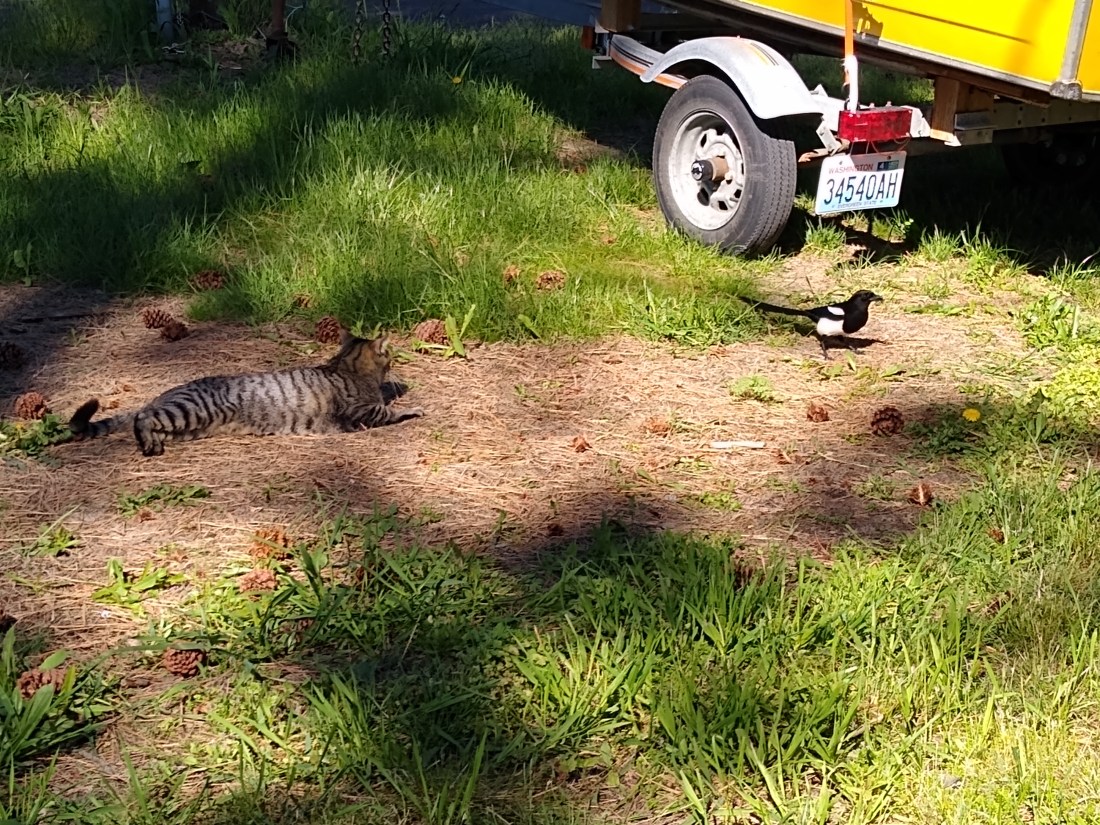
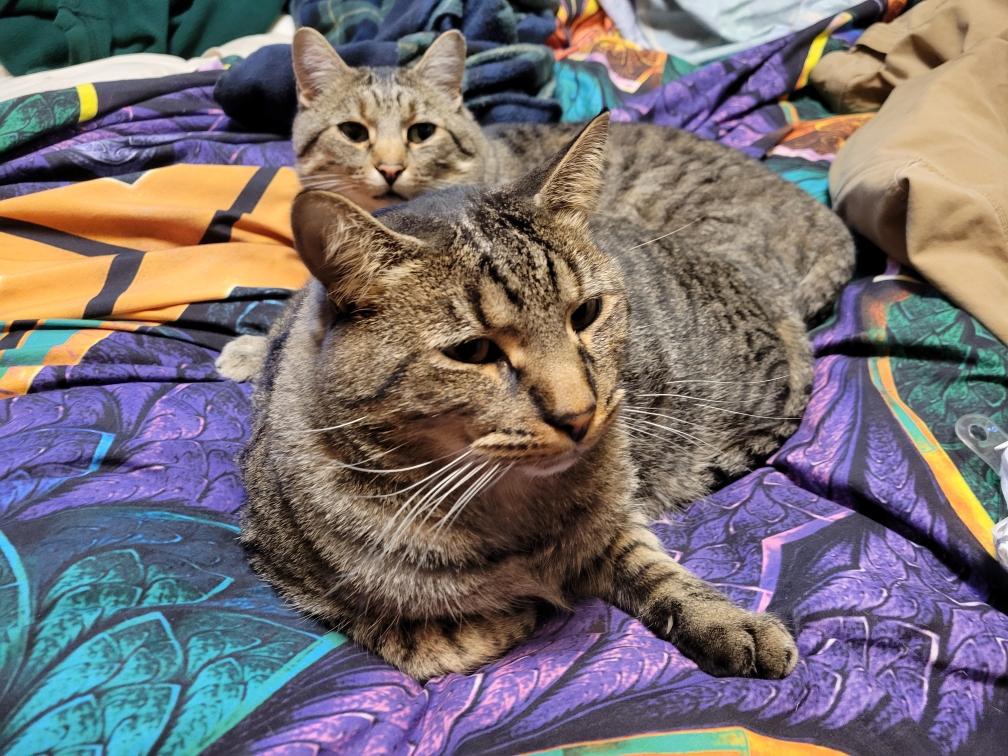
I’ve always been a dog person first, a horse person second, and only in recent years have I really begun to appreciate cats. We have had many barn cats over the years, all lovely and friendly animals. The goal of barn cats is to keep the mouse population down, but we still have many mice. Right now, we have two extra special cats: Purrcy and Squeaky. Both simply arrived in our barn. First Squeaky moved in, then a couple years later Purrcy showed up. They could be cousins based on appearance; they are very similar striped gray male tabbies. But in personality, they couldn’t be more different. Squeaky is shy, reserved, anxious about anything new or strange. Purrcy is bold, curious, fearless.
Although they started as barn cats, they both gradually morphed into indoor/outdoor cats and I have long considered making them into indoor-only cats. Indoor cats live longer, and they don’t eat wild birds. In the United States, outdoor cats kill about 2.4 billion birds every year (American Bird Conservancy). I really like birds, and Purrcy, in particular, is a skilled bird hunter. In addition, this year, we have worries of bird flu, carried by, you guessed it, birds. As best as anyone can tell with this new virus, if cats get bird flu, they die. Fast. And I like my kitties!
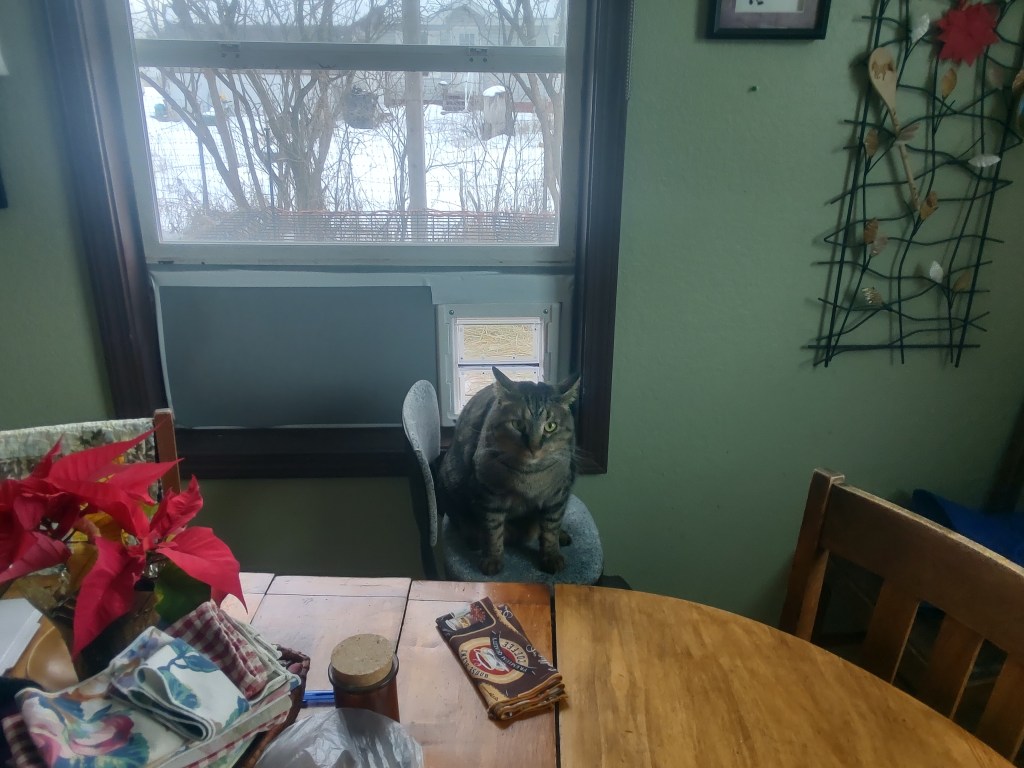
I’ve been planning the indoor transition all winter, and bird migration season is upon us. I knew it would be a rough transition for my cats, so I thought I would soften the transition by building a cat-patio (catio). This includes putting a cat door into a window, and then basically building a large cage outside. I ordered an insulated cat door and my mom and I started the project. My husband got to help with the sawing because I have a fear of cutting my fingers off with power tools, but other than that it is better for our marriage if we avoid construction projects together.
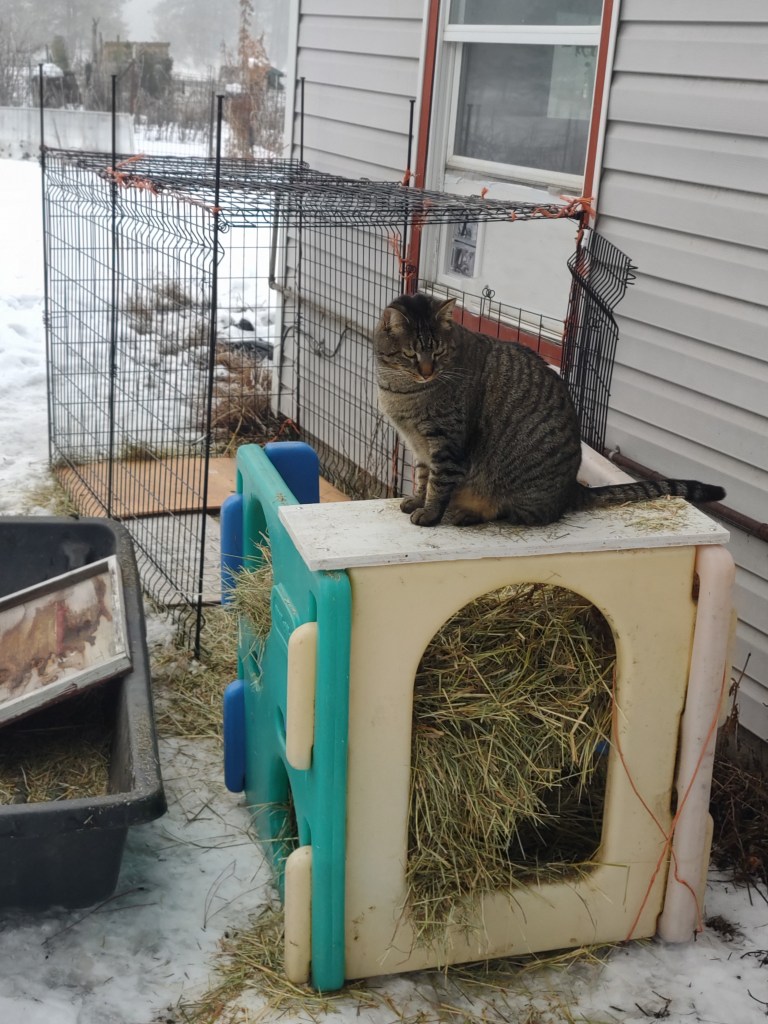
We cut the window plywood, painted it, attached the cat door, and added a layer of half-inch foam on the inside for insulation. Then we moved to the outside project. We built the cage out of yard fence panels and temporarily tied everything together with orange baling twine. In theory, if this catio experiment worked, we would eventually replace the garish twine with more subtle zip ties. In practice, we’ll see if I ever get around to it.
I repurposed a plastic yard kid toy under the window to make a bench for the kitties to step out onto from the cat door. Once everything was in place we were ready for the grand experiment to begin. My husband took off for a planned fishing weekend, and I was alone with the animals. Would the cats actually use the catio?
The first evening, after dinner, I introduced Purrcy, the bold cat, to the catio. I held the cat door open, put some yummy, canned cat food outside on the bench—he looked, hesitated, then walked out on his own. Soon he was coming in and out without help.
Later in the evening, it was Squeaky’s turn. I took him to the stool by the cat door, opened the door, put more yummy food outside—and Squeaky braced with his paws and claws spread wide, quickly becoming an immovable object. No way was he going outside, and I needed three hands just to hold him there. An hour later I tried it again, and I managed to push him out into the darkness. He ignored the food and started yowling, at one point climbing a fence panel like a monkey, looking for a way out. He dropped down and stayed in the corner close to the house, clearly upset.
Several times during the evening I opened the cat door and tried to coax Squeaky back in; no response. Purrcy also went in and out several times, seemingly checking on his buddy. Squeaky just hunkered outside, insulted, refusing to move. I wasn’t worried, there was warm hay in the catio and I knew he could survive the night, being a barn cat and all. Finally, before bed, I grabbed a flashlight and went out to visually check on Squeaky. I stepped out the back door onto our screen porch, and there was Squeaky, happy in his usual basket. How did he escape? He surely couldn’t fit between the fence panels. And cats don’t dig.
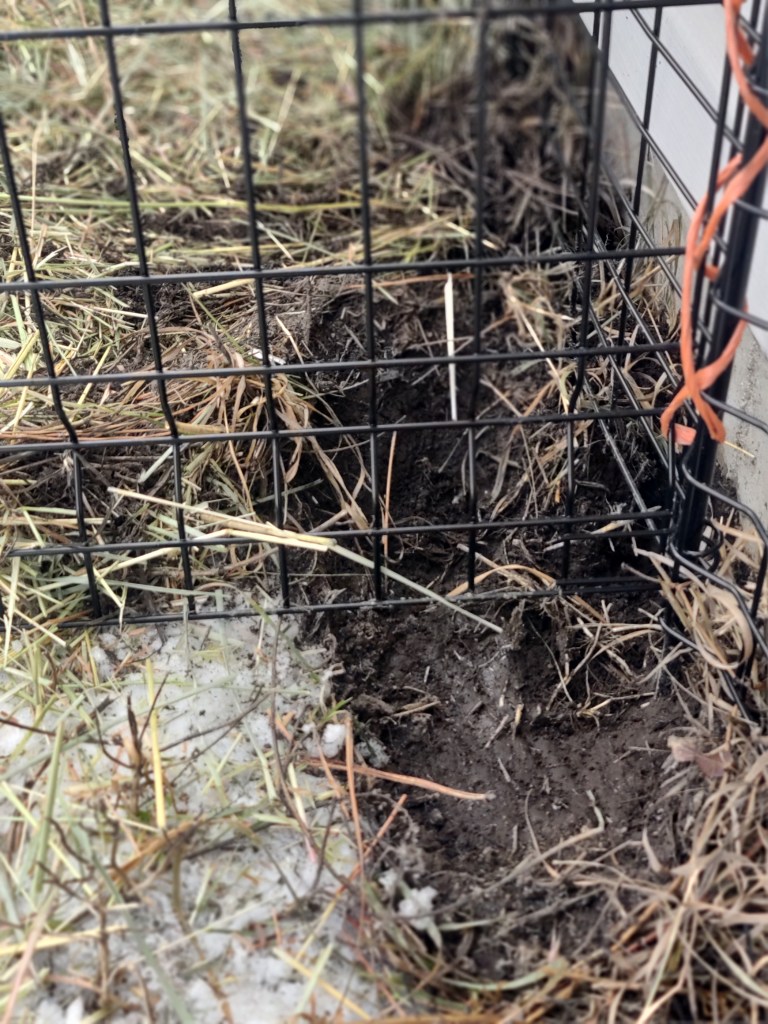
Turns out, Squeaky was a digger. He found the only thawed dirt close to the house and dug under the fence panels like a gopher. He was not staying in that repulsive cage. I was amazed and considered renaming him Sneaky.
That night, I put the plastic cover over the cat door to prevent cat escapes out through the newly dug tunnel and left the cats in the house all night. I expected a long and loud night. Typically, one or two cats will spend at least half the night on the bed, and then jump on me, or meow to be fed or to be let outside. At 2:30 Squeaky meowed to go out. Instead of letting him outside, I just pushed him out of my bedroom, shut the door, and figured he would quit meowing in a short time, then find a quiet spot to sleep. You may be wondering at this point how Squeaky got his name. He has a very strange, squeaky, non-melodic meow. And if you ignore his request for food, or to be let outside, he gets louder. The squeaky meow becomes a yowl, as if he is being tortured. The first yowl session lasted an hour before he finally quit. There were two more yowl sessions during the night, shorter, but plenty long enough to wake me up. One cat, probably Purrcy, decided it was time to get me up and stood at the bedroom door scratching and reaching his paws under, and somehow clunking the door, as if he were knocking. Between the yowls and the knocking, my dog and I barely slept.
Finally, morning came. I got up, started coffee, and let the cats go outside. I needed a mental break. I looked around the kitchen. The foam insulation on the window plywood was shredded, and bits of foam littered the floor. One cat wanted out that way last night, probably Purrcy, and was frustrated that I had locked the cat-door. Purrcy liked his catio.
My mom arrived and we went to work to fix the failings of the catio. First, we replaced the shredded foam. Then we put double-sided sticky tape all over a piece of poster board, and used that to cover the foam insulation. We thought this would prevent cat scratching, and it would also catch bugs, and possibly any humans that leaned against it.
Then we moved outside, discussed options, and decided to put a floor in the catio. We used scrap wood to make our floor, and used a large rock to close up the tunnel. During all of this activity, Purrcy kept going in and out of the cat door, checking on our work. He claimed that catio as his own. Once the fixes passed Purrcy’s inspection, we were ready for the next transition day.
Once again, I brought the cats in the house and was determined not to let them out. That night I left the cat door open and available for use and went to bed expecting to be awakened. Squeaky slept most of the night on my bed, with only a few meowing interludes that were short and moderate in tone. Purrcy wandered around the house, and in and out of the catio. The night went surprisingly well. My dog and I slept!
The next morning the cat door looked fine, and nothing was shredded. This was going great! By the next evening, Squeaky had figured out how to use the catio door on his own. Piece of cake! The experiment was working.
My husband returned home from his fishing trip, and I explained that the cats should now be permanent house cats. At the first sign of meowing to go outside, my soft-hearted husband wanted to let them out on the screen porch. The porch is enclosed, but it has a dog door. He blocked the dog door with the large dog food container and let Squeaky out. Squeaky figured out that the lightly loaded container could be moved aside. He was out and back in the barn quicker than we could say Sneaky Squeaky. I knew he would come back; his food was in the house. Eventually he did return, and we placed a heavier obstacle in front of the dog door. Squeaky spent time in his favorite basket on the porch, and he seemed happier.
Since then, our nights have been quieter, and we are more confident that our kitties will complete the transition to full-time indoor cats. They spend more time on our laps, and we find that they need some play time with us to expend some energy. We have toys spread throughout the house. Purrcy still wakes me up by jumping on me at some point before dawn, but when I push him out of the bedroom and shut the door, he finds something else to do. As I write this, I can hear the redwing black birds trilling outside and I see the California quail happily wandering in our yard, safe from our bird-eating cats. And hopefully our cats will be safe from bird flu.
Mary Jane’s Farm magazine once again was kind enough to publish an article of mine: Overalls Beat All, p. 29, in the June-July 2024, issue. This issue is on newsstands now. I hope you enjoy the magazine.
I can’t share that article from the current issue yet. Instead, I’ll share my last article, Feeling Her Oats, that was published in the April-May issue of Mary Jane’s Farm magazine. The theme for that “Keeping In Touch” section of the magazine was “Pony Up”.
Feeling Her Oats
The phrase “pony up” means to make good on a debt. However, as a horseperson, I focus on the word “pony.” To me, pony up means to mount up and ride. It reminds me of other sayings that started with horses, or that can apply to horses. Such as, “Don’t look a gift horse in the mouth.” This phrase originates from the fact that you can tell a horse’s age by looking at the wear on its teeth. Generally, only old horses are given away, so don’t look if you don’t want to know. Don’t ask if the gift is too good to be true. Young horses are expensive; you need to pony up substantial money for a good young horse.
Another phrase is “Don’t go against the grain.” I was taught to brush a horse with the grain of the hair, following the growth along the neck, over the back, and then dipping where the hair turns down in front of the flank. You brush with the grain because if you brush the wrong way, it may tickle the horse. And a ticklish horse may surprise you with a kick.
Paper has a grain. Paper tears and folds more easily in one direction than the other. The grain of the paper comes from the way the wood fiber was laid down when the paper was made. Wood has a grain, too. If you are carving, or even just whittling, the flakes will come off smoothly in one direction, while in the other direction, they will break off in jagged chunks. Always follow the grain of the wood with your knife, and always whittle away from you. I know this; my family usually cringes when I pick up a sharp knife. This reminds me of another saying: “A dull knife cuts worse than a sharp knife.” I have the scars to prove this.
Sand has grains. Sand grains flow with gravity, or with the wind. The tiniest grains can make a large dune. Just like the tiniest effort can make a change in the world. Rice is a grain, but in that case, you need to “separate the grain from the chaff,” or focus on the important stuff. Then there is salt: “Take that with a grain of salt.” Don’t always believe what you hear. Or better yet, don’t believe something unless it comes “straight from the horse’s mouth.”
Oats are also a grain. A horse that is “feeling its oats” is very rambunctious, as if it had sugar for breakfast and is full of energy. Sometimes, if a horse is feeling its oats, the rider gets dumped. Then the expectation is to “get back on the horse.”
I tried this recently, after an unplanned dismount. I insisted on finishing the ride because I follow through on commitments. But then I felt my injured hand swelling up inside my leather glove and the pain got worse. When I saw the lumps on my wrist, I decided that getting back on the horse was overrated. After a visit to the doctor and a diagnosis of a broken bone, I relearned another old saying: “Rest is the best medicine.”
Unfortunately, a rest for me means a rest for my horse. When I finally get back to riding again, he is likely to be feeling his oats. Hopefully, the next time I pony up, I will stay in the middle of the saddle and won’t need to revisit getting back on the horse. I am optimistic that instead, we will be calmly putting one hoof in front of the other and riding off into the sunset.
But it’s better than the alternative. An old friend used to say that. I’m understanding it more and more.
I still find it hard to believe, but a week ago I fell off my horse and broke my arm. Again. The left arm this time.
It was just a spook, a quick forward move that I can usually ride. And it was just a fall onto grass, a fall I have done in my home pasture many times before. It usually hurts, but I don’t usually break. These are new times in my life with horses.
I have gotten support, advice, and help from friends and family. The most obvious advice is never to ride bareback in the spring. Or never to ride bareback, period, since I’m old, and my balance isn’t what it once was. But I’ve also heard of other riders with injuries and falls this spring. More than one of us are spending the spring healing. It’s weirdly reassuring that I’m not alone.
The support has come in many forms. A friend helped me haul my horses to a vet appointment this week, while I pointed and advised and told her which of my look-alike fjord horses was which. Other friends offered any help I may need. My husband and son have been waiting on me, feeding me, and feeding the horses. My poodle, Cookie, has been keeping me company on the couch. The cats, however, have been indifferent and aloof.
It’s been a wakeup call, that I cant ride and play like I could when I was 16. Or 26. Or even 56. Horses have been the place where I can find my inner teenager, and just goof around. Now it’s the place where I have to find my inner cautious senior citizen. Safety before fun. The saddle is my friend.
I want to get through this healing journey quickly, but it was a displaced break, and will take time. Surgery, screws, and plates were involved. It’s hard to live in the moment, when I want to fast forward and figure out what kind of therapy I need and start exercises to get stronger. Instead I am forced to embrace the wisdom and patience of age, and breathe through the tweaks of pain. Because it’s better than the alternative.




 Michelle Eames