
After the broken arm, and after the angry nerve got less angry and my fingers and wrist were working again, a honeybee swarm settled on a corner post of our horse pen. At first it looked like a giant clump of moss, grown up overnight along the wooden post. At a closer look, it was clearly bees. I know just enough about bee behavior to recognize that the blob of bees was protecting a queen, and if I didn’t bother them, they wouldn’t bother me. Luckily, I’m not allergic to bees, so I was comfortable with the idea of live and let live. Or be and let bee.
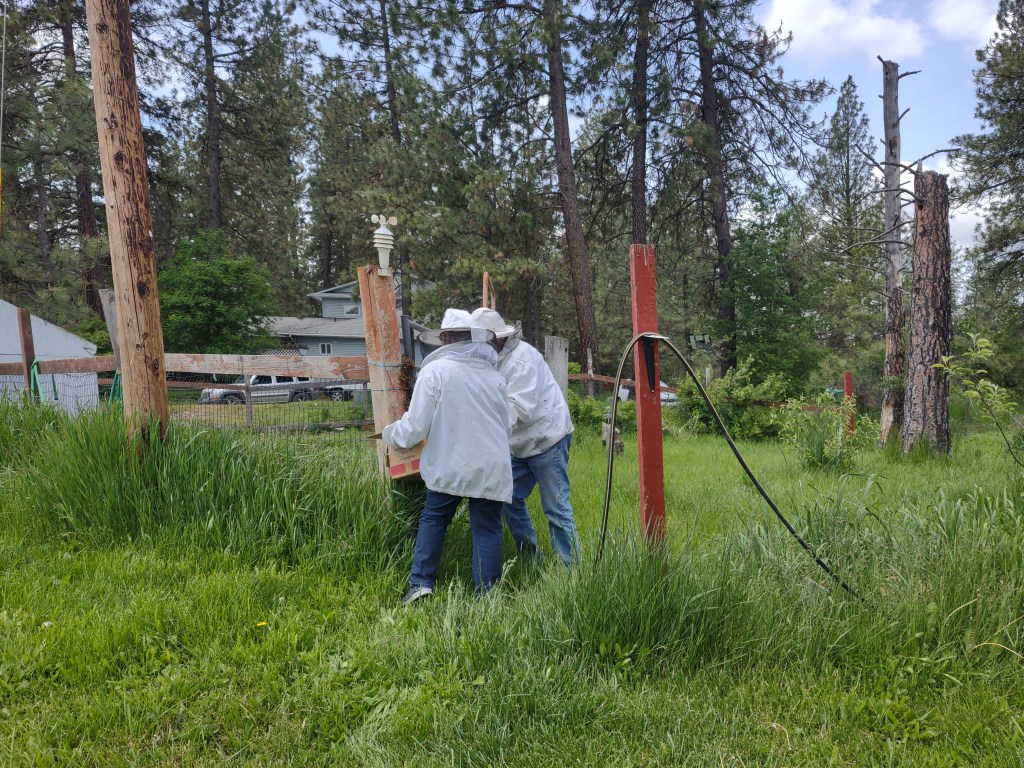
I did call my bee-keeping neighbors, and the husband-and-wife team came over to transfer the swarm to an empty hive at their place. My family and I were fascinated, and watched from a distance as they suited up into their white protective gear with mesh over their faces. My neighbor then reached his gloved hand in to the mass of bees for the queen, pulling, pushing, and brushing the bee clump down into a cardboard box. The bees came down in big blobs, and only a few started flying around. Once most of the swarm was moved into the box, my friends closed it up and carried it back to their car. I came closer to chat, and used a stick to swish a few extra bees off their bee jackets. One disgruntled bee flew off and landed in my hair. As I tried to gently brush him away, I got stung on my forehead, above my right eyebrow. Ow!
I knew the sting would hurt and swell. But I didn’t think the swelling would move down to my eyelids like it did, giving my eyes the appearance of pig-eyes. I didn’t think my eyes and forehead would still be swollen 48 hours later, despite popping Benadryl like candy. This was an unusual response for my body. Typically for me, a bee sting hurts, swells, then goes away quickly. I wasn’t particularly worried about potential for anaphylactic shock, but I still was vigilant to notice any changes to lips, mouth, or throat. There were none.
In thinking back, though, I remembered a few significant rash and swelling reactions in the past. Once, during our Peace Corps stint in the Gambia, we helped with a field study evaluating different varieties of sesame seeds. Our job was to help harvest, dry, and weigh the production of the plants. Sesame plants have fuzzy hairs on them like tomato plants. My body did not like those little pricklies. My whole face swelled up, including my eyelids. My angular face became round while my eyes peeked out of puffy slits. Benadryl (and time) was the answer then, too. And staying away from sesame plants.
Still, I can’t get over the changes in my body these days. The unpredictable responses. The wimpy bones. The stronger reactions to bee stings. The inability to sleep through the night. My body was always strong and tough over the years. Generally, I got sick, then I got well. Except that one time I caught Typhoid in West Africa…that’s another story. Now I wonder, where did my strong and supportive body go? Why is my body reacting so dramatically at this age, even though my brain is sure that I’m still twenty-three? Whose body is this, anyway?
Sigh. There must be a metaphor, a moral, or a lesson in here somewhere related to the swarming bees:
- To make the old hive stronger, you have to kick out a new queen now and then. Nope. That doesn’t feel right.
- To get a little honey, you have to put up with some bee stings. That’s better, but it doesn’t really connect to my wimpy body situation.
- Don’t mess with the old queen, or you’re going to get insect-butt-kicked by her drones. We’re getting closer. I like that sentiment. I can be the bossy queen when needed and tell my drones what to do.
Still, I’m not finding a lesson that clearly links to my weak body. Therefore, to conclude this blog with a deep philosophical thought, I must fall back on an old saying we learned in the Peace Corps:
- Just say yes to drugs! (As in antibiotics, or antihistamines, or anesthetics for arm surgeries…)
Sometimes, your body just needs a little help from the medical or pharmaceutical community. Much like swarming bees need a little help from the bee-keeper community.
 Michelle Eames