Publication News: Chicken Soup for the Soul; and a book drawing

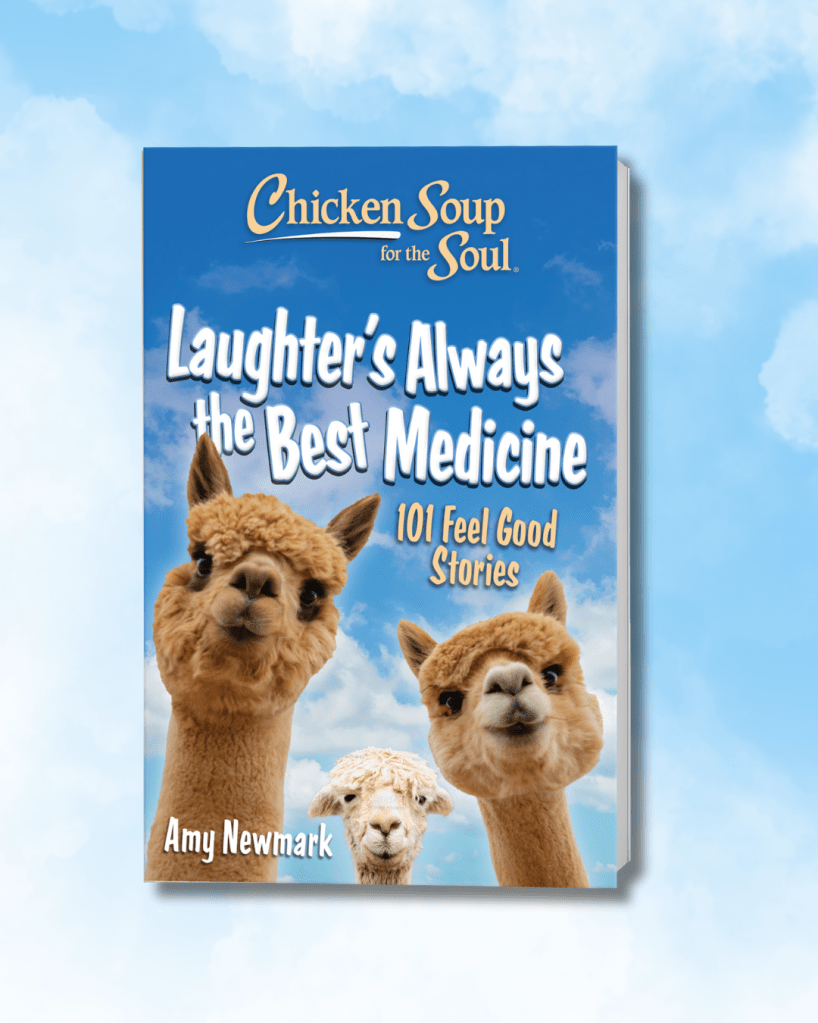
I’m excited to announce publication of my story in Chicken Soup for the Soul, Laughter’s Always the Best Medicine, 101 Feel Good Stories.  My true story is about a family fiasco of roasting a pig in a pit.  There are 100 more humorous stories by other authors in the book.  We all need a good laugh right now.

The paperback book will hit bookstores on February 18. See more here: https://bit.ly/4gczg9A

Just for fun, I am offering a drawing for a free copy of the paperback book.  All you have to do to enter is let me know in a message or a comment by February 27.  You can comment on this blog, comment on my substack (@Michelleeames), comment on Facebook (Michelle Eames Writer) or send me a message thru email (michelle@michelleeames.com) or Messenger.  The drawing will be held on February 28, 2025.   I’m sorry that the drawing will be limited to the U.S. only, due to prohibitive international postage costs. 

Speaking of money, I actually got paid for my story! It was a nice piece of change. Anyone can send in a story to Chicken Soup for the Soul. See their topics and guidelines here: https://www.chickensoup.com/story-submissions/possible-book-topics/. I’m sure I’ll send in more stories; making money is such a novel idea…

Book Review: The Three Mothers

In honor of Black History Month, I’m sharing a short review of The Three Mothers, How the Mothers of Martin Luther King, Jr., Malcolm X, and James Baldwin Shaped a Nation, by Anna Malaika Tubbs. 

I, like most Americans, knew about civil rights activists Martin Luther King, Jr., and Malcolm X.  I needed a refresher on James Baldwin—he was a poet and writer that often addressed civil rights and human rights in his writing.  I knew nothing about their mothers.  As the author writes in her introduction: “The three women I speak of are Alberta King, Berdis Baldwin, and Louise Little— women who have been almost entirely ignored through history. … While the sons have been credited with the success of Black resistance, the progression of Black thought, and the survival of the Black community, the three mothers who birthed and reared them have been erased.  This book fights that erasure.”

The author is right, I had never learned about, nor thought deeply about the mothers of these activists, or any activists for that matter.  But obviously, the mothers rocked!  They sacrificed to get their children an education.  They supported their children in hard times. They taught their children to have strength in their convictions.  Two of the moms outlived sons who died in violent deaths, and Berdis Baldwin also outlived James.  My words give just the barest overview  of the enormous challenges these moms and their children went through.  I’ll just say that the book was well-written, well-researched, and I learned a lot about struggles in eras that had only been lightly touched on in my history classes.  

I recommend this book.  It took me a long time to read, not because it wasn’t good, but because as I often do with serious non-fiction, I read a chapter, then mull it over for a while.  This book offers plenty to think about and is a good refresher on the civil rights struggles of the past, as we witness new civil rights challenges today. 

I Resolve to Have Goals (If I Feel Like It)

I don’t do New Years resolutions.  It’s not that I don’t believe in improving myself, it’s more that I don’t like to follow rules and expectations just because everyone else is doing it.  Just because it’s January first, doesn’t mean I must commit to an exercise program.  Instead, I might commit to an exercise program in October.  And finally get serious about it after Turkey Day, as I did this past year.  For me, resolutions are similar to spring cleaning.  Must I do it because everyone else is doing it?  No.  Spring is for outside work.  But I often do some serious cleaning and sorting in the Fall or Winter, when I’m spending more time inside and noticing the clutter.  It’s an opportunistic kind of cleaning, room by room as I feel like it.  If I feel like it. I have a high tolerance for clutter.  Eventually, though, the dirt and disarray gets to me, and I jump in for a serious clean.  Eventually, I get things done on my own time.

Nonetheless, I often revisit my writing goals and expectations in January.  I sometimes keep the goals in my head and I sometimes write them down.  But I don’t call them resolutions.  They are more of a plan for the year.  My writing goals include general intentions, and then those are broken down into specific attainable steps. The general goals can be vague, and by themselves overwhelming, for example, “Publish a new book”.  But if I break the goal down into small do-able steps, I can make progress toward the end goal. 

The other difference, to me, between resolutions and goals is that I can change my goals and steps regularly, when needed.  I revisit them as the year proceeds, as I get new information, new ideas, or new plans. These plans become to-do lists to reach the final result.  Even when I haven’t formally called them yearly goals, I am constantly making and revising to-do lists for my writing progress.   

Given all that, here is my first draft of my writing goals and steps for 2025:

Goal 1: Publish my new book of prose and poetry across Washington (I have a solid draft already).

 Steps to get there:

  1. Continue to research appropriate publishers and contests. 
  2. List the potential publishers on a matrix (I love matrices) to track submission information, dates sent, expected reply dates, and results.
  3. Follow online guidelines to send submissions to the publishers and wait for response.
  4. If no positive responses by about September, reconsider the plan. 

Goal 2: Write more stuff.

   Steps to get there:

  1.  Either through prompts, or on my own, do new writing several times a week, for at least an hour. 
  2.  Continue blogging, about twice a month.
  3.  Continue my Substack newsletter, about once a month. Continue newsletter for one year, then revisit whether it is still enjoyable, and useful to connect with readers.
  4.  Think about a third book, probably a humor book about hobby farming.
  5. Explore other forms of writing, maybe short stories.

Goal 3: Read more stuff.

  Steps to get there:

  1. Waste less time on social media, read more books.
  2. Last year I focused on poetry, this year focus on humor, satire, short stories.
  3. Do I have any Mark Twain books? Find some and read them. (Hey, I bet those are in public domain now, and I can find them free online!)

I was going to close this blog out with a final paragraph about the need to regularly revisit, revise, and revamp our goals, but it sounded, well… preachy.  You don’t need me to tell you what to do.  Instead, I’ll end with a quote by Mark Twain:

“Writing is easy. All you have to do is cross out the wrong words.”

P.S.  Here’s my latest substack newsletter, if you want to take a look:  https://michelleeames.substack.com/p/this-is-not-my-year-in-review

[photo credit pexels free photos]
Writing for My Audience

Know your audience, they say, in all of the “How to Write” essays and websites; then you can successfully market your books to that audience.  But my audience keeps changing as I write.  I tend to hop from humor, to poetry, to essays.  My styles and subjects vary widely.

There is the horse-people audience; where I can reach out to our commonalities and our love of horses.  My humorous memoir about living with horses sells best in a local tack shop.  

There is my home-town audience.  When I had a reading in my hometown of Blaine, Washington, I shared about what the town used to be like when I kept my horse in our back yard.  I pointed out that the current grocery store location used to be a big hay field where one of my stories occurred. 

When I had a reading in a Coeur d’Alene, Idaho, bookstore, I shared some of the humor from my book, and focused on the broader audience’s common love of animals, and what animals teach us.

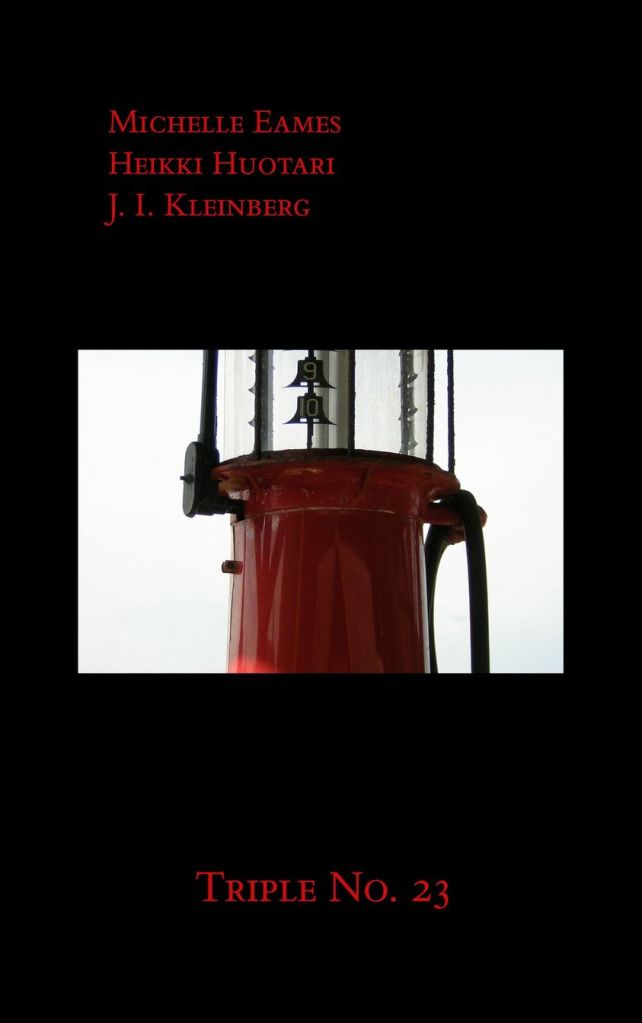
Another time, when I joined a panel with more literary-style poets and writers, I read a short prose piece from my book, to better illustrate the many ways of writing about animals, and how our relationships with animals can be used as metaphors for other things.  I also reached out to a more literary audience when I shared information on my short collection of fire poems in Triple 23.  Poetry readers are yet another audience that can be different than humor or memoir readers.    

I can’t decide if my eclectic writing style is a blessing or a curse.  If I only wrote humor, I could market that humor and immediately jump into writing another similar book.  Yet the poems and essays in my brain want to be written and heard, too.  Recently I saw writing described as “an expensive hobby” where only a relatively few writers make a lot of money.  I’ve decided to embrace that idea.  My hobby of writing is a second expensive hobby after my hobby of horseback riding. 

Like jumping my horse over fallen logs in the woods, I jump from audience to audience as my writing proceeds.  Just as I explore different riding disciplines with my all-around horse, I explore different writing disciplines.  I will be the all-around writer and rider.  When mixing Western and English styles of riding, I use the term “Wenglish”.  When I’m writing humor, essays, and poetry, I need a new term.  Maybe “Hum-ess-try”?  How about “Po-ess-um”?   Oh, that last word can be condensed to “possum”!  I think I need to write a poem about opossums. 

[photo credit pexels.com]

Happy New Year and Happy New Book Year!

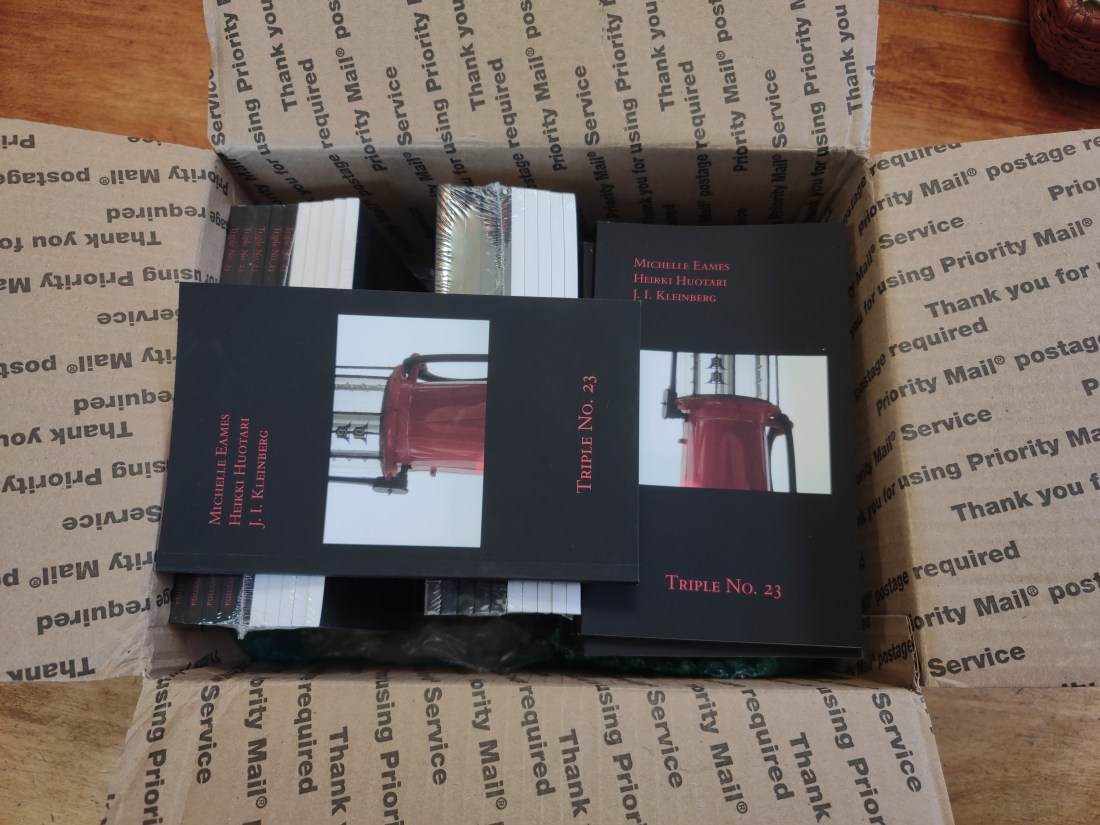
My fire poems are finally published! Ravenna Press has published Triple No. 23, with poetry chapbooks (short collections) by three poets (including me!). I was so happy to receive a box with my copies on the Winter Solstice.  It definitely brightened the longest night of the year.  Read on for details, and how to get copies.

My section of the book is titled Fire Triangle (Heat, Fuel, Oxygen) and includes 16 poems related to fire and wildland fire fighters, with several accompanying illustrations titled Arbitrary Borders by John Burgess, a graphic artist.

The second section of the book is titled Context for an Afterthought with prose poems by Heikki Huotari.

The third section of the book is titled Desire’s Authority with poems by J.I. Kleinberg.  This poet from Bellingham, Washington, writes collage poems, created with fragments of magazine text.  (They’re pretty cool; I might have to try some.)

How to get copies:

Option 1: If you would like a signed copy of the book, you can message, comment, or email me, and we’ll figure out the best purchase process.  The book is $12.95, and shipping within the U.S. is $5.00.  But if you’re close, I can deliver or meet you somewhere. I’m happy to provide copies until I run out.  Note that this option is the only way I get a bit of money, because, well, poetry.

Option 2: You can order the book from the publisher, here:   https://ravennapress.com/books/series/triple-series/

Option 3: You can ask your local bookstore to get you a copy.  And maybe they’ll order extras.  And maybe lots of people will buy them, and maybe we poets will be famous!!  But not rich.  Because, well, poetry.

Option 4: It should be available on Amazon, too. 

Again, Happy New Year and I hope you read lots of good books this year, including some poetry.