
In the last blog, my horse Vali shared his thoughts on the Big Ride, the John Wayne Trail Ride on the old Milwaukee Road railroad bed from Thorpe to Snoqualmie Pass in Washington. Now it’s my turn.
We did a lot to get ready for the ride. Maybe there are people who can just throw their horses in the trailer and go, but I am not one of them. When it comes to planning, I am a list maker. My riding buddy Solveig says I am one of her OCD friends. I say, if she thinks I’m OCD, she should meet my other friends! But maybe she’s right. That is one of the reasons I try to avoid planning things: it requires a lot of mental energy, lists on backs of envelopes, and sharpened pencils. Nonetheless, once we were committed and signed up for the ride, there were things to be done.
Camper Prep.
We would definitely take my truck with my pop-up slide in camper, because it is warm. It has a propane heater. However, we needed to be able to dry camp for 5 nights. I was pretty sure my current lead-acid battery system would not suffice. So I needed a better battery system, or a back-up of some sort. I called in my buddy Sandy to help re-do my camper with solar charging. She knows her stuff, given her experience outfitting her own camper from scratch.
First, she told me to buy a battery monitor and install it on the existing battery. This of course required buying a new lead-acid battery, since the old one was deader than dead. This is a skill of mine, killing batteries. With help from my techy son, we got the new battery installed and figured out the battery monitor. So cool! That would have been very useful over the years to know how much power was being used, and how much power was left. Did you know that lead-acid batteries can only be drawn down halfway without damaging them? That apparently is how I kill them. Anyhow, during our shake-down horse-camping trial at the local State Park, I tracked the use of the battery. On that very warm summer night, I used a third of my available battery life. The current system would only get us 3 nights, if we were lucky.
Sandy then designed a solar system (the battery kind, not the planets), told me what to buy, and came to visit and work for several days to install it. It was time consuming, but easier than I thought, especially because my job was to be the go-fer and assistant. That is my favorite job.
Once it was done, I camped in the yard for a test run. Everything seemed to work, but I still crossed my fingers. On the actual trip, the battery monitor would display a drop of about 10 percent each night, and recharge during the day to 100 percent. We had heat and water and lights and phone charge-ability—but most importantly we could run the propane fridge with electric controls each night and were able to have ice for our cocktails. We definitely needed our cocktails.
Trailer Prep and Supplies.
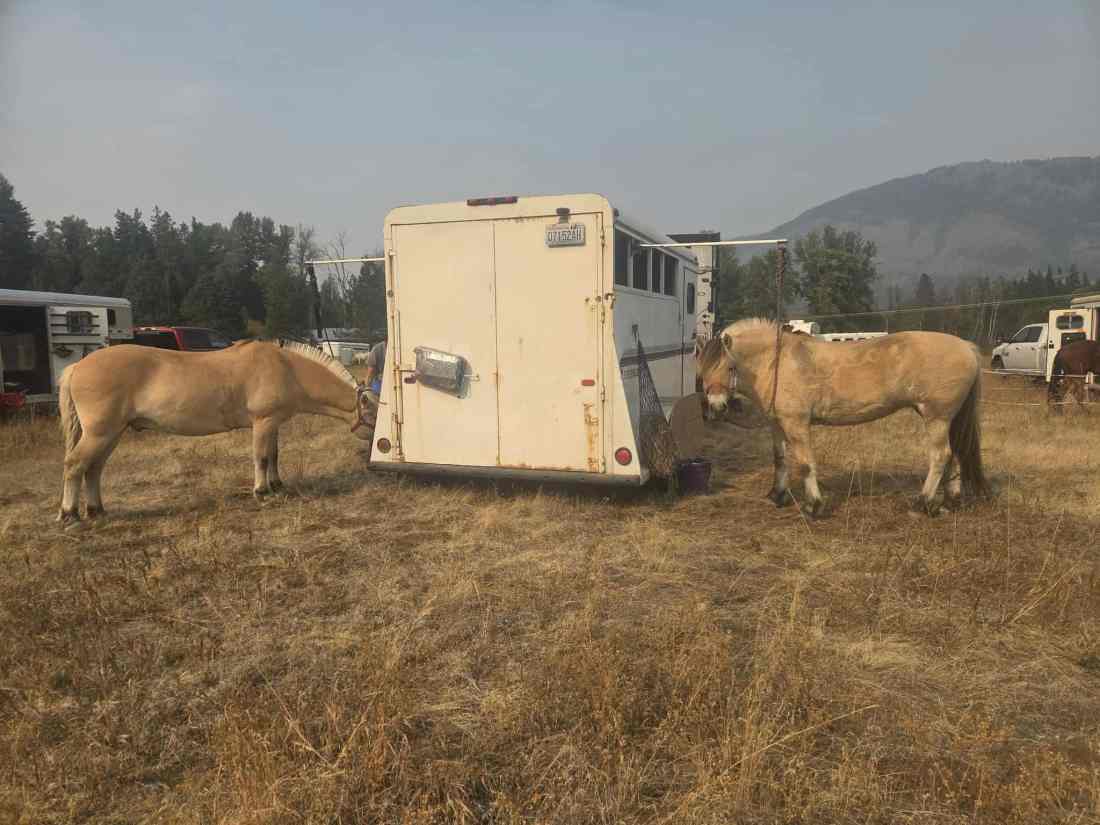
We briefly debated bringing my two-horse trailer, versus Solveig’s three-horse trailer. The three-horse was the better choice, because we could use the extra horse stall for hay storage. Then the trailer needed maintenance, installation of high-ties, designing of plywood covers to keep the horse’s legs out of the tires and fenders while tied, and we had to figure out all the extras to carry with us. We packed too much hay in the end, but that is better than too little.
We had to carry enough water to go at least 24 hours. Between us we had enough big blue jugs (5) plus some extra small ones. We filled them and packed the trailer a few days before the trip. Note to self: look in and wash out the jugs before filling. One had a dead mouse in it. Ick.
Prior to the trip we tested Solveig’s trailer behind my truck. Everything worked and the truck handled the weight. Hooray!
Gear.
The rides would be long, up to 19 miles in a day. Not only would the horses get tired and sore, so would the humans. And we had to carry food, water, rain gear, halters, lead ropes, and minimal emergency gear with us. We experimented with seat savers and saddle bags as we trail rode over the summer. By the time of the ride, we had all the kinks worked out. During the pre-rides and the Big Ride, we only wrecked two of our bags. One was fixable, one was not.
Horse fitness.
Once Solveig and I committed to the ride in July, we knew that fitness would be key for both horses. And although Vali was a pretty predictable and mostly brave trail horse, Moyfried was young, and had not been out a lot. We took the pair out on close to 30 trail rides and rode almost 220 miles before the Big Ride. Not only did this get our horses fit, it improved our rider fitness, too. One day we rode 16 miles. We knew if we could do that, we could do 19.
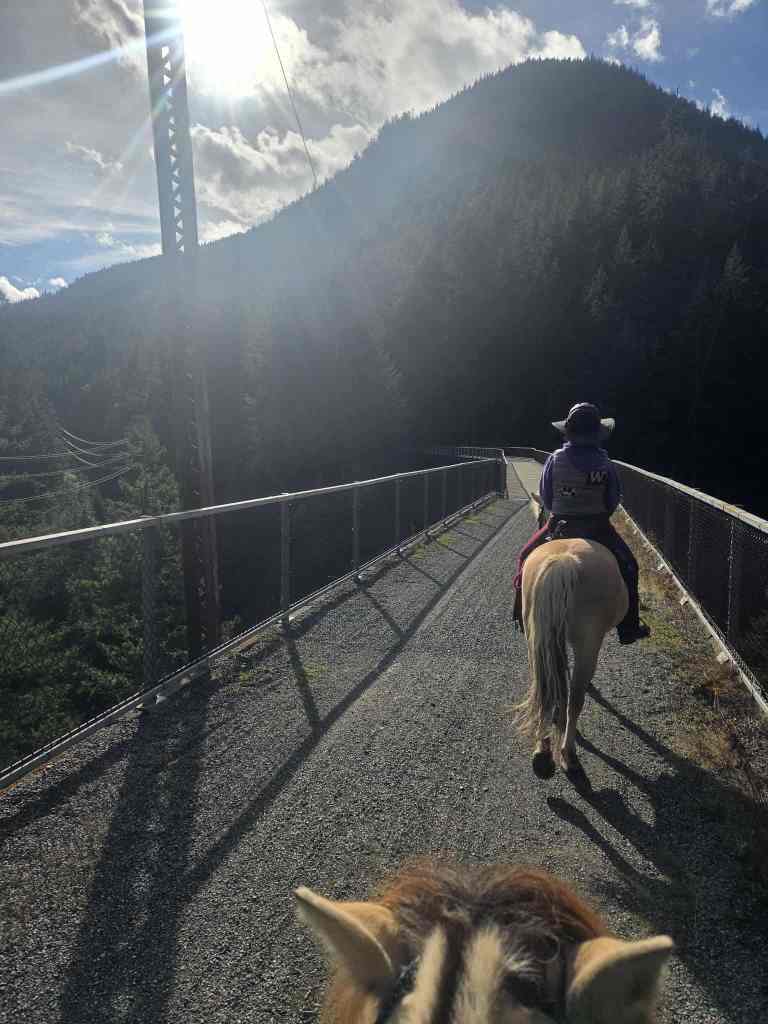
We exposed our horses to bikes, people, rivers, bridges, rough trails, easy trails, paved trails. We got them used to horse shoes, and then shoes with pads in preparation for rocks and gravel. We rode in groups from two to six horses. We rode with new horses and with familiar horses. We rode across the only trestle-like bridge I could find in the area, and we went under a rural overpass. Neither horse liked trucks and cars passing above them, but we did it. We tried to expose them to everything we could, but we could not practice tunnels. (Later, on the actual ride, we heard that people would ride at night with flashlights to get their horses tunnel-ready.)
Our horses practiced tieing, and standing, and being on the overhead high-ties at the trailer.
We were ready, except…
By the time we left, with all our gear, food, flasks, and cocktails packed, we thought we were as ready as we could be. Yet, some things surprised us.
The first half mile of the first day was road-riding. Moyfried had never been ridden on a road with cars passing. Luckily, it was a rural area with few cars and little activity. Also, those rural drivers knew how to pass horses slowly or not pass at all. I wish all drivers were as careful.
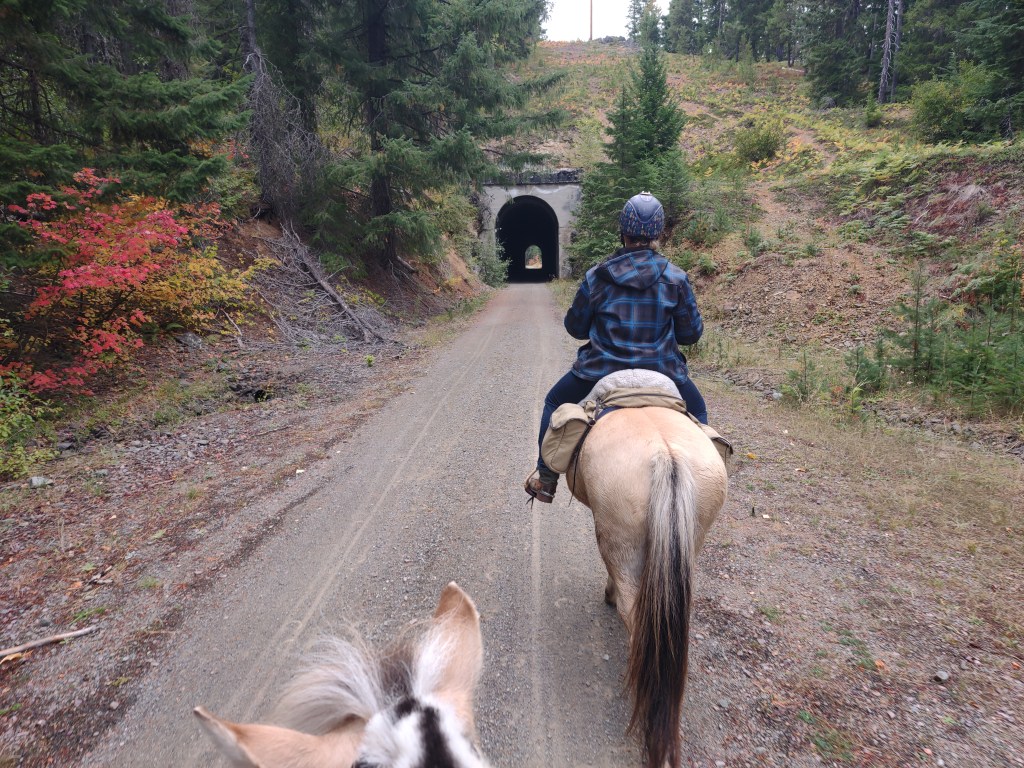
The tunnels were interesting, but not as much for the dark as for the noise. Vali has always been sensitive to noise, and I led him through the first one. We both rode the second one, but the intense dark was very disorienting, at least for me as a rider. Even though it was a short tunnel, pointing a flashlight on the wall helped.
There was a short bridge over an irrigation return canal, like a large waterfall contained in an almost-vertical cement channel. That was loud. I led Vali over that.
Toward the end of the first day, we had to go under two Interstate-90 overpasses. First the east bound, then the west bound. Both horses were worried, listening to the roar and bump of traffic over the expansion joints, and immediately after there was a wooden bridge that Moyfried thought she might need to jump. After some tense moments, we were able to get Moy behind Vali as I led Vali across.
Oh yeah, we walked right by a large pig farm on day two. Our horses were fine, but they have both lived near pigs. I figured that might have been interesting for some of the other horses, since pigs smell like carnivorous horse-eating beasts.
The trestles and bridges over the next few days got easier and easier for our horses. It was great to have two bonded horses, they gave each other confidence and were each brave about different things. We often clumped up with similar-speed horses, and a few times two women with more emotional horses tucked in behind us to borrow some of our calm. Our horses didn’t care.
All in all, Vali and Moyfried rocked the ride, mainly because we prepared them, and ourselves, ahead of time. I always thought I wanted to do the longer 17-day ride organized by the same group. Now I’m thinking a four-day ride is plenty. But my camper battery would definitely handle the longer time!





 Michelle Eames