How Long Does It Take for a Cat to Barf After Eating a Chipmunk?

I love our chipmunks, and I saw some cavorting in a Serviceberry bush yesterday evening as I was bird watching. I was so happy the cats were indoors, or in their small catio, and the birds were all safe in my yard. 

Apparently the chipmunks were not safe, however, as this morning my husband saw Purrcy run through the living room with a chipmunk in his mouth.  He yelled, “Where was the cat? He has a chipmunk!” as Purrcy ran upstairs past me and into my son’s room.  My son’s room is not a neat and tidy place.  There are many spots to hide, I realized, as I grabbed the cat with the small live mammal in his mouth, and he dropped it.  The chippy disappeared under the desk as I hurriedly put the cat out on the porch, and joined Doug in my son’s room.  His hands were on his hips and he was frowning, with no chippy in sight.  It had to be there somewhere.

We discussed a trap. But I don’t have a chipmunk-sized live trap.  I grabbed a couple of mixing bowls from the kitchen thinking we might capture him under one… and then, um, maybe slip a piece of cardboard under it, like capturing a house spider under a glass to free it outside…? Yeah, surely that would work.  But the chippy was nowhere in sight. 

So Doug let the cat back in the room to capture the chipmunk. Purrcy had it caught before I had time to think through how we might get the chippy out of his mouth without it escaping again.  Put the mixing bowl over the cat? Purrcy zipped out of the room, chimpmunk hanging from his mouth, past us, downstairs, and crashed through the swinging catio door.  We ran after him, closed the inner catio door, and then ran out our back door and around to the other side of the house to the catio with hopes of getting the cat to release the chippy.  Even before I had the outer catio door unlatched Purrcy had eaten the chippy’s head off.  We left him to devour the rest of the body.  

I love our chipmunks.  But this was definitely a survival of the fittest scenario.  That chipmunk obliviously entered a small fenced area that was full of cat-predator smell.  Of course it got eaten (after being traumatized by the cat and two humans).  As Doug says, even a blind squirrel will eventually find a nut.  Even a caged cat will eventually find some prey. 

At least it wasn’t a bird loose in the house.  This time, anyhow.

P.S.  At the time of this writing, it’s 24 hours later and I still haven’t found any cat puke.  That either means it’s not going to happen, or that Purrcy has already made his deposit in some dark and hidden location that I will only find when I step in it, barefoot, in the middle of the night.

[Photo Credit Openverse]
What’s the Buzz about the Third Person?

First there is “third person” as a point of view, where the writer is the narrator and tells a story using the names of people, and the pronouns he, she, or they, in the text.  “First person” is from my point of view.  I am my favorite narrator.  There is also “second person”, where the author is writing about you, the reader.  I find this a confusing way to write, and I’m sure you’ll forgive me for not going into detail on that point of view at this time. 

Second, there is “third hand” where information is passed on through several sources before reaching you.  Third hand information can be unreliable or exaggerated, like the game of gossip. While looking up a few definitions for this blog, I also found another kind of third hand, a robot-like stand with clips to hold things still while working on them.  I kind of want one, I figure I can always use another hand around here.   

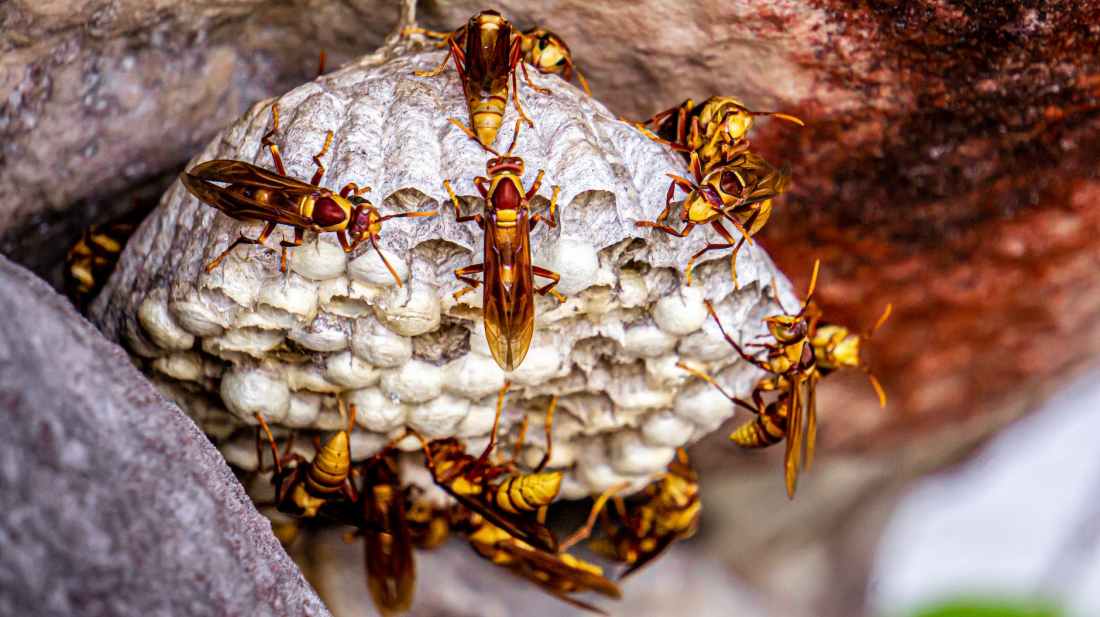
Finally, there is the “rule of the third person”.  I learned this rule from my husband, a wildland firefighter, that worked in the forest a lot.   The fire crew typically walks single file on their way to a work site, or an active fire.  The third person rule is relevant to bees and hornets. The rule goes like this: The first person walking close by a ground nest or hive wakes the bees up.  The second person walking by a ground nest makes the bees mad.  The third person gets stung. A lot.  Anyone after the third person runs like hell away from the angry bees hopefully avoiding being stung. 

I think of this rule regularly during hikes or rides in the summer, since I tend to prefer being at the end of the line in a small group of people or horses.  There comes a point in summer, we’ll call this bee season, where we minimize off-trail riding just in case there is a bee’s nest under the logs our horses are stepping over.  Or, if we still are determined to go cross country in late summer, I will guide my horse in a different and parallel path from the others, so that each of us is only at the first stage of waking the bees up, hopefully avoiding the third stage of angry bees.  I also watch the ground a lot, looking at flowers, mushrooms, and watching for dark buzzing insects crawling out of holes.   

I’ve yet to be on a horse stung by a bee, or bees, while riding, but I’ve seen it happen, once with some not-very aggressive bees.  My friend’s horse reacted to stings by hopping around, but the rider rode it well, and lived to tell the tale.  I have however, heard (third hand) stories of yellow-jackets or hornets attacking several horses at once, with resultant bucking, bolting, and dumping of riders.  I’m crossing my fingers that this doesn’t happen to me, or if it does, that my stoic draft pony will not react too badly. 

In the meantime, maybe I need to change-up my perspectives a bit and try to be the first person on the trail and let someone else bring up the rear for a change.  The second person might be you, followed by the third victim, I mean person.  Hopefully the third person will be alert to the buzz and choose her own path with her unique point of view. 

[photo credit: pexels.com]

Note: I actually appreciate all of the bees, wasps, and hornets, though many I prefer to keep at a distance.  They all have their place and their jobs in nature.  Of course, my favorite bees are the fuzzy native bumble bees, that will sting if they have to, but are usually not aggressive.  They are necessary for pollination of so many plants.  Learn more about bumble bees here: https://www.xerces.org/publications/identification-and-monitoring-guides/bumble-bees-of-western-united-states